Speaking at an investor conference on 13/8, Le Anh Tuan presented data indicating that deposit interest rates are currently high. The peak for the 6-month term reached 9,5% annually, with the system-wide average at 7%. For the 12-month term, rates fluctuate between 9% and 9,2%, compared to around 6% earlier this year. Many banks show discrepancies between publicly listed interest rates and actual deposit rates.
However, Tuan believes interest rates are "unlikely to reach new highs" because the State Bank of Vietnam has implemented various measures to support liquidity. Specifically, the central bank injected funds directly through open market operations (omo), at one point exceeding 18,6 billion USD. This involves the regulator repurchasing valuable papers from commercial banks to manage liquidity and stabilize interbank market interest rates. The State Bank also conducted foreign exchange swap (fx swap) transactions, supplying approximately 3 billion USD to the system.
In addition, the State Bank employs indirect measures such as easing the calculation of the loan-to-deposit ratio (ldr), increasing the ratio of short-term capital for medium- and long-term loans, and instructing banks to lower interest rates.
During a working session with the State Bank and credit institutions on the morning of 13/8, Prime Minister Le Minh Hung urged banks to reduce costs, stabilize interest rate levels, and genuinely lower lending rates. This aims to share the burden with citizens and businesses.
Despite these efforts, the CEO of Dragon Capital noted that with high credit demand and a widening gap between lending and deposit rates, a scenario of sudden sharp interest rate adjustments is unlikely. Instead, a slow decline is more probable.
According to Tuan, to achieve an average GDP growth target of 10% annually for the 2026-2030 period, Vietnam requires approximately 1,460 billion USD in investment capital, with the private sector accounting for over half. This represents an unprecedented amount. Four large corporations alone, including Vingroup, Sun Group, Masterise, and Thaco, are estimated to need a combined capital of 65 billion USD.
The lending-deposit gap reached 89 billion USD by mid-year, up from about 68 billion USD at the end of last year. This reflects a reality where banks lack sufficient funds to meet the demand for medium- and long-term loans.
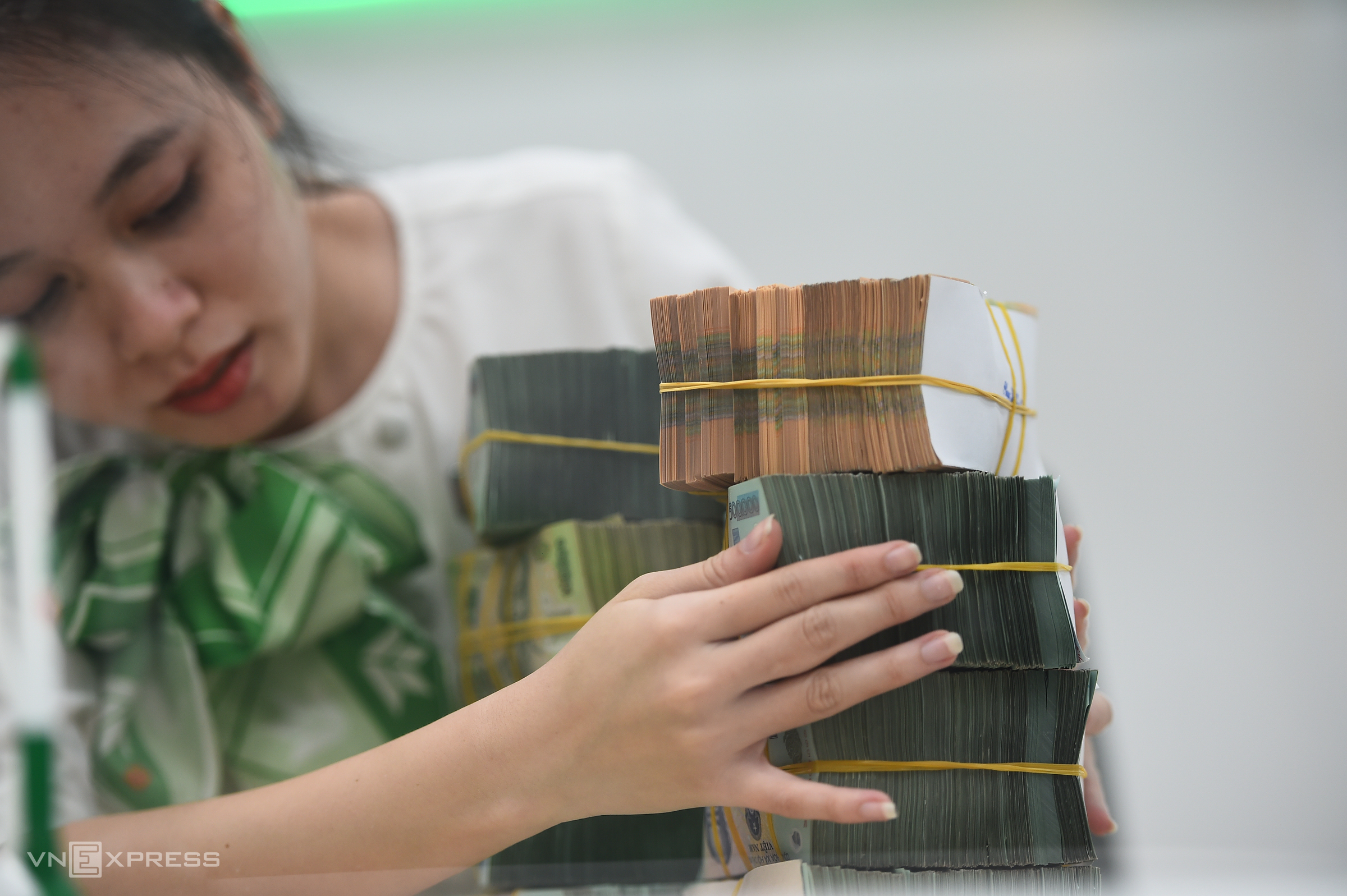 |
Bank employees in TP HCM count cash. Photo: Thanh Tung
Some banks and independent analysis groups have previously offered conflicting forecasts regarding interest rate trends. Pham Nhu Anh, CEO of MB Bank, leans towards a flat scenario for the remaining months of the year. He stated that while system liquidity has improved, it is not yet significant, and the economy's capital demand continues to rise with many large-scale projects being implemented and businesses expanding investment.
Conversely, the leadership of ACB Bank anticipates a slight increase in interest rates during the second half of the year. However, the bank expects that monetary and fiscal policies could help improve liquidity, thereby gradually stabilizing and moderating interest rates.
Sharing this view, Cao Viet Hung, director of financial and banking sector analysis at ACB Securities Company, predicts that deposit interest rates will remain relatively high and may only decrease slightly by 0,2-0,5% in the second half of this year if foreign direct and indirect investment performs positively. He suggests that this largely depends on developments in Middle East tensions and world oil prices.
Phuong Dong