China's General Administration of Customs reported on 9/6 that total exports in May increased by 19,4%, and imports rose by over 27% compared to the same period last year. Both figures surpassed April's performance and exceeded economists' forecasts in a Reuters survey. Consequently, the trade surplus for May reached 105,4 billion USD.
Specifically for the US market, exports surged by 35,4% year-on-year. This marks the highest growth rate since 3/2021, according to research firm Wind Information. US-China trade is still recovering after experiencing double-digit declines for most of last year due to import tariff pressures.
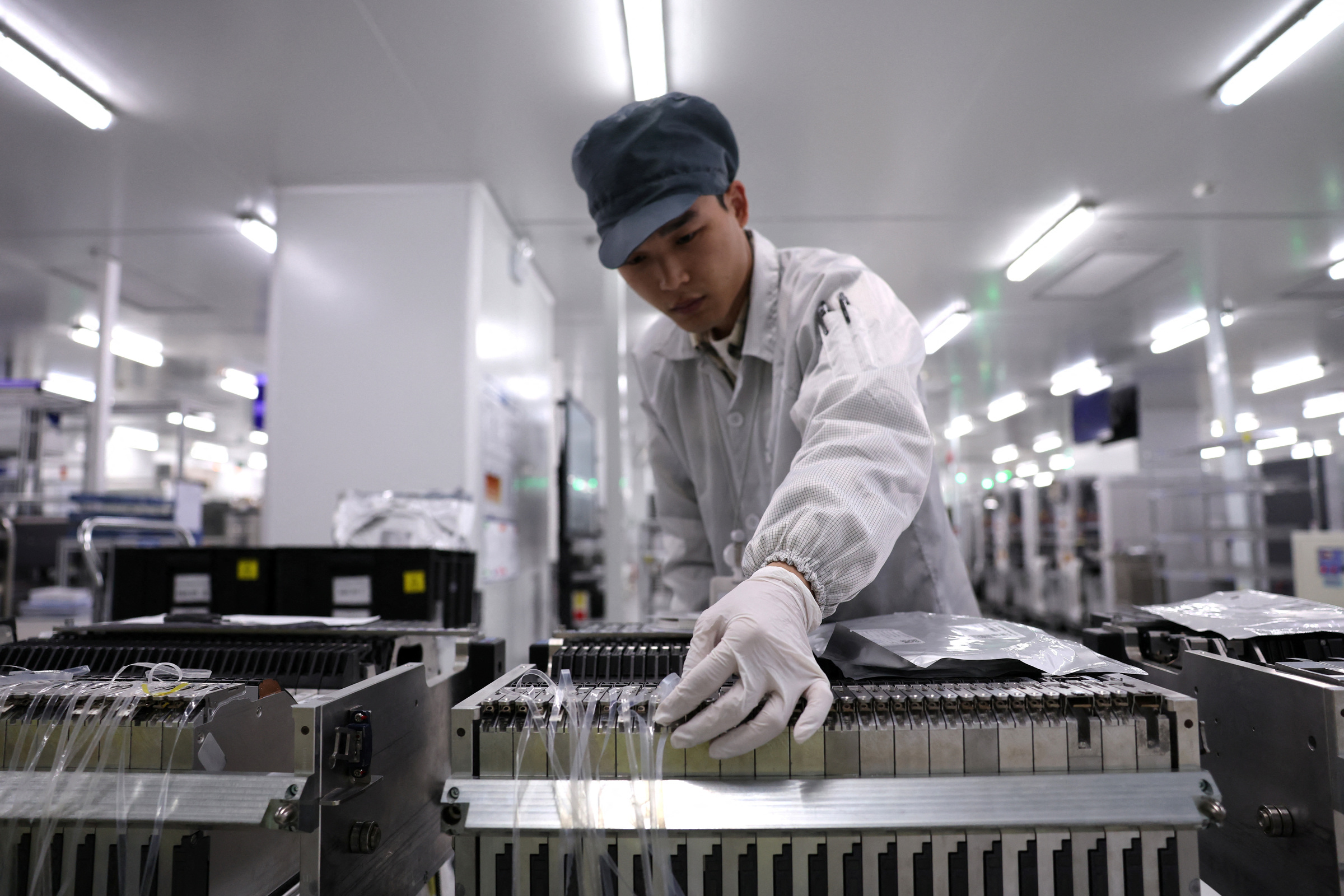 |
Workers at a factory producing components for autonomous driving technology in Guangdong in 3/2026. *Photo: Reuters* |
Experts on China Daily suggest that the easing of trade tensions between the two nations, following US President Donald Trump's visit to China in mid-May, could reduce instability for Beijing's exports and for US businesses. Zhu Min, former Deputy Managing Director of the International Monetary Fund (IMF), stated, "Cooperation with the US helps alleviate external instabilities for China, thereby significantly contributing to maintaining economic stability, and vice versa."
US import tariffs on Chinese goods are currently at a general rate of 10%, after the Supreme Court rejected tariffs imposed by President Donald Trump under the International Emergency Economic Powers Act (IEEPA) in late February. However, tariffs applied under other statutes to specific sectors such as aluminum, steel, and automobiles remain at 10-50%.
In May, global demand for high-tech products boosted China's exports. This demand is expected to remain strong in the second half of the year, providing necessary support for the country's economic growth.
Robin Xing, chief China economist at Morgan Stanley, noted that China's exports are showing "remarkable resilience", driven by global investment in artificial intelligence (AI) and the extended growth cycle of the energy sector. Xing stated that Chinese companies have developed "core competitiveness" in printed circuit boards (PCB), optical components, and memory chips, benefiting from the growth momentum in the AI hardware sector. According to the China Chamber of Commerce for Import and Export of Machinery and Electronic Products, in the first four months of the year, the volume of integrated circuit (IC) exports increased by 10,6%, while export value surged by 78,3%.
In the energy sector, Xing noted that large-scale AI data centers require vast amounts of electricity. China currently holds a "leading position" in the global energy transition, from wind and solar power components to grid equipment and energy storage batteries. According to China's General Administration of Customs, in the first four months of the year, electric vehicle exports increased by 68,1% year-on-year. Lithium battery exports rose by 43,2%, and wind power generation equipment exports grew by 40,7%.
Ha Thu (according to Reuters, China Daily)