PNJ's recently released financial report revealed a consolidated after-tax loss of nearly 283 billion VND, a stark contrast to the profit of almost 437 billion VND recorded in the same period last year. This marks the company's largest loss since it began disclosing information in Q3/2008.
The main reason for PNJ's record Q2 loss was a 5,2-fold increase in enterprise management costs compared to the same period last year, reaching nearly 1,063 billion VND. Over 865 billion VND of this stemmed from a provision related to product repurchases, despite this activity occurring after the accounting period's end.
The pressure to repurchase products intensified after the director of PNJ Appraisal Company (P-Lab) was prosecuted in connection with a diamond smuggling case. Although Chairwoman Cao Thi Ngoc Dung affirmed that these smuggled diamonds did not enter PNJ's system, the incident affected customer sentiment and created significant pressure on the company's liquidity. From early July, PNJ observed a sharp increase in demand for diamond jewelry resales. By the end of 27/7, the company announced it had repurchased over 7,000 billion VND worth of products, primarily diamonds, gold, and other jewelry.
In meetings with investors, PNJ's management repeatedly asserted that the company possessed sufficient resources to manage the situation and uphold its commitments to customers. However, after the initial three weeks of buybacks with 24-hour payments, the company adjusted its process from 21/7. If customers sell, the company will make payments in installments, extending up to 120 days. If customers exchange for other products, the process is immediate and includes an additional discount.
Management stated that the provision was determined based on available information and reasonable assumptions at the time of preparing the financial report. The criteria for establishing the provision included: the value of repurchased diamonds, the estimated recovery price, and estimated adjustment rates for each diamond size group.
The leading jewelry company's loss was not a result of declining business operations. From April to June, PNJ's net revenue still grew by 12%, reaching nearly 8,484 billion VND. 24K gold, a product line with a lower profit margin, was the primary contributor to this revenue.
This revenue structure led to a 4% decrease in gross profit, settling at over 1,563 billion VND. The gross profit margin also adjusted from 21,5% to 18,4% during this period. However, the substantial contribution from 24K gold allowed the company to reduce selling costs by 12%, as these products incur fewer direct selling expenses.
The Q2 consolidated financial report also reflected the company's financial health. Total assets reached nearly 21,018 billion VND, an increase of 854 billion VND compared to the beginning of the year. Among these assets, PNJ held nearly 609 billion VND in cash and cash equivalents, an increase of almost 17% from the start of the year. These are highly liquid assets, convertible into cash quickly with minimal change in value. Additionally, the company had over 3,393 billion VND in short-term financial investments, a 64% increase compared to the beginning of the year. Of this, more than 3,294 billion VND consisted of time deposits with original maturities exceeding three months, maturing within 12 months from the end of June.
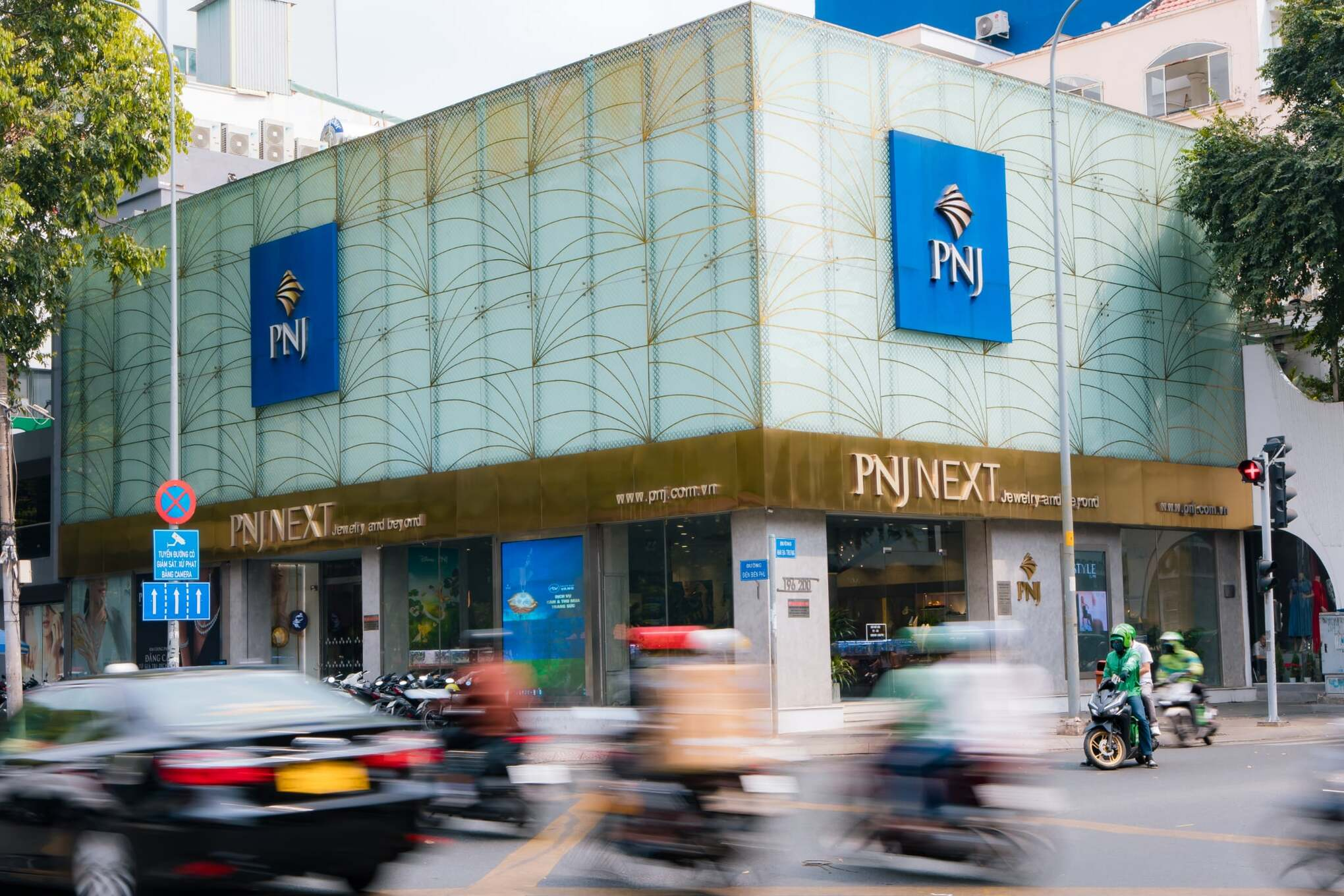 |
Outside a PNJ store on Hai Ba Trung street, Tan Dinh ward (TP HCM). Photo: Hung Viet |
During this period, PNJ's inventory decreased by over 2% to 15,560 billion VND, primarily comprising products, goods, and raw materials. The company established a provision for inventory write-down of over 410 billion VND for damaged or substandard merchandise. This amount is nine times larger than at the beginning of the year. Conversely, PNJ's total liabilities increased by 3% to over 7,105 billion VND. Financial debt accounted for more than 3,989 billion VND, a decrease of over 5%. All of these were short-term loans from commercial banks such as Vietcombank, BIDV, and VietinBank.
Tat Dat