SMIC, Trung Quoc's largest chip manufacturer, announced a 16% revenue increase in 2025 over 2024, reaching a record 9,3 billion USD. LSEG analysts estimate this year's revenue could surpass 11 billion USD.
Hua Hong, another domestic chip manufacturer, also reported record revenue of 659,9 million USD in the fourth quarter of 2025. Moore Threads, a company aiming to compete with Nvidia, forecasts 2025 revenue of approximately 1,45-1,52 billion yuan (209,8-219,9 million USD), representing a 231% to 247% increase over 2024.
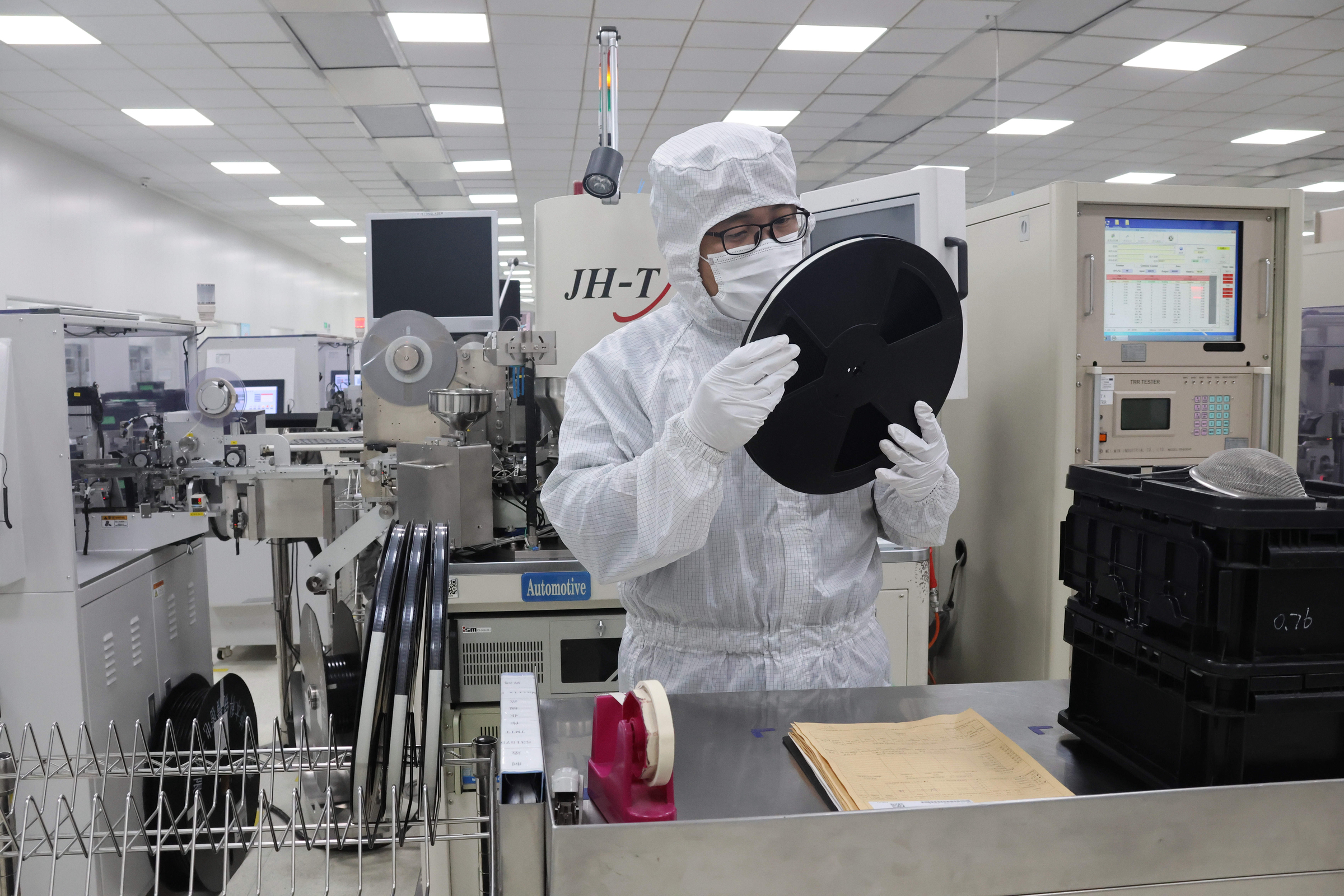 |
Workers in a semiconductor factory in Shandong, Trung Quoc, 15/1/2025. Photo: *Reuters* |
Analysts identify several factors contributing to the Chinese chip manufacturing industry's success. According to Paul Triolo, an expert at Albright Stonebridge Group, the growth of electric vehicles and related infrastructure has boosted demand for less common chip types. Concurrently, demand for advanced chips has "surged due to AI".
Simultaneously, US restrictions aimed at cutting Trung Quoc off from key technologies have spurred self-sufficiency efforts, creating opportunities for the domestic semiconductor industry. For instance, the restriction on Nvidia chip exports has led Beijing to encourage businesses to purchase domestic solutions as replacements.
"Although Trung Quoc has not yet led in high-end GPU performance, these domestic solutions are filling the domestic 'computing gap' and driving record revenues", commented Parv Sharma, a senior analyst at Counterpoint Research.
Trung Quoc's memory chip manufacturing sector has also benefited. Memory chips are critical components for AI data centers and consumer electronics. Global scarcity of these chips is driving unprecedented revenue growth.
ChangXin Memory Technologies (CXMT), one of Trung Quoc's leading memory chip manufacturers, reported a 130% revenue increase, surpassing 55 billion yuan (8 billion USD). The global high-bandwidth memory (HBM) market is dominated by three manufacturers: Samsung, SK Hynix, and Micron.
Export restrictions on HBM to Trung Quoc have created opportunities for CXMT, even though its technology is not yet on par with leading manufacturers, according to Phelix Lee, a senior equity analyst at Morningstar. "CXMT is becoming the sole domestic alternative", he said.
According to Triolo of Albright Stonebridge Group, expertise gained from memory chip manufacturing could lead to advancements in other chip types like GPUs. "All memory chip factories in Trung Quoc are now incubating advanced processing technology in unimaginable ways, even before US export controls came into effect in October 2022", he said.
Despite recording record revenues, the Chinese semiconductor industry still faces challenges. Its companies have not yet caught up in technological capabilities compared to rivals in My, South Korea, Europe, and Taiwan. SMIC and Hua Hong still cannot produce the world's most advanced chips at scale like TSMC due to lack of access to the most advanced tools manufactured by ASML in the Netherlands.
According to Triolo, Chinese semiconductor companies face significant pressure from US export controls. Domestic alternative solutions are increasingly common in many smaller sectors, but not across a broad spectrum.
"Trung Quoc is the only country attempting to recreate most of the semiconductor supply chain, and this is quite challenging; it will take more time to overcome US controls in critical areas", he said.
Phien An (via CNBC)