Domestic lychee season, typically in May and June, usually brings an abundance of fruit. However, this year, many local growing regions experienced severe crop failures, particularly for seedless lychee, with production plummeting by 80-90% compared to the same period last year. This scarcity of domestic supply prompted many traders to turn to imports from China to meet market demand.
Hong Anh, a trader in Xuan Hoa ward, shared her experience with importing Chinese seedless lychee. She has brought in two batches, each weighing around 60 kg, via hand-carry, and both sold out within one week. She explained that at the start of the season, she attempted to source domestic seedless lychee but found almost no available stock due to the poor harvest. Consequently, she shifted to importing from China.
"Initially, customers were hesitant," Hong Anh said, "but after trying it, many rated the quality as comparable to Vietnamese varieties, leading them to reorder. Even after factoring in shipping costs, the selling price is still about 35-40% lower than domestic seedless lychee."
VnExpress observations in TP HCM confirm that Chinese seedless lychee is currently selling for 350,000-480,000 VND per kg. This represents a significant price reduction of 40-50% compared to last year's prices.
A representative from an imported fruit store in Tam Binh ward, TP HCM, attributed the sharp price drop to a more abundant supply of seedless lychee from Hainan, China, this year. Last year, only a few distributors imported the fruit on a trial basis. This year, however, numerous businesses are participating, resulting in a richer supply and more competitive pricing.
According to the store, this lychee variety was originally destined for export to Japan. However, the rising demand from Vietnam, coupled with its closer geographical proximity, has substantially reduced both shipping time and costs. The journey from Hainan to TP HCM takes only a few hours by air or a few days by sea, offering a significant logistics advantage over more distant export markets.
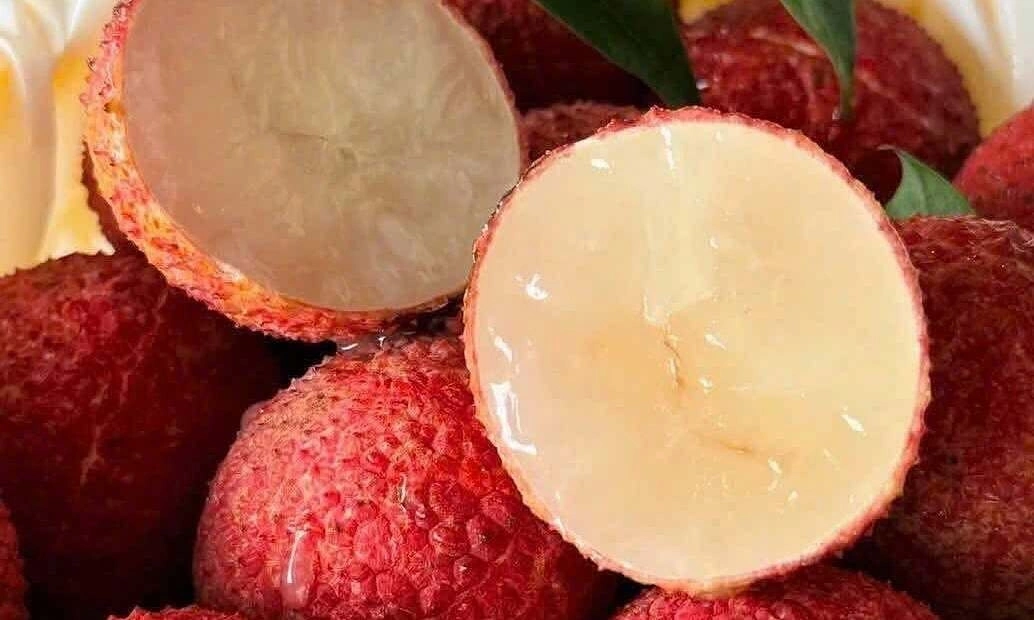 |
Chinese seedless lychee sold at a store in Tam Binh ward (TP HCM). Photo: An Phu |
Despite the price reduction, this remains a premium product. Its current selling price is approximately two times higher than traditional thieu lychee, making it a popular choice for gifts or for those seeking to try a new fruit. The distinctive features of this seedless lychee include its reddish-pink skin, thick, juicy flesh, and a near absence of seeds; only about 2% of the fruits may contain small, bean-sized seeds.
Beyond the regular product, some stores also import organically grown seedless lychee from China. This premium variant is priced around 1.4 million VND per kg, which is about 10% lower than its price in 2025. Hoang, manager of a fruit store in Tan Hung ward, noted that this high-end lychee is meticulously selected for its thick flesh, delicate sweetness, and uniform size. Due to its limited availability and high price, his store primarily accepts pre-orders before importing the fruit.
From a consumer's viewpoint, Loan, a resident of Xuan Hoa ward, expressed her family's preference for seedless lychee. She finds it to have a milder sweetness than traditional thieu lychee and appreciates its convenience when eating. Its appealing appearance also makes it a frequent choice for gifts.
In Vietnam, seedless lychee remains a scarce commodity. Currently, only Ho Guom - Song Am Company in Thanh Hoa has successfully commercialized this variety since 2023, with limited production. Other regions that have attempted cultivation have not achieved satisfactory results due to low yields.
Bui Duc Thuy, Deputy Director of Ho Guom - Song Am High-Tech Agriculture Company, explained that many northern lychee growing regions, including Bac Ninh, Hung Yen, and Thanh Hoa, were severely impacted by extreme weather this year, with some areas experiencing crop losses of up to 90%. In his company's growing area in Thanh Hoa, the initial flowering rate was only about 27%. This was followed by prolonged heat interspersed with thunderstorms during the fruit setting stage, leading to a massive drop of young fruits. Consequently, the company's seedless lychee production this year is estimated at only one ton, a sharp decrease from 7 tons last year.
Thuy added that the small harvested volume means the company cannot fulfill all orders placed since the beginning of the season, with most of the production currently prioritized for diplomatic gifting. At wholesale markets in TP HCM, traders indicate that Chinese seedless lychee is primarily distributed through high-end fruit stores rather than traditional markets, owing to its higher price compared to common thieu lychee. These markets mainly sell domestic thieu lychee, priced at 60,000-80,000 VND per kg. This year, the crop failure has not only affected seedless lychee but also many traditional varieties such as u trung and u hong, leading to a significant reduction in supply reaching TP HCM compared to last year.
Thi Ha