Recent reports indicate that Bitcoin (BTC) is losing buying power from both sides. Many sides noted that capital outflows from spot exchange-traded funds (ETFs) catalyzed BTC's recent price drop. However, according to CoinDesk, a similar decline in buying power from digital asset treasury (DAT) companies – firms whose core activity is accumulating Bitcoin as a reserve asset – has been less discussed.
Analysts at Glassnode stated in their latest market update that as BTC dropped from the mid-70,000 USD range to near 60,000 USD, the net flow from treasury companies also sharply decreased. Daily purchases slowed, becoming a fraction of their previous rate.
"The decline in Bitcoin accumulation suggests this group is becoming more cautious, removing a key demand driver amidst weakening overall market sentiment," the report noted.
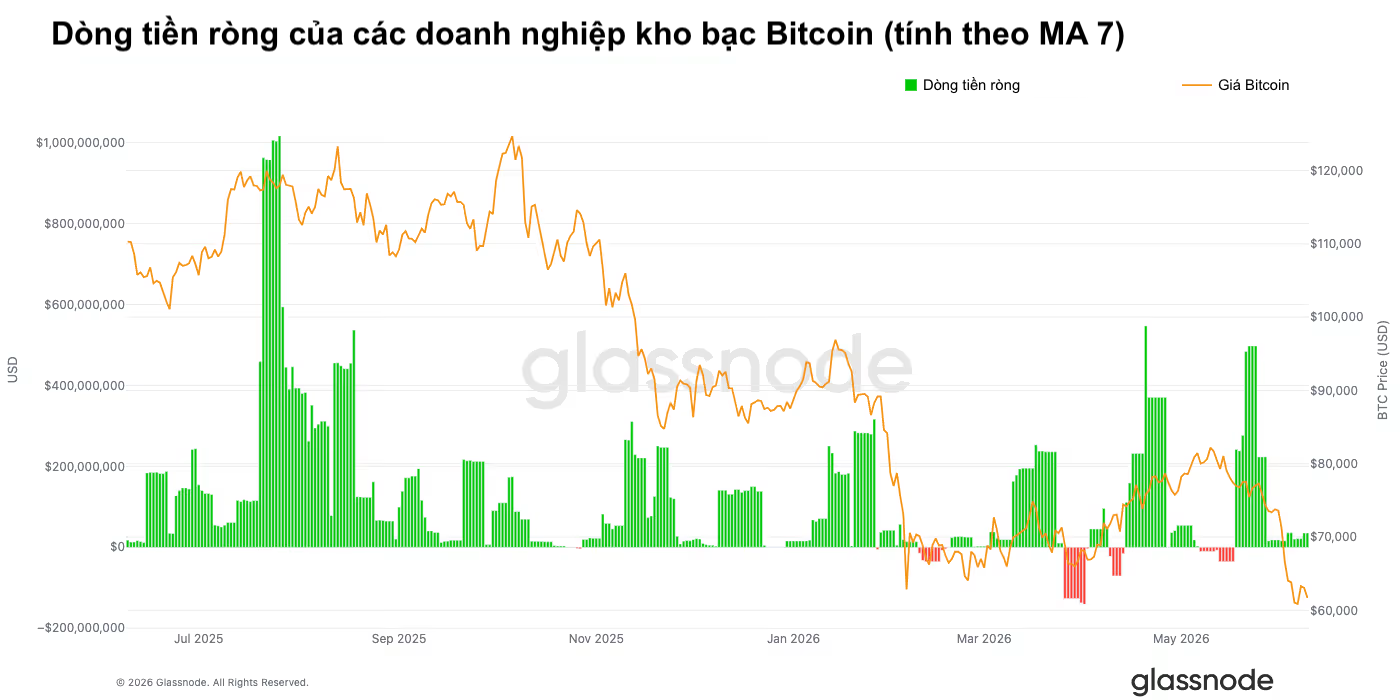 |
Net flow from Bitcoin treasury companies has significantly weakened in recent weeks. Source: Glassnode |
In the chart above, the blue and red columns represent the daily net purchase value from digital asset companies since 6/2025, converted into a 7-day moving average (MA7). Demand from the crypto treasury group has almost evaporated this month, a sharp decrease from daily accumulation exceeding 500 million USD in 4/2026 and 5/2026. This partly explains why BTC quickly fell from 74,000 USD to under 60,000 USD last week.
Some analysts attribute the sell-off primarily to Strategy, the world's largest publicly listed BTC holder, which announced the sale of 32 BTC in late may. However, the company re-entered the market last week, purchasing approximately 100 million USD worth of BTC. Despite this, the move was insufficient to prevent the price from dropping below 60,000 USD.
US-listed spot ETFs remain another major drag, with continued capital outflows reducing the potential for a sustainable BTC price recovery. On 10/6, 11 funds recorded a net outflow of 213,85 million USD, according to SoSoValue. Total outflows have exceeded 5,72 billion USD since the second week of may.
 |
Bitcoin symbolic coins placed on multiple US dollar bills. Photo: Reuters |
The digital asset treasury (DAT) model is a business model that uses capital, debt, or additional stock issuance to accumulate Bitcoin and other digital assets as a core component of its balance sheet. During bull markets, this model can create a positive feedback loop: rising crypto prices increase net asset value. DAT stocks often trade at a premium to their asset holdings, enabling companies to raise more capital to purchase additional digital assets.
The valuation of stocks in this group relies heavily on a premium rather than net asset value (NAV), helping companies like Strategy, Metaplanet, and other DATs attract investors seeking indirect exposure to crypto through the stock market. Keyrock, a digital asset investment group, estimated that Bitcoin treasury companies once traded at an average premium of 73% over the value of their BTC holdings.
However, when the market reverses, weaknesses become clearer. Asset values decrease, premiums shrink or turn into discounts, and the ability to raise new capital weakens, while debt and shareholder dilution pressure persist. The recent Bitcoin drop from over 70,000 USD to under 60,000 USD shows that buying from DATs has significantly slowed, removing a source of demand that once supported the market.
Tieu Gu