Nguyen Tuan Quang, deputy director of the Climate Change Department, part of the Ministry of Agriculture and Environment, shared this information at the Vietnam Carbon Forum on 14/8.
Vietnam's carbon exchange began pilot operations in late June, featuring two types of commodities: greenhouse gas quotas and carbon credits. While quotas are limited to 92 allocated businesses, the carbon credit market is open to all interested organizations and enterprises.
Quang explained that the first type of credit recognized on the domestic carbon exchange is issued by competent authorities. The Ministry of Industry and Trade and the Ministry of Construction have developed the technical framework for measurement, reporting, and verification (MRV). Recently, the Ministry of Science and Technology issued forest carbon standards, which form the basis for a large credit supply under this mechanism.
The other two types adhere to Articles 6.2 and 6.4 of the Paris Climate Agreement. This means they follow mechanisms established by countries in bilateral cooperation with Vietnam and methods defined by the United Nations Framework Convention on Climate Change (UNFCCC). Under the bilateral mechanism, Vietnam has signed credit exchange agreements with Japan, Singapore, and will soon with Switzerland and South Korea.
Regarding credits under independent standards such as Verra and Gold Standard, Quang noted that recognizing these mechanisms on the exchange "could be considered" for trading. Although not yet traded on the domestic exchange, credits under these independent standards are sold to international markets, according to Decree 112/2026 on the international exchange of greenhouse gas emission reduction results and carbon credits.
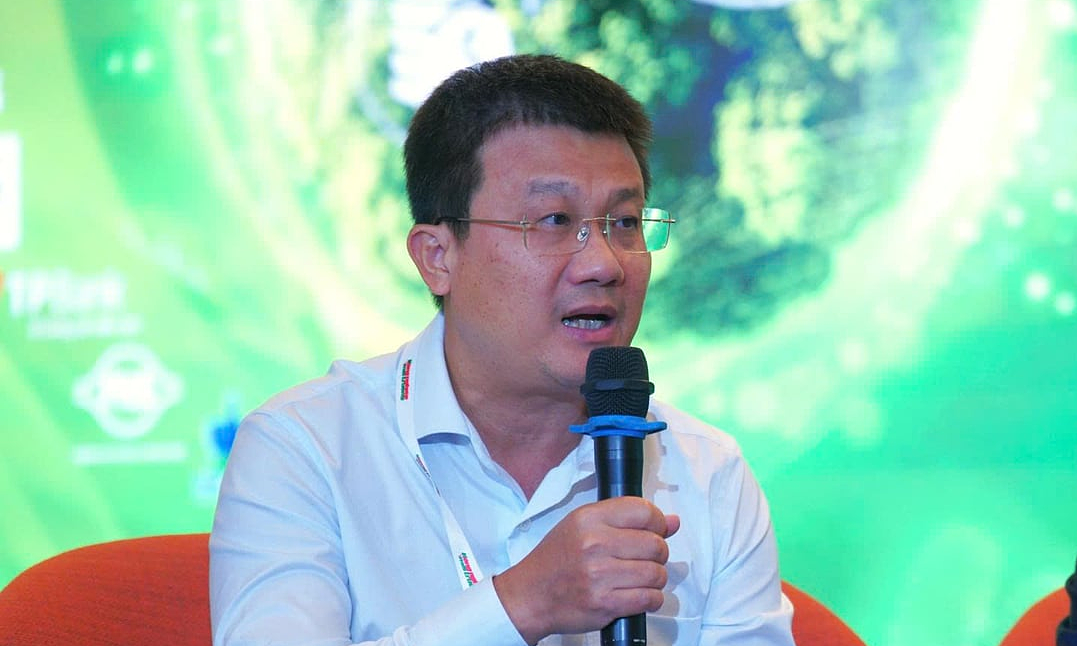 |
Nguyen Tuan Quang, deputy director of the Climate Change Department, at the event. Photo: Nong nghiep va Moi truong newspaper
A carbon credit is a tradable license or certificate. It grants the holder the right to emit one ton of CO2 or another listed greenhouse gas. However, according to Quang, not all emission reductions automatically generate credits. A reduction project might be considered for credit issuance but must meet specific conditions, including additionality. For example, if a project applies technology beyond common practice, or if revenue from credits helps implement and maintain the project, it could be considered for technological or financial additionality.
Projects must also ensure environmental sustainability and have emission data inventoried, measured, monitored, reported, and verified according to regulations. This is an area many businesses lack when first entering the carbon market. For credits to become tradable commodities, the market must also have purchasing demand and sufficient liquidity.
Nguyen Thanh Cong, head of the Carbon Market Division at the Climate Change Department, cautioned that selling credits to airlines or under bilateral mechanisms requires review by the Ministry of Agriculture and Environment, along with binding ceiling rates (50% or 90%). This is because when carbon credits are sold abroad, Vietnam's emission reduction results are correspondingly deducted, impacting national commitments.
Deputy Minister of Agriculture and Environment Le Cong Thanh acknowledged that the carbon market remains a new field for Vietnam. During the pilot implementation, management agencies will continue to refine policies and the measurement, reporting, and verification (MRV) system. For Vietnam's carbon market to develop, Deputy Minister Thanh suggested that businesses need to shift their mindset to proactively create value from emission reduction activities, rather than viewing it merely as an obligation.
By Thi Ha - Thuy Truong