During a meeting on 26/5 regarding proposed amendments to the Land Law, Deputy Prime Minister Ho Quoc Dung highlighted the law's direct links to the economy, national security, social order, and its role as a crucial resource for national development.
According to the Deputy Prime Minister, this revision of the Land Law must aim for sustainable development, environmental protection, and the resolution of practical issues. He urged the simplification of administrative procedures to prevent any new burdens on citizens and businesses. The timeframe for resolving land-related procedures also needs to be shortened, becoming quicker, more streamlined, and more effective.
Concurrently, policies concerning land finance, planning, and land use must be optimized to support development. This approach aims to maximize the effectiveness of land resources, which are public property managed uniformly by the State.
Regarding the process, the Deputy Prime Minister instructed the Ministry of Agriculture and Environment to promptly finalize the draft law, decrees, and guiding circulars. This preparation will ensure immediate implementation once the law takes effect.
The 2024 Land Law, which became effective on 1/8/2024, has encountered numerous shortcomings requiring adjustment after nearly two years of implementation. One significant issue is that from 1/7/2025, the country will adopt a two-tier local government model, comprising provincial and commune/ward levels. However, the current Land Law still stipulates a three-tier system for land use planning and schemes: national, provincial, and district.
The Ministry of Agriculture and Environment states that this three-tier planning model is no longer suitable. It causes overlap and lacks synchronization with other sectors following the abolition of the district level.
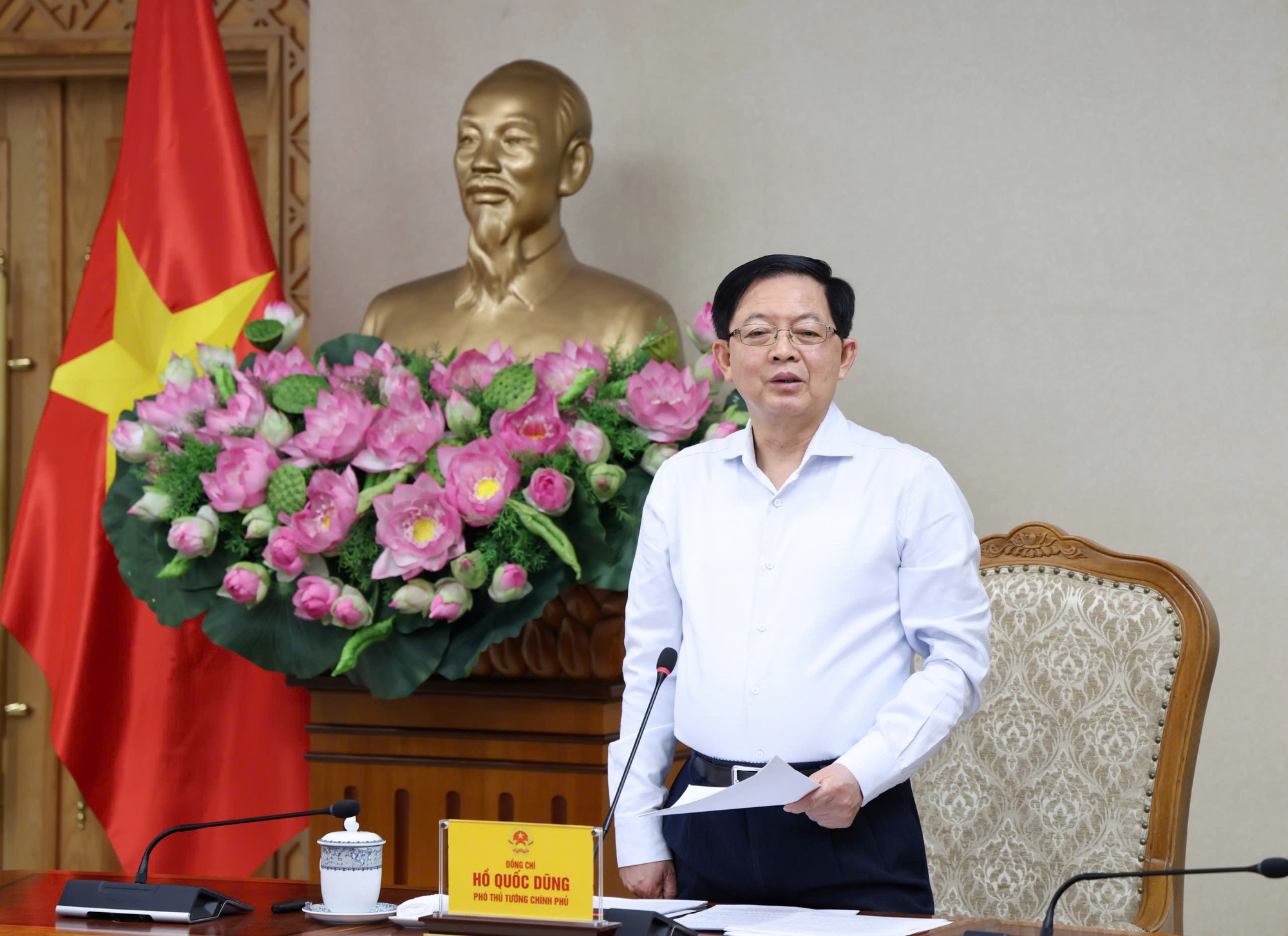 |
Deputy Prime Minister Ho Quoc Dung speaks at the meeting, 26/5. Photo: VGP.
Under the draft amended Land Law, which the Ministry of Agriculture and Environment is currently seeking feedback on, 65 articles of the 2024 law are expected to be adjusted. Key proposals include granting land use right certificates (red books) for land bought and sold with handwritten papers during the period 2014-2024, tightening land transactions during periods awaiting reclamation, and increasing decentralization to align with the two-tier local government model.
The Ministry of Agriculture and Environment announced that in the coming period, it will continue to collaborate with relevant agencies to submit the proposal to the National Assembly Standing Committee for the inclusion of the draft amended Land Law in the 2026 legislative program.
Phuong Dung