On 19/5, Standing Deputy Prime Minister Pham Gia Tuc and Deputy Prime Minister Le Tien Chau met with the Ministry of Industry and Trade to discuss a draft decree. This decree guides the National Assembly’s (NA) Resolution 235 on special energy development mechanisms for the 2026-2030 period.
According to Deputy Prime Minister Le Tien Chau, the decree must not grant any preferential rights beyond the NA Resolution, while still ensuring the goal of accelerating power project implementation.
Regarding offshore wind power projects, the deputy prime minister emphasized that assigning survey rights does not automatically mean investment approval. "The terms must be public, transparent, stable, and have clear criteria to prevent 'reservation' mechanisms or monopolistic investment opportunities", he stated.
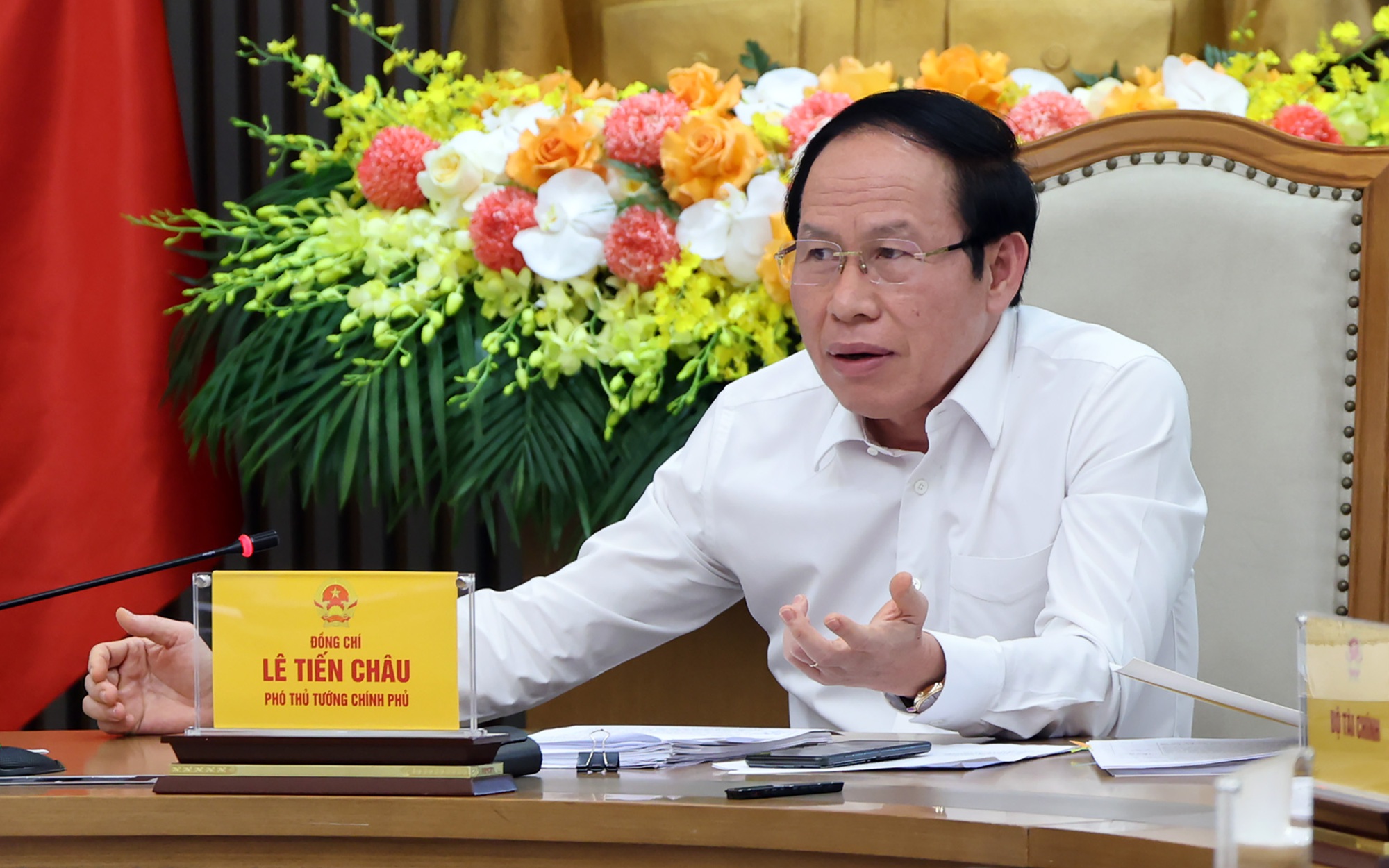 |
Deputy Prime Minister Le Tien Chau speaks at the meeting, 19/5. Photo: VGP |
Deputy Prime Minister Le Tien Chau speaks at the meeting, 19/5. Photo: VGP
The Ministry of Industry and Trade, the agency developing the draft decree, stated that the document will detail the conditions for survey units and enterprises proposing offshore wind power investments. It will also specify the procedures for receiving and processing survey applications and investment approvals, along with coordination mechanisms among relevant agencies.
During the meeting, ministries and agencies agreed on the necessity of issuing the decree. This will prevent situations where an offshore wind power project has investors simultaneously applying for both surveys and investment approvals, or multiple entities proposing surveys in different sea areas.
Many participants suggested clearly defining how to handle applications already received by the Ministry of Agriculture and Environment and the Ministry of Finance before the decree takes effect. This is to safeguard investors' rights.
Concluding the meeting, Standing Deputy Prime Minister Pham Gia Tuc highlighted the significantly increasing electricity demand for production, in the context of a two-digit growth target. Therefore, the National Assembly issued Resolution 253 to create special mechanisms and accelerate power projects for the 2025-2030 period.
Regarding offshore wind power, the government leadership acknowledged that this sector requires enterprises with substantial financial capacity, technology, and experience. Thus, the draft decree needs to clearly specify criteria for capital, technology, and progress commitments from investors when proposing surveys or seeking investment approval.
However, while attracting experienced foreign enterprises and technology, the deputy prime minister also noted the importance of enabling domestic enterprises to participate in surveys and investments. This should be done with appropriate criteria and fair competition. The entire project implementation process must comply with regulations to avoid potential international disputes.
The two deputy prime ministers requested clear regulations on coordination mechanisms among ministries and agencies to prevent bottlenecks during the decree's implementation. For transitional projects, the Ministry of Agriculture and Environment and the Ministry of Finance will review and categorize applications by stage, clarifying their completeness, financial capacity, commitments, and investor compensation responsibilities. This aims to establish strict transitional provisions and prevent complications.
The two deputy prime ministers also instructed the Ministry of Industry and Trade to collaborate with other ministries and agencies to review and finalize the draft decree for early submission to the government for promulgation.
According to the revised Power Plan VIII, Vietnam aims for 6,000 MW of offshore wind power by 2030, and 17,500 MW by 2035. By 2050, this power capacity is projected to reach 113,000-139,000 MW.
Phuong Dung