On 12/8, Deputy Prime Minister Ho Quoc Dung chaired a meeting to address recommendations and difficulties faced by businesses in the areas of land, environment, mineral exploitation, and material sources.
He emphasized that legitimate recommendations and existing shortcomings must be definitively resolved. Unclear issues require specific guidance to provide genuine relief for businesses.
Regarding land, the Deputy Prime Minister requested a review and resolution of matters concerning unit prices, land price tables, adjustment coefficients, land lease fees, tax enforcement, and planning. For environmental issues, management agencies need to focus on resolving challenges related to community consultation, procedures for dredging and maintaining seaport channels, deposits for scrap import, circular economy, production, and recycling.
According to the Deputy Prime Minister, laws related to agriculture and environment, including the Land Law, will be amended in the coming period. Therefore, the Ministry of Agriculture and Environment must absorb feedback on land issues to update the law revision process or guiding decrees.
"It's not just about providing answers; we must find solutions to enable businesses to operate," the Deputy Prime Minister stated, urging the Ministry of Agriculture and Environment to comprehensively address all issues reported by businesses.
He noted that over one million businesses contribute significantly to the national budget and economic growth. If business operations stagnate and resources are not unlocked, it will directly impact growth targets. Therefore, removing obstacles for businesses is a key solution to boost economic development.
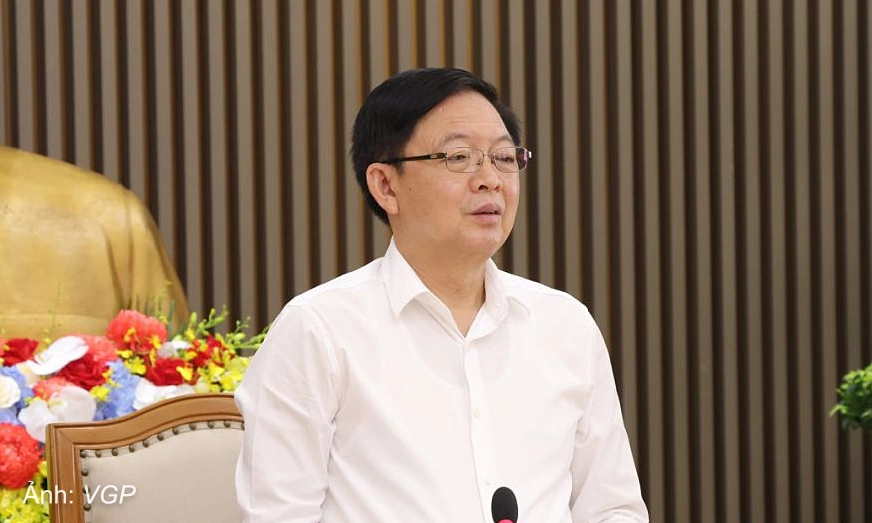 |
Deputy Prime Minister Ho Quoc Dung speaking at the meeting on 12/8. *Photo: VGP* |
During the meeting, Deputy Minister of Agriculture and Environment Vo Van Hung reported that the ministry reviewed 18 groups of issues and recommendations, providing responses and identifying responsible units. However, according to the Ministry of Agriculture and Environment leadership, some inter-sectoral issues, such as land finance, interest rate support, scrap deposits, and fly ash standards, require coordinated inter-sectoral resolution.
The Vietnam Chamber of Commerce and Industry (VCCI) highlighted discrepancies in land valuation and delays in land handover to businesses despite payment. Additionally, some shortcomings stem from a lack of quantitative criteria for planning and a waste management approach that leans towards disposal rather than circularity.
From a business perspective, Nguyen Hoai Nam, General Secretary of the Vietnam Association of Seafood Exporters and Producers (VASEP), proposed extending land use duration for large-scale agriculture and aquaculture projects. He noted that many aquaculture areas have a land use term of only 20 years, which is not commensurate with the significant capital and infrastructure investment.
Dang Hong Anh, Chairman of the Vietnam Young Entrepreneurs Association, called for a single-point mechanism to streamline investment, construction, and land procedures, rather than requiring businesses to work with multiple departments and agencies. He also suggested that environmental impact assessment (EIA) dossiers completed before decentralization to localities should be inherited to avoid duplication.
In response to these recommendations, Deputy Prime Minister Ho Quoc Dung instructed relevant agencies to classify and address each recommendation specifically within August. He reiterated the principle of "no evasion, no buck-passing," emphasizing clear responsibilities and lead agencies for resolution.
The Government leader also warned against converting reduced business procedures and conditions into new regulations disguised as standards, technical regulations, or "ancillary permits." This aims to prevent eliminating one barrier only to create another elsewhere.
By Phuong Dung