Vo Nguyen Khoa Tuan, Senior Securities Operations Director at Dragon Capital, presented this information at an investor conference on 13/8. He emphasized two directions: not every dip is a buying opportunity, but volatility can create more attractive price ranges; avoid speculative stocks, instead select long-term oriented groups using the dollar cost averaging (DCA) method.
Select stocks, maintain disbursement flexibility
According to Dragon Capital, when the market corrects, investors should not equate falling stock prices with buying opportunities. Instead, selection should focus on businesses with a long-term orientation, capable of sustaining growth and profits.
Beyond stock selection, investors need to manage their portfolio proportions instead of disbursing broadly or over-concentrating in one sector. Maintaining some cash also provides leeway to buy more when valuations become more attractive or major variables like interest rates and tariffs become clearer.
DCDS's fund management activities reflect this approach. The fund actively changes asset allocation based on valuation and risk levels. The weighting of residential real estate was reduced from nearly 16% to below 6%, given actual home loan interest rates of 14-16%. For the securities group, DCDS reduced its weighting to about one-third of what it was at the beginning of the year. Despite more reasonable valuations after the correction, the fund prioritizes risk management.
Conversely, the weighting in banking was slightly increased due to the group's low valuations and lower volatility. The fund also raised its cash weighting to 25,2%, to maintain disbursement capability when interest rate and tariff signals become clearer.
DCDS also increased its cash ratio to 25,2% to protect assets and proactively maintain disbursement flexibility when the opportune time arises. Long-term, DCDS has recorded positive results with cumulative growth of 18,1% over two years, 41,7% over three years, and a superior internal rate of return (IRR) compared to the VN-Index over five-year and ten-year timeframes.
From this portfolio management approach, Dragon Capital shows that the strategy during volatile periods is not just about seeking growth opportunities but also about maintaining the portfolio's resilience.
 |
From left: Diep Quoc Khang, Vo Nguyen Khoa Tuan, Le Anh Tuan, Luong Thi My Hanh, and Nguyen Sang Loc at the "Investing Amidst Variables" Investor Day on 13/8. *Photo: Duc Duy* |
DCA reduces reliance on market timing
In addition to asset selection and proportion management, Dragon Capital recommends investors use the dollar cost averaging (DCA) method. According to Tuan, instead of trying to precisely time the market bottom, investors can divide their funds and disburse periodically. The key point experts emphasize is that the longer the investment period, the higher the cumulative efficiency.
Luong Thi My Hanh, Head of Domestic Asset Management at Dragon Capital, illustrated the effectiveness of regular accumulation through a 22-year study on DCDS. Assuming a monthly investment of 10 million VND, a portfolio that always bought at the bottom reached 11.8 billion VND after 22 years, while one that bought regularly on the first day of the month reached 11.4 billion VND. The difference between the two methods is very small, only 2,7%.
This gap shows that investors do not necessarily need "prophetic" ability — to accurately predict the bottom — to achieve long-term results. Dividing funds and maintaining disbursement discipline helps reduce the risk of relying on a single buying moment.
Previous statistics from Dragon Capital also show that longer holding periods are generally associated with a higher probability of profit. From its inception on 20/5/2004 until the end of 7/2026, DCDS's probability of profit was 63% with a three-month holding period. This rate increased to 69% after six months and 76% after one year, corresponding to median returns of 6,9% and 16,6%.
When extending the investment period to two years, the probability of profit reached 83%, with a median return of 30,6%. After three years, this rate increased to 98% and the median return reached 47,2%. With holding periods of five years or more, the probability of profit reached 100%, with a median return of 94,1%; for a ten-year term, the median return soared to 276,6%.
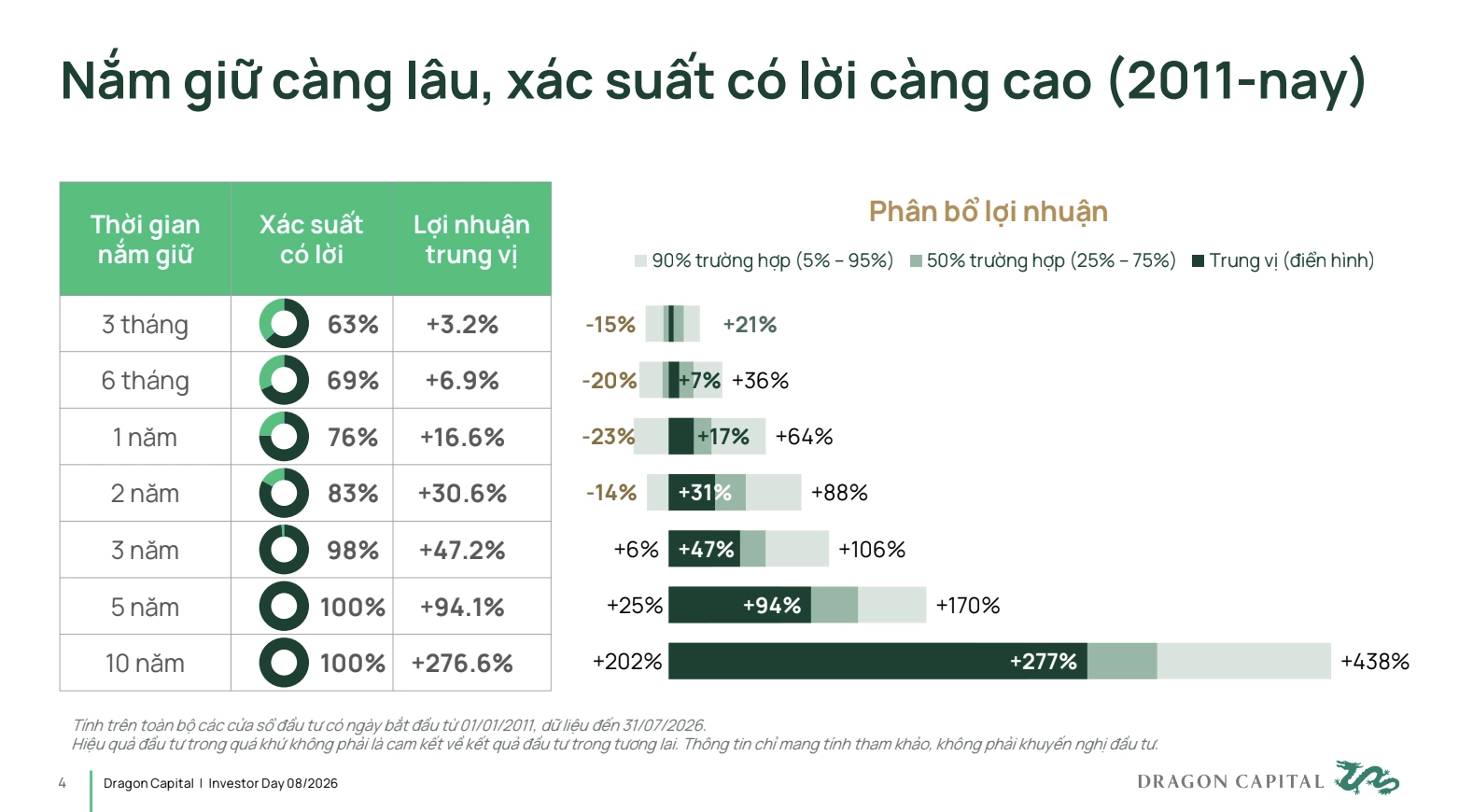 |
Statistics show that longer holding periods are often associated with a higher probability of profit. *Source: Dragon Capital* |
From this perspective, market volatility can become an accumulation opportunity when investors are not just looking for a single buying point, but building a plan that includes selecting fundamentally sound businesses, allocating proportions reasonably, disbursing in parts, and maintaining a sufficiently long holding period.
Thai Anh