This marks an unprecedented high, positioning durian as the largest contributor among agricultural products to the sector's overall export turnover.
The primary driver for this growth is the Chinese market, which accounted for 94.35% of the total 10-month turnover, equivalent to over 3.14 billion USD. Despite a more than 41% decrease in export volume in October compared to the previous month, attributed to the end of the season and import control adjustments, the cumulative value to this market still rose by nearly 14% year-on-year.
Specifically, durian export turnover in October reached over 572 million USD, 2.7 times higher than the same period last year.
According to Dang Phuc Nguyen, General Secretary of the Vietnam Fruit and Vegetable Association, Vietnamese durian continues to grow well despite facing various technical barriers from China. This success is due to improved quality and competitive pricing. The average export price for a ton of Vietnamese durian is 3,696 USD, which is 15% lower than Thai durian. Leveraging its price advantage and shorter transportation times, Vietnam is currently the second-largest durian exporter to China, trailing only Thailand.
Since the beginning of the year, in response to stricter technical requirements from China, many Vietnamese businesses have upgraded their cultivation areas, invested in cold storage, packaging lines, and developed their own brands. The Ministry of Agriculture and Environment has also established a separate control process for durian, which is considered an important precedent for expanding other agricultural exports to this market.
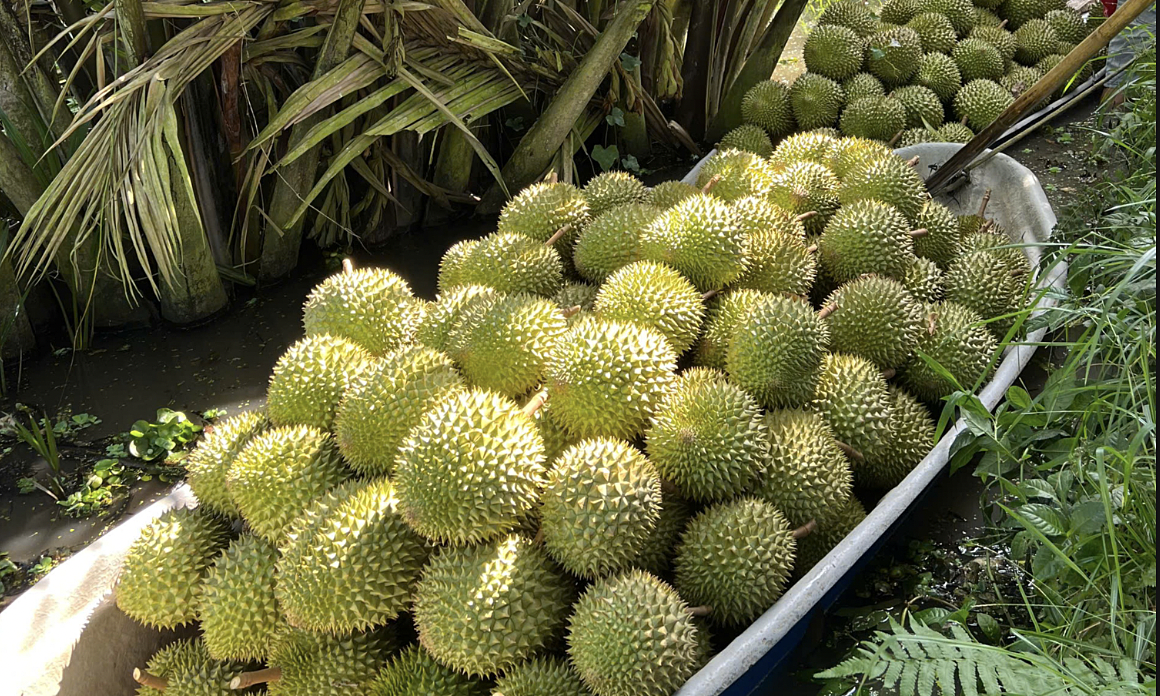 |
Durians harvested at a garden in the Mekong Delta. Photo: Manh Khung |
Beyond the primary market, several other destinations have recorded strong growth. Hong Kong saw a nearly 89% increase, reaching over 45 million USD, continuing its role as a crucial transit hub. Papua New Guinea and Malaysia also experienced sudden surges, though their scale remains modest. Japan and Canada maintained double-digit growth, indicating potential for expansion into high-standard markets.
Conversely, exports to Thailand decreased by 77% to over 34 million USD, primarily due to direct competition in the Chinese market, where Thailand is boosting its production. Exports to Taiwan, South Korea, and Cambodia also saw significant declines, reflecting limited market expansion beyond China.
Experts caution Vietnam against over-reliance on durian, a commodity that currently accounts for over half of its fruit and vegetable export value. To sustain growth and strengthen its position in major markets, the agricultural sector needs to diversify products, upgrade cold chains, and enhance control over quarantine standards and preservation quality.
Given the current growth momentum and positive signals in the final month of the year, Nguyen forecasts durian export turnover could reach 4 billion USD in 2025. Preliminary estimates from the association indicate that durian export turnover reached approximately 3.7 billion USD in 11 months.
Thi Ha