Observations in the Mekong Delta provinces show that Monthong durian grade A (2,7 lobes) is purchased at warehouses for 90,000-95,000 VND, a drop of about 35-40% compared to late February, early March. Similarly, Ri6 grade A currently ranges from 70,000-75,000 VND per kg, about 25% lower than last month.
At the farm gate, the price drop is even more pronounced. Monthong is purchased at 65,000-80,000 VND per kg, while Ri6 stands at 45,000-60,000 VND. Many farmers are accepting early sales to avoid the risk of further price declines.
Ms. Hoa, a durian farmer in Dong Thap, stated she just sold her entire 0,5 hectare Ri6 orchard for 55,000 VND per kg, about 15,000 VND lower than last month. Previously, before the peak season, her family did not rush to sell, hoping for higher prices. However, with continuous price drops in recent days and concerns of further decline, she decided to sell the entire orchard at once. Even at this price, farmers still make a profit.
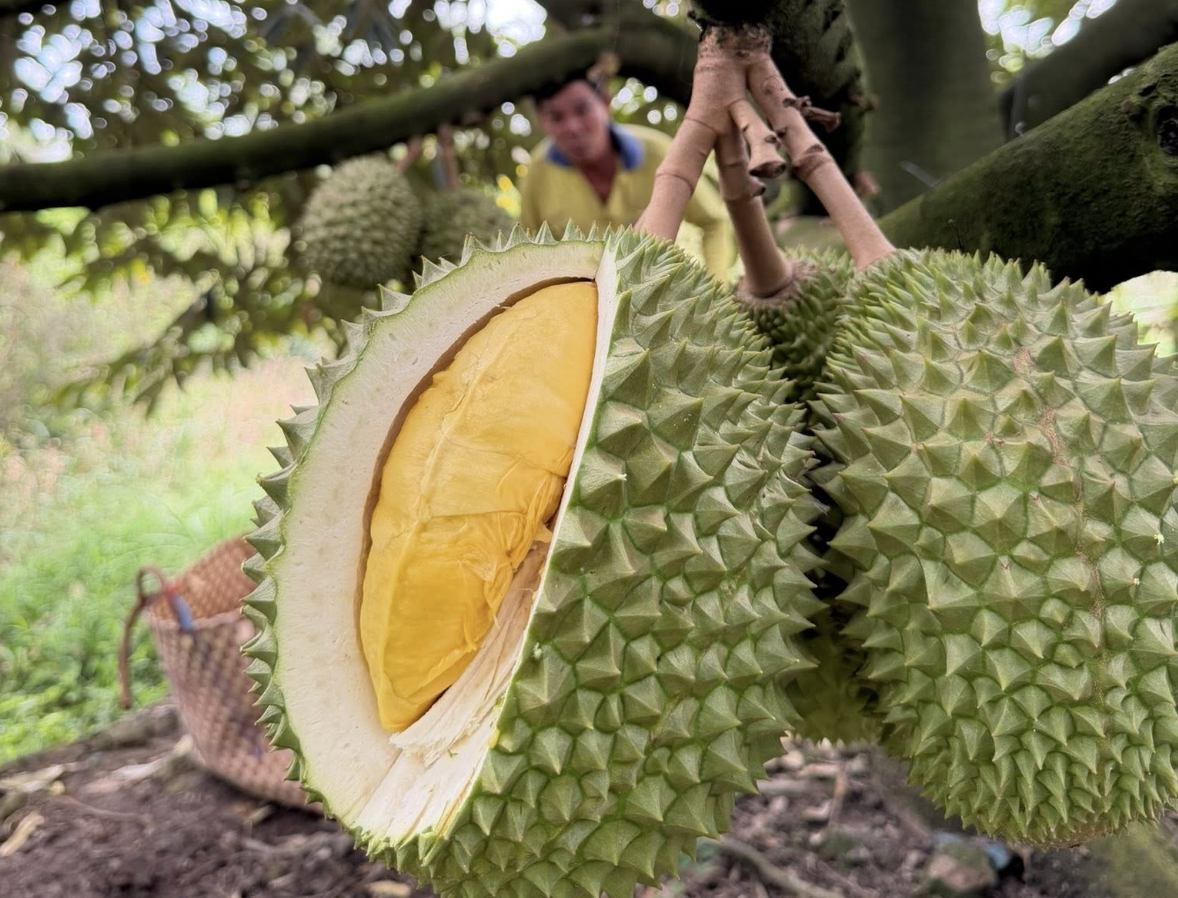 |
Durians at a farm in the Mekong Delta. Photo: Manh Khuong
In the purchasing stage, supply rapidly increased from mid-March as many regions began harvesting. Mr. Hoang, a trader in Dong Thap, said that while previously he could only collect 10-20 tons per day, output has now increased two to three times. For Monthong, despite its relatively small output, prices have fallen sharply because it no longer holds the monopoly advantage it had at the beginning of the year, now facing direct competition from Thai durians.
According to Mr. Dang Phuc Nguyen, General Secretary of the Vietnam Fruit and Vegetable Association, from March to June is the peak harvesting season for Thai durians. This year, Thailand's output is estimated to reach about 1,78 million tons, a 16% increase compared to last year, with the eastern region accounting for nearly 60%. The large supply from Thailand coinciding with Vietnam's durian harvest season has reversed the supply-demand balance, leading to a rapid price decline.
Furthermore, many other fruits are currently in season, giving consumers more choices and forcing durian prices down to compete.
On the export front, pressure also comes from increasingly stringent technical requirements. Mr. Nguyen stated that Thailand is strictly controlling its harvesting process, picking durians only when they reach standard ripeness, thereby enhancing its advantage in the China market. Meanwhile, China continues to tighten quarantine and traceability regulations, including requirements for growing area codes, packing facilities, and testing for cadmium residues and auramine O dye from accredited laboratories.
These regulations are expected to be fully implemented from June 1, forcing the entire supply chain to adhere more strictly. In this context, Mr. Nguyen advised farmers and businesses to strictly control quality and fully meet the standards of importing markets. If products fail to meet requirements, they risk being returned, leading to a sudden increase in domestic supply and potentially further sharp price drops.
Thi Ha