At a seminar on peak season electricity saving held on 22/6, Ngo Son Hai, Deputy General Director of Vietnam Electricity (EVN), stated that the national power system needs to add around 4,000-5,000 MW of new capacity annually to meet demand.
He explained that bringing a 1,000 MW liquefied natural gas (LNG) or offshore wind power project online typically takes three to four years for preparation and construction. In contrast, if the entire system saves around 2% of its electricity consumption, the resulting effect is equivalent to reducing the need to invest in about 1,000 MW of new generation capacity.
"Electricity saving is a much faster, more effective, and less costly solution compared to investing in new power sources", Hai said.
According to the EVN leader, every saved kWh helps households and businesses reduce their electricity bills, while also contributing to lowering overall societal costs. When electricity demand surges, the system must mobilize more expensive power sources to meet it. Efficient electricity use helps limit the activation of these costly sources, thereby reducing the entire system's operating expenses.
Sharing this perspective, Ha Dang Son, Chairman of the Energy and Green Growth Research Center, noted that many international organizations, including the International Energy Agency (IEA), consider electricity saving as the "first fuel". This is because it is the lowest-cost solution for increasing energy supply capacity.
According to Son, awareness of electricity saving has significantly improved within the business sector, as it directly impacts profits and production costs. However, in the residential sector, which accounts for about 30% of total electricity demand, the conscious use of electricity remains limited.
 |
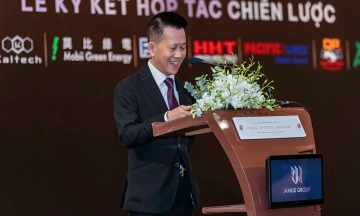
Ngo Son Hai, Deputy General Director of EVN (center). Photo: VGP
Under Directive 10 on strengthening electricity saving for the 2026-2030 period, the country aims to save a minimum of 3% of electricity consumption in 2026. It also seeks to reduce peak load by at least 3,000 MW through demand-side management and load adjustment programs.
The call for energy saving comes amid rapidly increasing electricity demand. A late May heatwave pushed peak power consumption to nearly 58,000 MW, a 5.6% increase over the 2025 record, with daily electricity output exceeding one billion kWh. With a target of two-digit economic growth, electricity demand is expected to continue rising sharply in the coming years.
According to a representative from the Ministry of Industry and Trade (MOIT), one of the biggest current risks is geopolitical instability directly impacting global energy supply chains.
"When supply chains are disrupted, energy costs can increase by 15-20%, or even higher", Dung said. He cited the example of tensions in the Strait of Hormuz, where oil prices once surged from around 50-60 USD to over 100 USD per barrel, creating significant pressure on business operations and the entire economy.
Vietnam also faces pressure from increasingly stringent emission reduction requirements imposed by major export markets. According to Dung, mechanisms such as the European Union's Carbon Border Adjustment Mechanism (CBAM) and the European Green Deal are compelling the power system to gradually reduce its carbon emission factor, thereby accelerating the transition to renewable energy. However, renewable energy, like wind and solar power, heavily depends on weather conditions. With unpredictable climate change, forecasting and operating the power system become more complex.
Furthermore, according to MOIT leadership, the investment progress for power source and grid projects also faces pressure from investment procedures, site clearance, and implementation challenges.
Given these challenges, Dung believes that efficient energy use is one of the pillars for ensuring energy security, alongside developing coal, oil and gas, and renewable energy sources.
The MOIT is also researching financial solutions to support businesses in technology conversion and improving energy efficiency. According to Dung, the agency will coordinate with the Ministry of Finance to establish an Energy Saving and Efficiency Fund, aiming to create additional resources for the green transition process.
Phuong Dung