This assessment was made by Bruno Jaspaert, Chairman of the European Chamber of Commerce in Vietnam (EuroCham), on the occasion of the Vietnam - EU Free Trade Agreement (EVFTA) marking six years since its effective date of 1/8/2020.
According to data from the General Department of Customs and the General Statistics Office, bilateral trade turnover between Vietnam and the EU, since the establishment of diplomatic relations (1/1995 to 6/2026), has surpassed 900 billion USD.
Of this total, 42,6%, equivalent to 383,8 billion USD, has been generated since the EVFTA's implementation. In the first half of 2026 alone, bilateral trade reached 41,4 billion USD, with Vietnam holding a 22 billion USD surplus, surpassing the entire 2019 figure (21,7 billion USD), prior to the agreement becoming effective.
The agreement also boosted investment and business activities of European enterprises in Vietnam. EuroCham's Business Confidence Index (BCI) for QII indicates that 55% of surveyed businesses consider Vietnam a core operational hub or a key growth area.
Among businesses engaged in import-export, one-half directly benefited from the EVFTA. As many as 66% reported specific financial savings, mostly reaching 5-15%. According to Bruno Jaspaert, after six years, the EVFTA's impact is tangible and measurable.
"The agreement has reshaped trade flows, built business confidence, and positioned Vietnam as one of Europe's leading 'economic anchors' in Asia", he commented.
Entering its 7th year, the EVFTA approaches a milestone where the EU will complete its trade liberalization roadmap, granting tariff exemptions for 99% of Vietnam's exports. Meanwhile, Vietnam will finalize its tariff reduction process for EU goods by 2030.
EuroCham Vice-Chairman Jean-Jacques Bouflet – who participated in the EU's negotiating delegation during the EVFTA discussions – stated that European goods such as high-tech, advanced machinery, and pharmaceuticals directly boost Vietnam's industrial productivity.
Conversely, Vietnam's strengths in electronics, mechanics, textiles, footwear, wood products, and agricultural produce are a perfect fit to strengthen supply chains and serve millions of European consumers.
"There is still significant room for deeper cooperation", Jean-Jacques Bouflet remarked. He encouraged Vietnam to increase imports of high-tech solutions from Europe to modernize its industry, master production value chains, and balance bilateral trade.
As tariff barriers are gradually removed, administrative complexity and compliance costs have emerged as key bottlenecks, according to EuroCham.
Among businesses encountering difficulties in utilizing the agreement, 50% identified core obstacles: domestic tax management, complex tax processing procedures, and delayed VAT refund mechanisms.
33% mentioned the complexity of Rules of Origin (RoO), Certificate of Origin (C/O) procedures, and varying verification requirements across jurisdictions. 17% believe that compliance costs remain too high compared to the marginal tax savings achievable.
EuroCham cited a multinational manufacturing enterprise stating that less than 20% of shipments to the EU currently qualify for EVFTA benefits. This is due to differing interpretations of documentation between EU member states and Vietnam, alongside constantly changing origin requirements, making compliance difficult to maintain.
Therefore, maintaining Vietnam's export advantage will increasingly depend on simplifying customs procedures, accelerating tax refunds, digitizing documentation, and clarifying rules of origin, according to EuroCham.
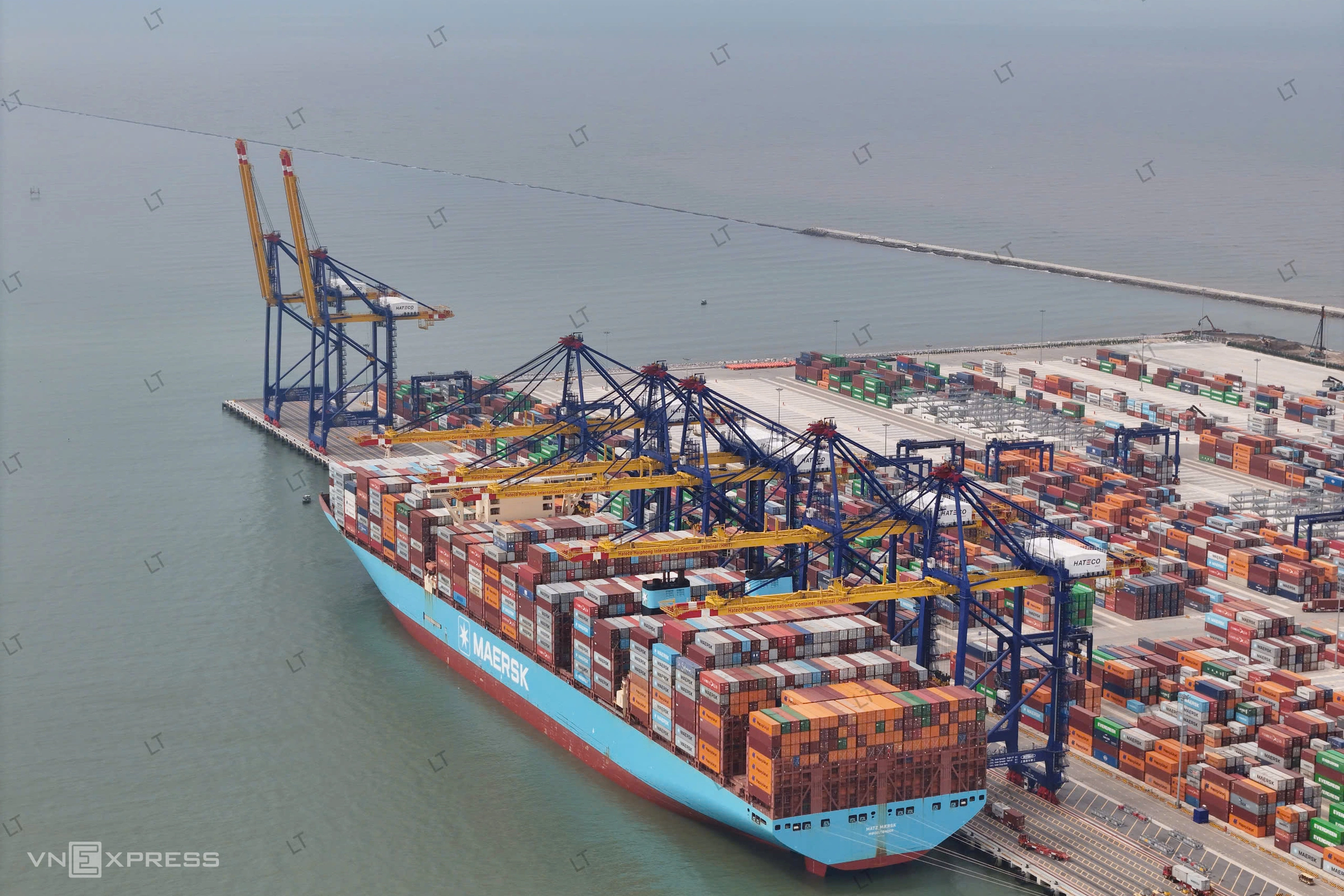 |
A vessel with a deadweight tonnage (DWT) of over 213,000 arrived at Hateco port, part of the Lach Huyen deep-water port complex in Hai Phong, on 23/6. Photo: Le Tan. |
A vessel with a deadweight tonnage (DWT) of over 213,000 arrived at Hateco port, part of the Lach Huyen deep-water port complex in Hai Phong, on 23/6. Photo: Le Tan.
By Vien Thong