The Ministry of Industry and Trade (MOIT) has proposed new regulations in a draft circular on national technical standards for electric vehicle (EV) charging infrastructure. These regulations mandate that measurement devices at charging stations must adhere to metrology standards. The systems must clearly display kilowatt-hour (kWh) consumption, unit prices, service fees, charging duration, and the total payment, with capabilities for data storage and retrieval.
These provisions aim to empower users to monitor transactions, compare services, and minimize billing disputes, according to the MOIT.
Additionally, public EV charging stations must incorporate monitoring systems for status, warnings, voltage, and power. All measurement and payment data must be synchronized, backed up, and protected from unauthorized modification.
For charging stations integrated with solar power, battery energy storage systems (BESS), or other distributed sources, investors must ensure safety, prevent uncontrolled reverse power flow, and comply with all connection regulations. These stations are also required to meet technical specifications for site layout, equipment safety, and power supply.
Given the inherent risks of unauthorized access to networked charging stations and electronic payment systems, the MOIT requires these systems to include solutions for authentication, authorization, data backup, and incident handling. The collection of user data must strictly adhere to legal provisions.
These regulations are slated for application to charging stations in public areas, centralized parking facilities, and rest stops. Charging stations located within buildings will also need to comply with additional construction and fire safety regulations.
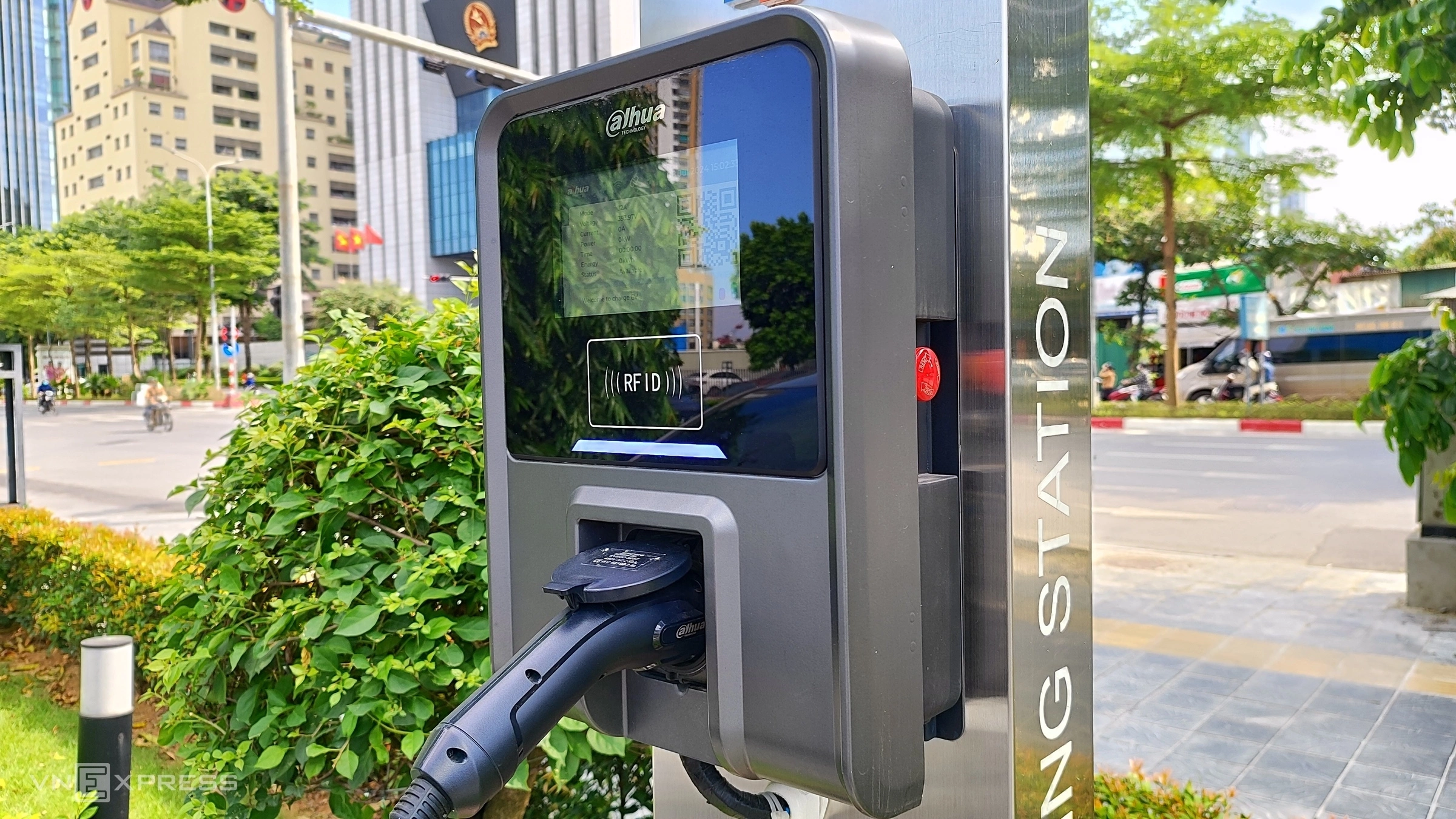 |
An electric vehicle charging station in Hanoi. Photo: Luong Dung |
The MOIT stated that existing regulations concerning electricity, construction, fire safety, metrology, and information security are currently fragmented across various documents, lacking a unified technical framework for charging infrastructure. Therefore, this draft circular seeks to establish minimum standards for safety, measurement, operation, and the protection of user rights.
The circular is expected to take effect on 1/7/2027. Currently operational stations will be granted six months to review their compliance and an additional 24 months to rectify any non-conforming aspects.
Vietnam currently has approximately 6,7 million automobiles, with about 3% being electric vehicles, and 70 million motorcycles, of which 4,3% are electric. The majority of electric vehicles are concentrated in major urban areas, creating an urgent demand for adequate parking and charging infrastructure.
In line with Vietnam's strategic roadmap to achieve net-zero emissions by 2050, the country aims for 50% of urban vehicles and all buses and taxis to be electric by 2030. The World Bank estimates that Vietnam will require approximately 2,2 billion USD by 2030 and 32,6 billion USD by 2050 to develop its charging station network.
Phuong Dung