On the morning of 22/8, the National Assembly discussed in the hall policies related to land reclamation urban development projects for integration into the draft Law on Urban Development.
Explaining the proposal to the National Assembly, Finance Minister Ngo Van Tuan stated that a mechanism is essential for land reclamation urban development activities. This aims to create a new growth pole, contributing to the achievement of double-digit growth targets by 2030.
According to the Minister, this activity will facilitate the formation of new, modern, smart, and nationally iconic urban areas at sea. These areas would be attractive enough to draw strategic investors and consumers.
In the draft, the Government proposes a specific mechanism for land reclamation urban areas with capital exceeding 100 trillion VND. Projects below this threshold would adhere to land law. The Government also suggests that projects within land reclamation urban areas apply a controlled trial mechanism, policies on work permits for foreigners, and duty-free shops.
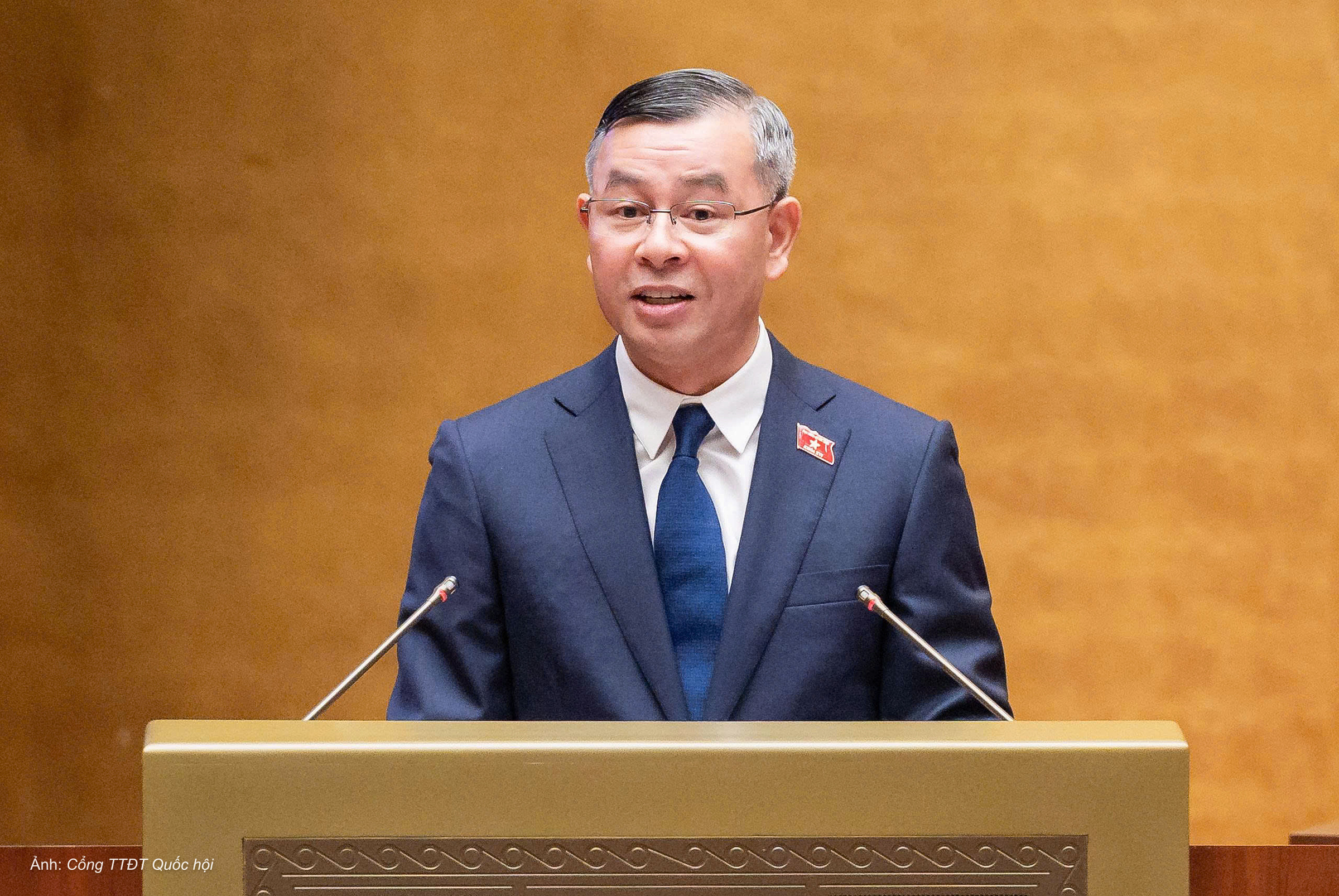 |
Finance Minister Ngo Van Tuan speaking at the morning session on 22/8. Photo: National Assembly Portal
Nguyen Ngoc Son, a full-time deputy at the National Assembly's Committee for Science, Technology, and Environment, supported establishing a special mechanism to form new growth poles from the marine economy.
However, the deputy noted that stronger incentives and deeper decentralization entail greater subsequent risks. He argued that these are not merely typical urban development projects; they involve converting part of the sea into a land fund for investment, business, and residential organization.
Son proposed that for larger projects, limits on authority and control mechanisms should be more strictly regulated. He called for clarification on the timing for project transfers, as well as an assessment of the buyer's capacity. This would ensure the full inheritance of capital obligations, progress, environmental protection, and national defense and security responsibilities.
The draft currently stipulates that strategic investors are permitted to transfer a portion of a project, but not exceeding 50% of the reclaimed urban area where technical infrastructure has been built.
Thach Phuoc Binh, Deputy Head of the National Assembly Delegation of Vinh Long province, also raised the risk of land reclamation projects having basic infrastructure in place but not being fully completed. In such cases, Binh believes regulations must clarify the feasibility of continuing project implementation.
"If implementation continues, what mechanism would be used to select a successor investor? How would the transfer and handling of the rights, obligations, debts, collateral, and environmental protection responsibilities of the previous investor be carried out?", Binh questioned.
He proposed that the State should be responsible for ensuring project safety and public interests, but not assume the commercial obligations of investors. According to Binh, it is unacceptable to turn business risks from enterprises into a burden on the state budget simply to rescue a land reclamation project.
Regarding the issues raised by the deputies, the Finance Minister affirmed that the draft law contains strict conditions for investor transfers. According to Tuan, allowing the sale of up to 50% of the reclaimed area with complete infrastructure both holds investors accountable and enables businesses to recover and mobilize capital for smooth project implementation.
The Minister shared that mobilizing no less than 4 billion USD for a land reclamation project is extremely challenging. Therefore, he emphasized the need for sufficient mechanisms and policies to attract investors with strong potential and management experience, ensuring the construction, operation, and good management of the entire project.
According to Tuan, the draft also establishes principles requiring all land reclamation projects to align with planning, ensure national defense and security, jurisdiction, and national interests at sea. Projects will also be decided based on a full assessment of natural conditions, hydrography, ecosystems, impacts on coastal areas, and adaptability to climate change and sea-level rise.
The National Assembly is expected to consider and pass the draft Law on Urban Development, which includes provisions on mechanisms and policies for land reclamation urban development, on 24/8.
Anh Tu