


Vietnam's government is set to introduce a new decree, replacing existing regulations, that will empower petroleum wholesalers and retailers with the authority to declare and self-determine their selling prices. This move aims to streamline market operations and foster greater business autonomy.
At a conference on 16/1, Tran Huu Linh, Director of the Domestic Market Management and Development Department under the Ministry of Industry and Trade, announced the forthcoming decree on petroleum business management. Under the new framework, regulators will grant businesses the right to manage and set petroleum prices, while ministries and agencies will focus on inspections, post-audits, and strategic planning. The Ministry will also publish a list of traders, establish price declaration rules, and collaborate with other ministries in overseeing the fuel price stabilization fund.
Linh emphasized that businesses failing to publicly list or declare prices would face severe penalties once granted pricing autonomy. To enhance transparency and consumer oversight, regulators plan to develop a commercial infrastructure map application. This application, built on data reported by businesses and traders, will help consumers monitor price declarations.
"This map will identify the coordinates of 17,200 gas stations nationwide," Linh explained. "Through it, consumers can easily locate nearby gas stations, compare prices, check fuel availability, or get directions."
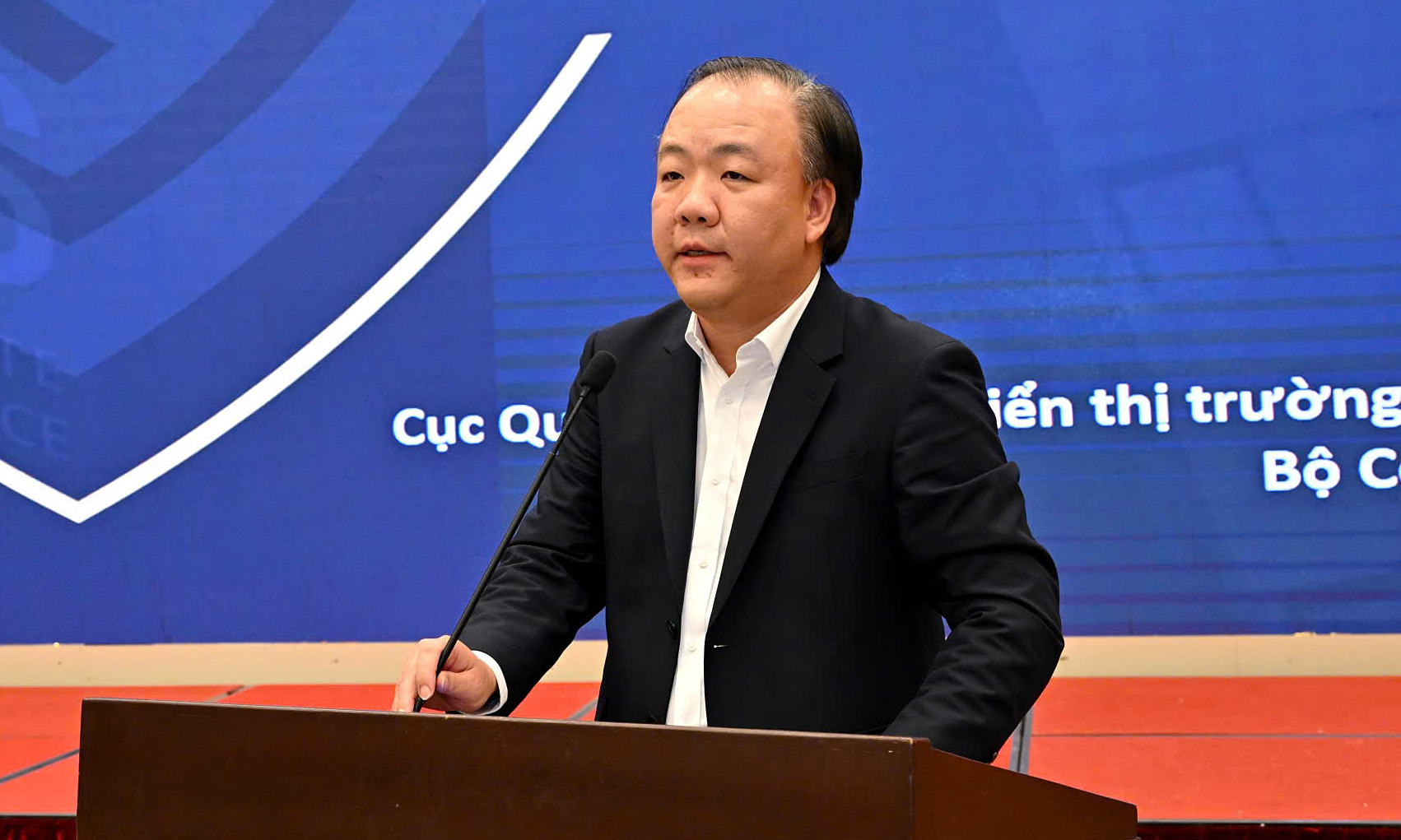 |
Tran Huu Linh, Director of the Domestic Market Management and Development Department (Ministry of Industry and Trade), speaks at the conference on 16/1. *Photo: DMS*
This year, Vietnam aims for double-digit economic growth. To support this target, the Ministry of Industry and Trade has mandated a minimum total petroleum supply of 31,7 million m3/ton. Consequently, petroleum traders must ensure consistent production and supply throughout the entire system.
"Businesses must ensure an uninterrupted supply, meet the minimum total supply, and maintain mandatory reserves," Linh stated. He also urged local authorities to facilitate transportation and circulation, closely monitor local supply and demand, and verify business compliance.
A critical aspect of the supply mandate is ensuring the blending and nationwide provision of E10 gasoline from 1/6. E10 gasoline is prone to evaporation, potentially converting into E7 or E8 with a lower ethanol percentage. If the ethanol content falls below regulatory standards, these evaporated gasoline types could be classified as "counterfeit goods."
Bui Ngoc Bao, Chairman of the Vietnam Petroleum Association, expressed the industry's significant concerns regarding technical regulations for bio-gasoline. Bao argued that classifying businesses as sellers of counterfeit goods due to a drop in ethanol percentage would be "unfair to businesses." He proposed that the Ministry of Industry and Trade, the Ministry of Science and Technology, and relevant agencies collaboratively research and synchronize technical regulations and standards, specifically considering the unique characteristics of E10 gasoline.
In response, a representative from the National Standards and Metrology Committee (Ministry of Science and Technology) confirmed that the agency acknowledges the businesses' recommendations and is actively researching potential solutions for the near future.
Last year, petroleum prices underwent 54 adjustments, with alternating increases and decreases. By year-end, prices for all items had decreased by 6-17% compared to the beginning of the year. Specifically, E5RON 92 gasoline saw an 8,1% reduction, RON 95 gasoline an 8,8% decrease, diesel oil an 8% drop, and mazut fuel a 17,11% decline.
Phuong Dung


