News from the Middle East conflict continued to influence the gold market this week. Prices surged on 8/4 and 9/4, exceeding USD 4,800 per ounce after the US and Iran announced a two-week ceasefire agreement. The precious metal then saw a slight decline, fluctuating between USD 4,700 and USD 4,800 for the remaining sessions.
Despite this, a Kitco News survey conducted this weekend among bank executives, analysts, and investors revealed their readiness to re-enter the market, after gold recorded its third consecutive week of gains. According to the survey results, 50% of participants expect prices to rise next week. Only 14% anticipate a decline, and 36% predict a sideways market.
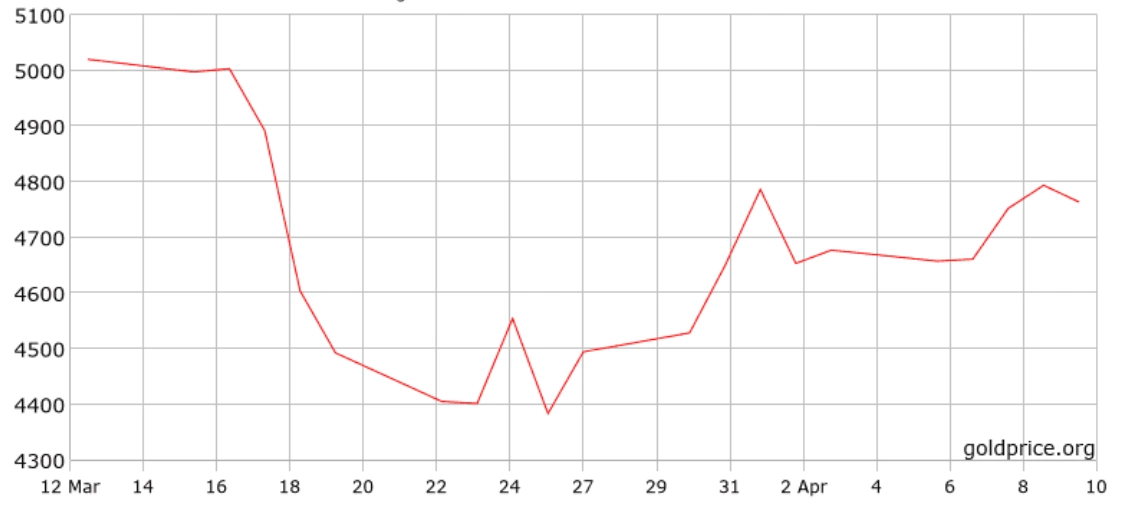 |
Global gold price movements over the past month. Chart: Goldprice |
Adrian Day, president of Adrian Day Asset Management, commented: "If the ceasefire holds, monetary factors, such as inflation, will return to dominate the market. Should the conflict escalate, gold's role as a safe-haven asset will be further underscored".
The geopolitical landscape remains uncertain. On 11/4, US Vice President JD Vance announced that negotiations with the Iranian delegation in Pakistan concluded after 21 hours without an agreement. He stated that the US had clearly outlined its red lines, its willingness to compromise, and its non-negotiable points, but Iran "chose not to accept these terms".
Rich Checkan, Chief Operating Officer of Asset Strategies International, believes "gold has been oversold recently". He projected: "Gold prices are likely to continue their upward trend, heading towards USD 5,000 and beyond". However, Checkan also warned that if the fragile ceasefire agreement shows cracks, gold prices could fall. Gold would experience a short-term sell-off if market liquidity decreases.
Meanwhile, Darin Newsom, market analyst at Barchart.com, forecasts the opposite. He suggests prices will decline in the short term, as June gold futures appear to be nearing a peak, indicating the start of a downward trend.
Colin Cieszynski, market strategist at SIA Wealth Management, maintains a neutral short-term outlook on gold, but emphasizes that prices are unlikely to be stable. "I think gold could be very volatile, but it's hard to tell which way. Prices could reverse several times in a single day", he commented.
Considering recent inflation figures, Cieszynski believes gold's previous rally largely reflected this situation. On 10/4, the US Bureau of Labor Statistics reported that the country's consumer price index (CPI) rose 3,3% in March, the highest in nearly two years. Most of this increase was due to energy prices, which have surged since the Middle East conflict began.
Cieszynski suggests that gold's trend has shifted from upward to sideways. The current trading range could extend to hundreds of US dollars, but identifying the short-term trend is almost impossible. He explained: "That depends on the conflict's developments. Just this week, with news of a ceasefire, gold prices surged. Previously, when US President Donald Trump threatened to attack Iran, prices fell".
Next week, investors will receive several US economic data points, including the producer price index, March home sales, and weekly jobless claims.
By Ha Thu (according to Kitco, Reuters)