Global crude oil prices continued to edge higher on the morning of july 16. Brent crude rose 0.3% to 85 USD per barrel, while WTI crude increased 0.5% to 80 USD.
This marks the fourth consecutive session of price increases, following repeated US airstrikes on Iran. These actions have sparked fears of a full-scale conflict re-erupting, threatening global energy supplies through the Hormuz Strait. Iran's Parliament Speaker Mohammad Bagher Ghalibaf declared on july 15 that they are "in a life-or-death struggle" with the US. Tehran also threatened to cause more disruption to regional energy exports.
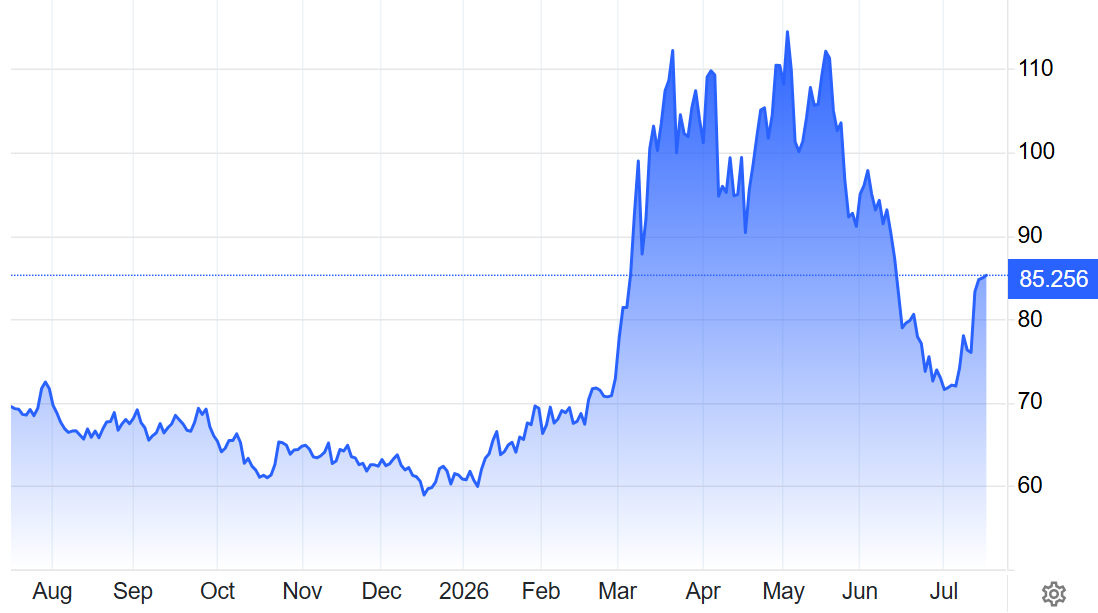 |
Brent oil price movements over the past year. Chart: Trading Economics. |
"As Middle East tensions resurface, buying activity has increased. Despite ongoing mediation efforts by neighboring countries and a low probability of a full-scale conflict, WTI could still reach 85-87 USD, depending on developments," said Hiroyuki Kikukawa, chief strategist at Nissan Securities Investment.
Oil prices this week reached a one-month high as US-Iran tensions escalated again late last week, jeopardizing a ceasefire signed in june. Beyond potentially closing the Hormuz Strait – a route for 20% of global oil and gas before hostilities – Iran could leverage Houthi forces in Yemen to block access to the Red Sea. This would open a new front of confrontation with Washington, threatening two critical global energy waterways.
Goldman Sachs forecasts Brent crude prices could exceed 100 USD per barrel if the recovery of Gulf exports continues to slow. However, prices could also fall to around 60 USD by the end of this year if tensions ease and production recovers faster than expected.
In the US, the Energy Information Administration (EIA) reported that crude oil inventories decreased by 1,7 million barrels last week. This figure was lower than the forecast decrease of 2,6 million barrels.
Ha Thu (Reuters)