On 8/1, US automaker General Motors (GM) announced it would recognize a $7.1 billion charge against earnings in its Q4/2025 financial report. Of this, $6 billion relates to reversing electric vehicle (EV) investments. The remaining $1.1 billion covers restructuring costs for its SAIC General Motors joint venture in Trung Quoc, along with "an additional legal provision."
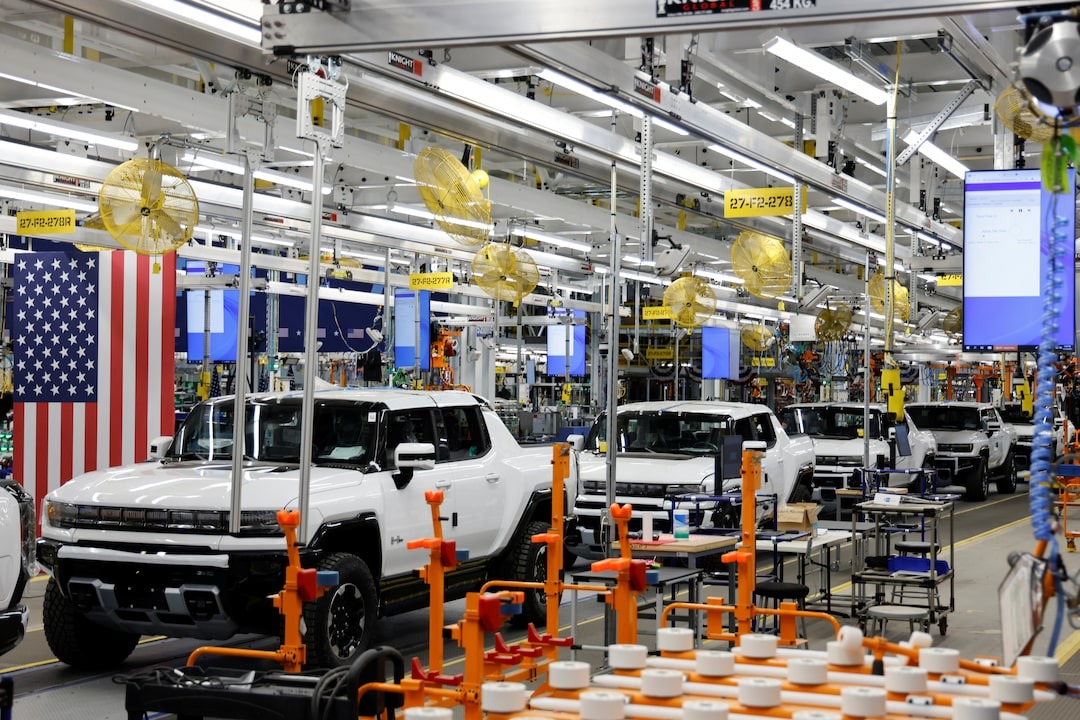 |
An electric Hummer from GM at a factory in Detroit, Michigan. Photo: Reuters
Previously, in Q3/2025, the company also recorded a $1.6 billion charge due to strategic adjustments as EV policies changed dramatically under US President Donald Trump. During former US President Joe Biden's term, GM CEO Mary Barra heavily invested in EV production capacity. In 2021, the company announced a goal for all automobiles and trucks sold by 2035 to be zero-emission.
However, Trump dismissed climate change as "a hoax," subsequently ending many major EV initiatives approved by former President Joe Biden. In addition to canceling tax incentives for EV buyers, the US government also eased emissions regulations.
Barra stated that EVs remain a long-term priority for GM. However, the company must adjust its investments to align with consumer demand. "After certain consumer tax incentives were terminated and the stringency of emissions regulations was relaxed, EV demand in North America began to slow in 2025," GM explained as the reason for its "proactive reduction of EV capacity."
Early last year, John Murphy, an analyst at Haig Partners, warned that automakers heavily investing in EVs might face valuation reductions. Besides GM, Ford also announced mid-last month that it would recognize a $19.5 billion charge over the next few years due to a changing policy outlook. Ford adjusted its EV plans approximately one year earlier than GM.
Ha Thu (according to AFP)