At the end of the 2018 ski season, when Ceüze 2000 resort closed, employees made plans for the next winter. Located in the southern Alps in Hautes-Alpes province, France, this iconic resort had operated since 1935. Ski trail maps were stacked next to a stapler, and employee schedules were pinned to the wall.
However, Ceüze 2000 never reopened. During its demolition late last year, a half-empty water bottle remained on a table, beside a yellowed newspaper dated 8/3/2018. It is one of more than 186 "ghost resorts," abandoned ski facilities across France due to global warming.
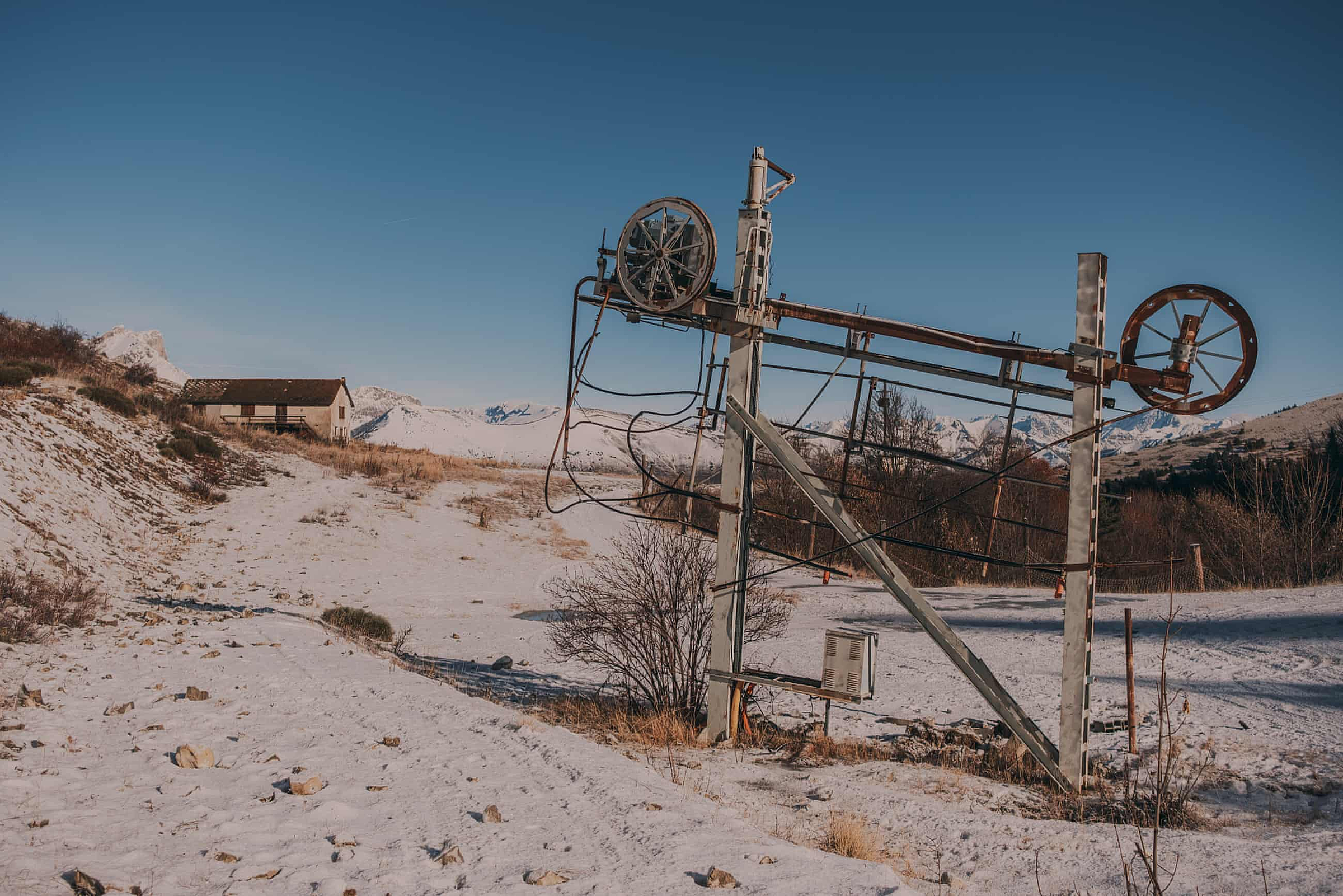 |
The remnants of a ski lift system at Ceüze 2000, Hautes-Alpes province, France, 11/2025. Photo: The Guardian |
This phenomenon not only impacts France's ski economy but also pushes the "snow belt" higher up the Alps. The Alps, Europe's largest and highest mountain range, are central to a winter tourism industry valued at 180 billion euros (210 billion USD).
Europe has over 2,200 ski resorts. A study in the scientific journal Nature Climate Change indicates that more than half of these face a risk of declining snow if the Earth warms by 2 degrees Celsius compared to pre-industrial levels. For high mountain ranges like the Alps, about one-third of resorts are at risk. For lower ranges such as the Pyrenees, the impact could affect up to 89%.
In France, some resort projects, like St-Honore 1500, were abandoned before completion. Even large resorts are struggling to remain viable.
During seven years of considering Ceüze 2000's closure, management tried to find viable operating solutions. For financial efficiency, the resort needed to open for at least three months. In its last winter season, it operated for only one and a half months. The two previous seasons saw no operation due to lack of snow.
Meanwhile, operating costs reached 450,000 euros (526,000 USD) per season. As snow diminished and the ski season shortened, these costs became misaligned with revenue. The decision to close was made to avoid a debt spiral.
Before Ceüze, many resorts in the French Alps, including Alpe du Grand Serre, Grand Puy, and La Sambuy, also closed due to insufficient snow.
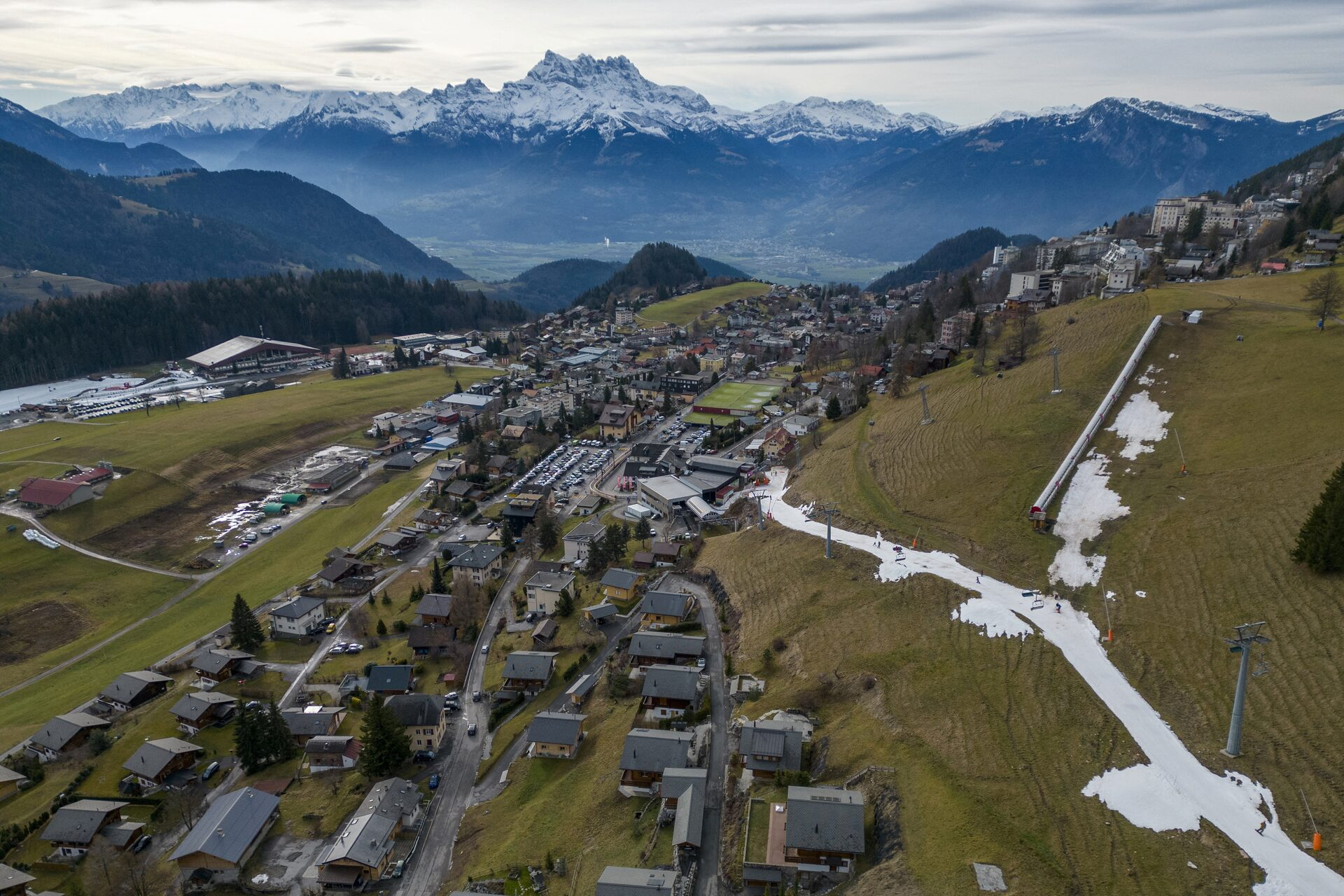 |
A thin artificial ski run created by a warmer-than-usual winter in the Alps at Leysin, Switzerland, 4/1/2023. Photo: Reuters |
Speaking on CNN, Jacques Dalex, a representative for La Sambuy's management, stated that the area typically received snow from early december to late march. However, in 2023, snow fell for only four weeks, with reduced amounts. Rocks and gravel quickly appeared on the slopes. Operating at an annual cost of 80,000 euros while the tourist season was so short proved financially unfeasible.
The scarcity of snow has led many resort managements to invest in artificial snowmaking machines. According to WWF, creating a 30 cm layer of snow on a one hectare slope requires at least one million liters of water. This process consumes significant electricity, increasing greenhouse gas emissions and exacerbating the climate crisis.
According to a 2023 estimate, the electricity needed to supply artificial snow for all resorts in the Alps is approximately 600 GWh, equivalent to the annual consumption of 130,000 households.
For resorts that cease operation, most structures and machinery are left to decompose, impacting the environment. Statistics from the Mountain Wildlife Conservation Association show that over 3,000 structures and 113 ski lifts (with a total length of 63 km) have been abandoned, gradually degrading one of Europe's most pristine wilderness areas.
France has a policy requiring the dismantling of disused ski lifts. However, this policy only applies to lifts installed after 2017. With an average lifespan of 30 years, no lifts are considered expired until 2047.
High costs also deter many management entities from dismantling. For example, the demolition of Ceüze 2000 late last year cost 123,000 euros (nearly 144,000 USD). Ski lifts were transported by helicopter to minimize environmental impact and soil compaction.
The non-profit organization Mountain Wilderness advocates for policies to dismantle old ski infrastructure, allowing nature to reclaim the land. "When building things you believe are permanent, ask yourself 'what remains afterwards?'", said Nicolas Masson, a representative for the organization. He added that humans are finite. Even what we create and consider permanent will someday lose its utility.
Meanwhile, nature is gradually regenerating in these "ghost resorts." On the ski trails that once belonged to Ceüze 2000, wild rose bushes, no longer pruned, are thriving and bearing berries. These berries are an important winter food source for birds, while the thorny stems provide nesting sites in spring.
In summer, orchids bloom on the hillsides. The hills surrounding this area are classified as Natura 2000, meaning they are home to some of the continent's rarest and most protected wildlife. Endangered species like wild boar and European roe deer will benefit, and partridges will find easier refuge as winters become quieter.
"This place is transforming into a forest, though I don't know if it will take 10, 20, or 50 years," Masson said.
Bao Bao (according to The Guardian, Euronews)