According to data from the Customs Department, in the first seven months of the year, Vietnam imported 595,700 tons of meat and meat products, valued at over 1.7 billion USD. This represents an 11.4% increase in quantity and a 32.4% rise in value compared to the same period last year.
Poultry meat and edible by-products accounted for 36.5% of the total imported meat volume, reaching nearly 217,400 tons. Chicken alone comprised over 90% of this category, indicating its dominant position among imported poultry. The import value for this group totaled 221.1 million USD, making up 13% of the overall import turnover.
The import structure reveals that most chicken entering Vietnam is frozen and pre-cut into portions before being distributed to the market. According to the Vietnam Poultry Association (VPA), frozen chicken thighs alone account for approximately 71.5% of the total imported chicken volume.
On average, each kilogram of imported poultry meat and by-products costs approximately 1.02 USD, equivalent to 26,500 Vietnamese dong. This price is nearly 29% lower than the same period last year, while import volume has increased by over 40%.
These low prices are also reflected in the market. A survey of imported food businesses in Ho Chi Minh City indicates that retail prices for imported frozen chicken thighs range from 45,000-55,000 Vietnamese dong per kilogram. This is comparable to or even lower than many vegetables, which typically sell for 45,000-80,000 Vietnamese dong per kilogram. Imported frozen offal, such as hearts and gizzards, is even cheaper, priced at approximately 30,000-35,000 Vietnamese dong per kilogram.
In contrast, domestic industrial chicken parts, including wings, thighs, and breasts, are priced between 70,000-100,000 Vietnamese dong per kilogram. Consequently, imported frozen chicken thighs are 15,000-55,000 Vietnamese dong per kilogram cheaper, representing a 21-55% lower cost compared to domestic industrial chicken parts.
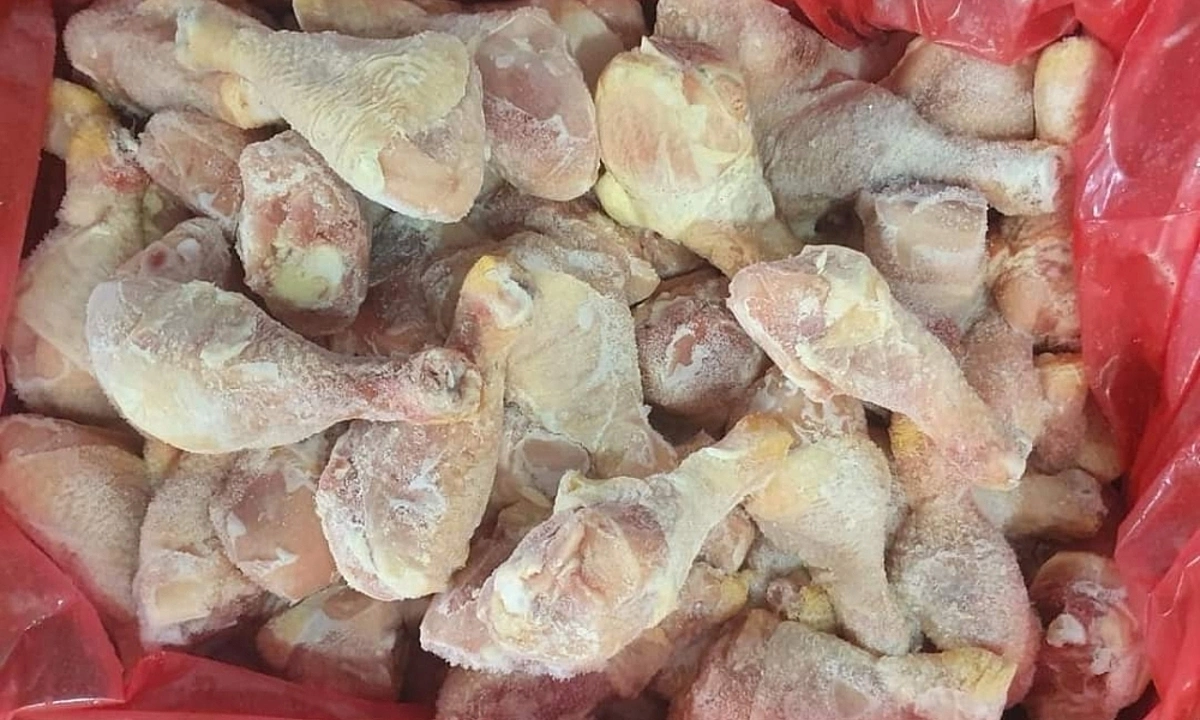 |
Imported chicken thighs are retailed at 50,000 Vietnamese dong per kilogram and wholesaled at 45,000 Vietnamese dong. Photo: Hong Chau |
According to Nguyen Quy Khiem, Vice Chairman and Secretary General of the Vietnam Poultry Association (VPA), the product structure is a primary reason for the low prices of imported chicken. Shipments to Vietnam predominantly consist of thighs, necks, wings, and edible by-products such as hearts and gizzards, rather than the highest-value meat cuts.
In many exporting countries, consumers tend to prefer breast meat, leading companies to sell these portions domestically at higher prices. According to Khiem, breast meat prices in Europe are approximately four times higher than other parts, allowing businesses to largely recoup their costs. Consequently, thighs, necks, wings, and by-products are exported to Vietnam at lower prices.
Beyond product structure, exporting countries also benefit from lower feed costs and large-scale industrial production models that apply advanced technology, thereby reducing overall production expenses. Khiem noted that the cost of producing chicken in countries like the US and Brazil is only about 16,000-20,000 Vietnamese dong per kilogram, which is significantly lower than domestic production costs.
Regarding by-products like hearts and gizzards, Khiem suggested that these also contribute to the low import prices. Such products are less consumed in certain markets, allowing businesses to export them to regions where there is demand, rather than incurring additional processing or disposal costs.
Thi Ha