Mr. Hoang established an advertising company in TP HCM in 2019 but ceased operations a few months later due to a lack of clients. He stated that the company never generated revenue and had no tax debts when checked via the eTax Mobile application.
Similarly, Ms. Ngoc Anh in TP HCM founded a cosmetics distribution company with a charter capital of one billion dong in 2014. She paid the business license fee for the first year but then let the company become dormant as she no longer wished to continue business. The company also did not generate revenue or purchase invoices during this entire period.
Concerned about potential travel bans due to their companies being in status 06 (inactive at the registered address), both individuals consulted tax advisory groups for dissolution procedures and costs. Many others with similar situations also wondered if tax finalization declarations were required and what fees and penalties would apply for company dissolution.
According to the Tax Department's guidance, a business that has not generated revenue and has not used invoices from its establishment until dissolution falls under the regulations for tax finalization declarations and audits. However, businesses still need to review their tax registration status, tax declarations, invoices, business license fees, tax debts, penalties, and other obligations, if any.
Elaborating on this issue, Mr. Le Van Son, Head of Training for the Ho Chi Minh City Tax Consultants and Agents Association and General Director of Kim Thuy Accounting Limited Company, stated that business owners facing status 06 have two options.
If they wish to resume operations, they must submit form 25/DKT to restore their tax identification number, explaining the reason and providing the current office address. If they do not intend to continue business, they must complete procedures to terminate their tax identification number, leading to company dissolution.
"The tax obligations for both options are the same; that is, outstanding tax declarations must still be filed, and any tax debts, late payment charges, and administrative penalties must be settled," Mr. Son said.
Even if a company has been inactive and generated no revenue for many years, tax obligations do not automatically cease. This is because the business did not notify the Department of Planning and Investment (now the Department of Finance) of a temporary suspension of business or dissolution.
To complete the dissolution procedures, a business may need to pay the following amounts:
Arrears of business license fees: The amount of arrears ranges from one to three million dong per year, depending on the charter capital and legal regulations during different periods.
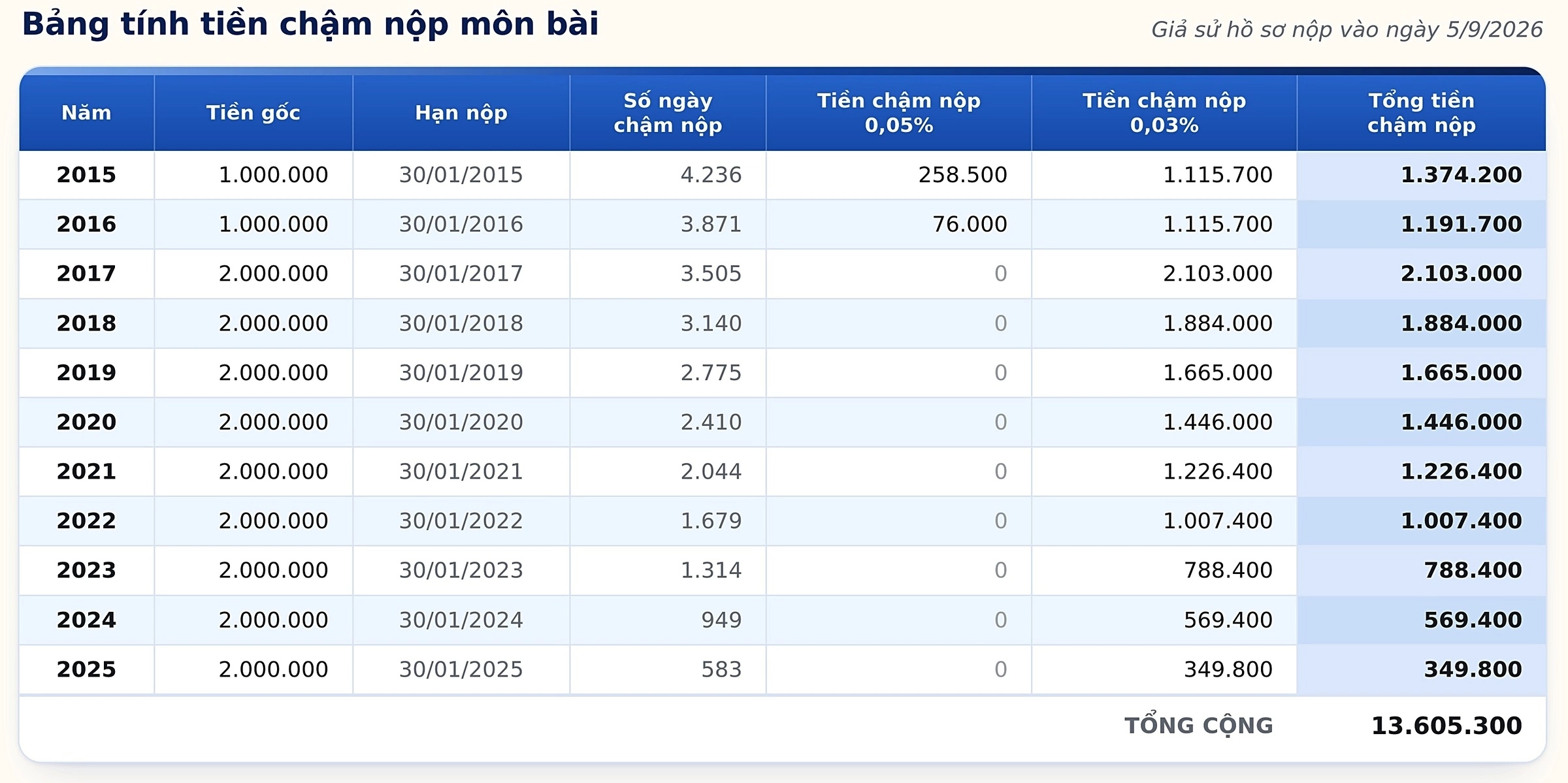
For instance, Ms. Ngoc Anh's company, with a charter capital of one billion dong, would owe one million dong per year in business license fees for the 2015-2016 period and two million dong per year for the 2017-2025 period. From 2026, the tax authority will abolish this fee. Thus, Ms. Anh's company would be retrospectively charged 20 million dong in business license fees.
Late payment charges for business license fees: This is 0.03% per day, calculated on the cumulative late payment amount over the years. Specifically, for Ms. Ngoc Anh's company, the estimated late payment charges for business license fees from 2015 to present amount to approximately 13.6 million dong (as shown in the table below).
 |
Penalties for late submission of tax declarations: Not having sales invoices means no value-added tax (VAT) or corporate income tax (CIT) arises. However, businesses are still obligated to file tax declarations. When a company has been dormant for many years, it will incur administrative penalties for late submission of tax declarations.
According to Mr. Le Van Son, businesses should prepare all declarations for the same tax type and submit them on the same day. In this scenario, the business may only be penalized for one act at the highest penalty rate, rather than for each late declaration. Using this method, a business might pay 15 million dong for monthly/quarterly VAT declarations and 15 million dong for CIT finalization declarations.
If no salaries were paid to employees during the dormant period, the business is not required to submit monthly, quarterly, or annual personal income tax declarations.
Mr. Son emphasized that the total amount a non-revenue business must pay also depends on its tax status before entering status 06, its tax obligations to customs authorities, and amounts due for social insurance, trade union fees, and other liabilities.
If choosing dissolution services through a tax agent, business owners may incur an additional 10-30 million dong. The specific amount depends on the volume of documents, the status of document storage, and the number of years that require explanation to the tax authority.
The process and required documents for dissolving a non-revenue company are similar to those for dissolving a company that has generated revenue. Business owners must issue a dissolution decision, address obligations to employees, creditors, and related parties, and submit dissolution documents to the Business Registration Authority. Subsequently, all outstanding tax declarations, tax debts, administrative penalties, and late payment charges must be settled to proceed with the tax identification number closure procedures.
The duration for closing a tax identification number depends on the completeness of the documents and how the tax authority assesses the specific risk for each business.
However, Mr. Son noted that the tax identification number closure for a non-revenue business might be shorter because the process is handled by the enterprise management department at the tax authority, rather than being transferred to the audit department. Additionally, non-revenue businesses do not need to reconcile output invoices, tax declarations, and accounts receivable tracking tables.
This expert recommends that business owners complete dissolution procedures as soon as possible if they no longer intend to conduct business. Continuing to let a company remain dormant, even without generating revenue, will increase tax declaration obligations and could lead to the legal representative of the business being temporarily banned from leaving the country.
Phuong Dong