The US Bureau of Labor Statistics announced that the consumer price index (CPI) for June rose 3.5% compared to June 2025, a decrease from 4.2% in May. Excluding food and energy prices, the core CPI increased 2.6% year-on-year, down from 2.9% in May. Month-over-month, the core CPI remained unchanged from May to June.
Grocery food prices in June saw a modest 0.2% increase from May and were 2.7% higher year-on-year. Meanwhile, apartment rental costs cooled, rising only 0.1% for the month and 2.8% over the past year.
The range of items with moderating prices last month was broader than economists expected, with electricity and apparel prices seeing slight monthly declines, though still higher year-on-year. According to investors, the positive CPI data may alleviate concerns at the US Federal Reserve (Fed) that inflation could become more persistent.
Based on Fed interest rate futures trading at CME Group, traders now estimate a roughly 10% chance of the Fed raising interest rates by 0.25 percentage point at its 28-29/7 meeting. This marks a significant drop from 35% before the June CPI report was released.
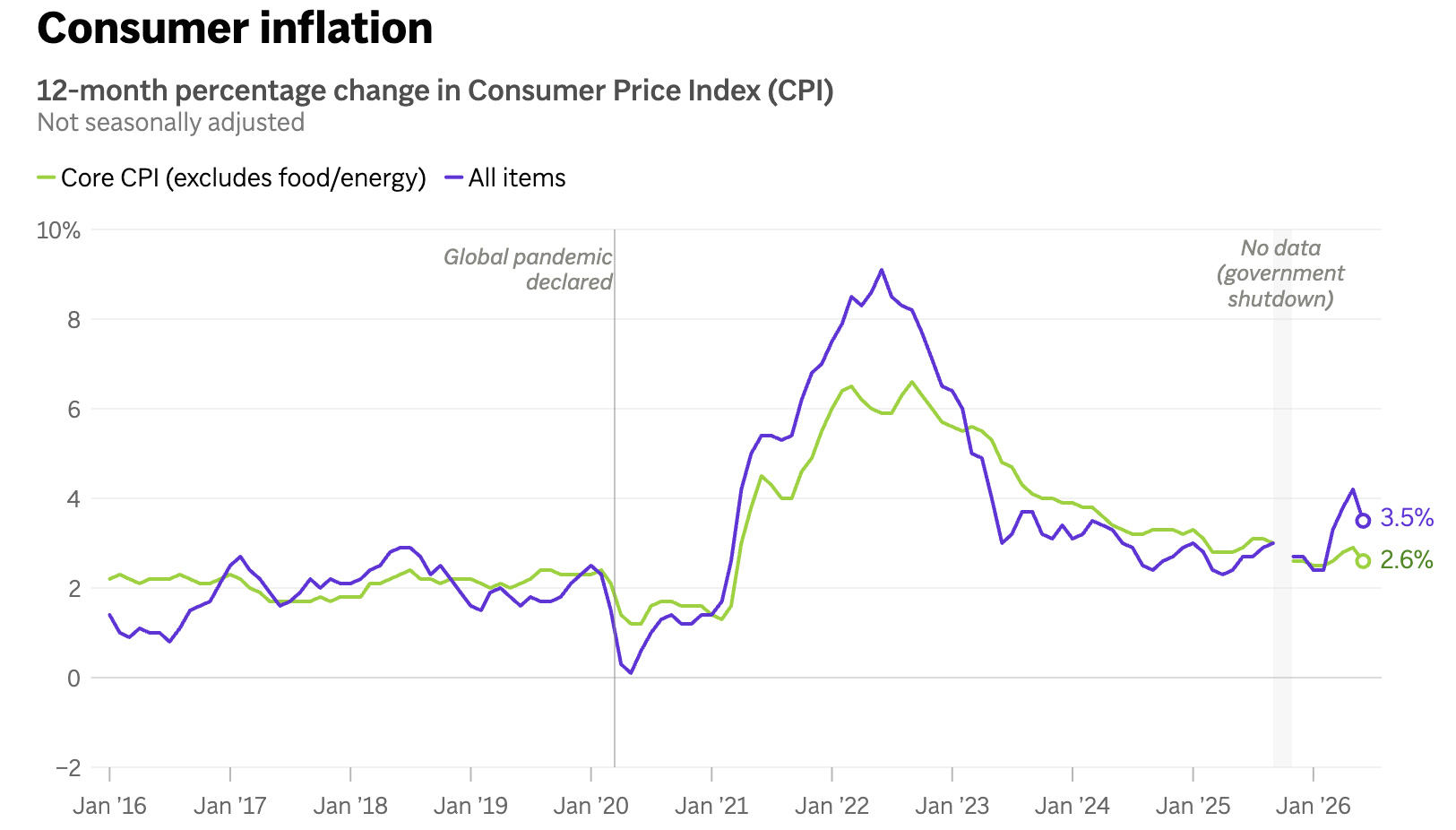 |
The US consumer price index (CPI) over the past 10 years. Purple represents CPI, and green represents core CPI. Graphics: AP
Market expectations for a Fed rate hike at the 15-16/9 meeting are now around 60%, down from over 90% prior to this data. Fed Chairman Kevin Warsh has repeatedly emphasized the goal of bringing inflation back to the 2% target but has not signaled specific next steps.
He is scheduled to begin two days of congressional testimony on the morning of 14/7. In prepared remarks sent to the House Financial Services Committee, he affirmed "no tolerance" for high inflation and pledged to make this situation "a thing of the past".
On 13/7, before the CPI data release, Fed Governor Christopher Waller commented that rate hikes might be necessary "in the near future" if core inflation, measured by core CPI, remained high. He stated that several more months of cooling inflation would be needed before the Fed could be comfortable not raising rates.
Many Fed officials believe that massive investments in artificial intelligence (AI) infrastructure could also fuel inflation by driving up prices for memory chips, other semiconductors, and electricity.
Additionally, gasoline prices, after falling nearly 20% from their peak in late May, rebounded last week. According to the American Automobile Association (AAA), the national average gasoline price on 14/7 was 3.86 USD per gallon (3.78 liters), 6 cents higher than a week ago, but still below 4.09 USD a month ago.
About half of the 19 members of the Federal Open Market Committee (FOMC) believe an increase in the benchmark interest rate is needed before year-end, while nearly half of the remaining members predict the Fed will maintain or even cut rates.
Analysts at Capital Economics suggest that the question is not whether the Fed will raise rates, but when. "In our view, the wave of AI investments, coupled with signs of recovering consumer demand, will continue to keep core inflation above the target level," the experts noted.
Phien An (according to Reuters, AP)