Since early March, the stock market has seen significant fluctuations, leading to an increase in insider transactions by business leaders. Le Hai Doan, a member of Vinasun's board of directors, registered to buy nearly 4,9 million VNS shares between 8/4 and 7/5 to increase his ownership. If completed, Doan's stake is expected to rise to about 13,6% of the charter capital.
At Taseco Land, Le Duc Long, an independent member of the board of directors, also registered to buy an additional 155.000 TAL shares from 13/4 to 12/5 to increase his personal holdings.
After successfully acquiring 5 million shares in mid-March, Doan Nguyen Duc (known as "Bau Duc"), chairman of Hoang Anh Gia Lai's board of directors, further registered to buy 4 million HAG shares between 26/3 and 24/4. The Hoang Anh Gia Lai chairman stated that his continuous purchases aim to increase his ownership stake as the company's financial situation has clearly improved. Last year, the company reported revenue of 7.440 billion VND, an increase of nearly 29% compared to 2024. After-tax profit reached 2.243 billion VND, doubling the same period. Additionally, the debt-to-equity ratio decreased from over 2 times to 0,86 times, and debt-to-total assets stood at about 0,46 times.
Insider transaction reports indicate that many business leaders are acquiring more shares to increase their holdings amidst market volatility. Middle East conflicts and rising input costs have led to a decline in many stock prices. However, the positive business outlook for some companies has prompted leaders to increase their ownership stakes.
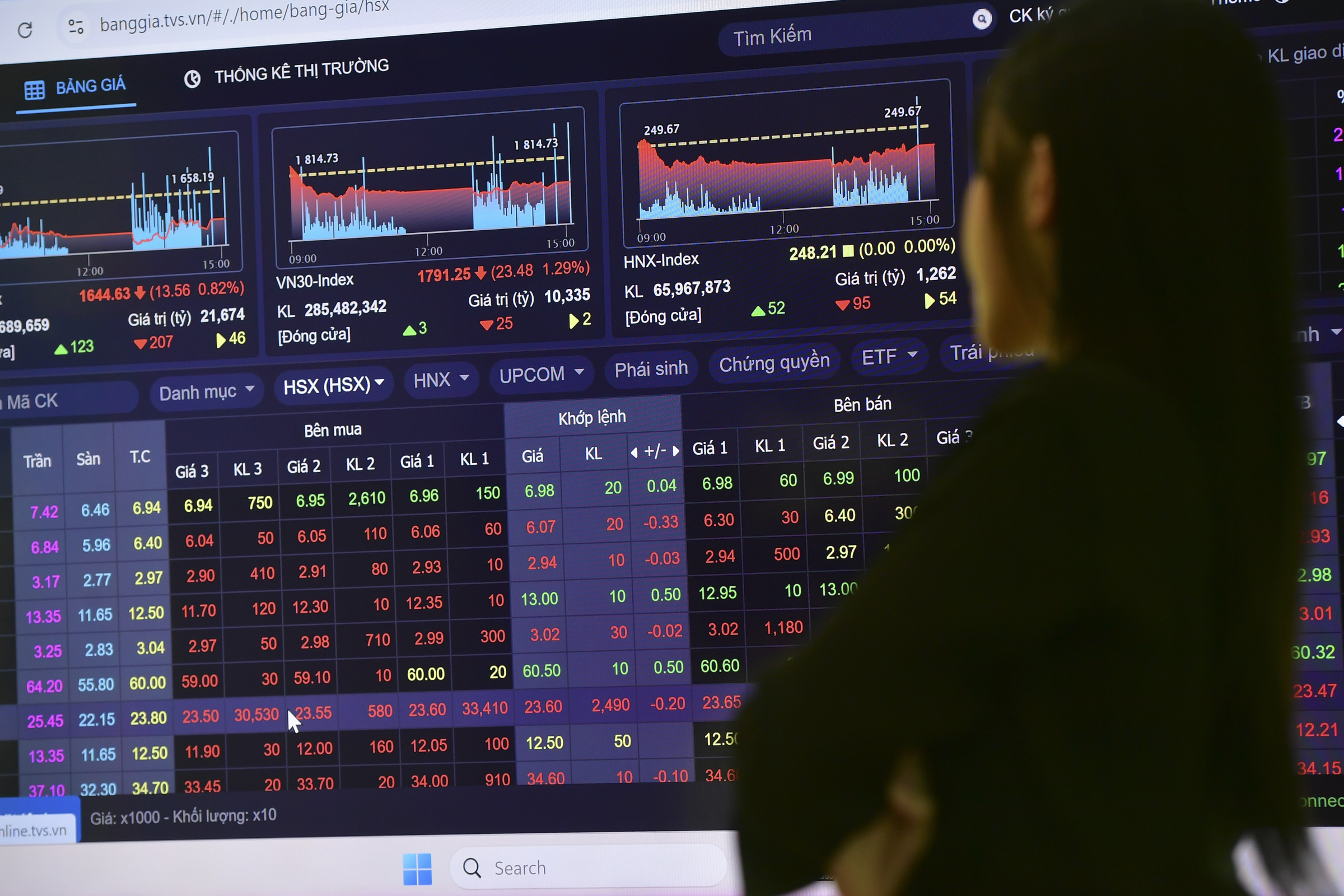 |
Investors monitor the stock market at a company in Ho Chi Minh City. Photo: Thanh Tung |
Beyond increasing ownership, many business leaders are also taking the opportunity to sell shares to restructure their portfolios. For example, Pham Quang Khanh, a member of AAV Group's board of directors, registered to sell 15 million AAV shares from 9/4 to 8/5, significantly reducing his ownership stake from over 23,5% to about 1,8% of the charter capital.
Concurrently, Kim Nguu Consulting Company Limited, an entity linked to Vinasun's leadership, registered to sell all of its more than 8,29 million VNS shares between 7/4 and 5/5 to restructure its portfolio.
The divestment by business leaders is largely driven by personal financial needs. These transactions also reflect a trend of portfolio adjustment amidst a competitive and volatile market.
Securities companies assess that the market is currently retesting supply and demand after a recovery phase. During the week of 6-10/4, the VN-Index rose 65,96 points to 1.750 points, but experienced significant fluctuations as profit-taking pressure increased at higher price levels. Liquidity on HoSE averaged about 24.300 billion VND per session, a slight decrease from the previous week, reflecting continued caution in cash flow.
According to Bao Viet Securities (BVSC), the VN-Index still has room to grow, with a target range around 1.770-1.785 points if it maintains its accumulation base. Meanwhile, SSI Securities believes the current developments lean towards a short-term rebalancing state, as selling pressure increases at high price levels. Viet Capital Securities (VCSC) suggests the index is likely to continue fluctuating within a narrow range with alternating ups and downs.
Nevertheless, Vietnam's stock market is highly regarded for its prospects, especially after its upgrade from a frontier market to a secondary emerging market from 21/9. This upgrade helps the market attract more large-scale international capital. Some securities companies estimate about 6-8 billion USD in foreign capital flowing into Vietnam, while HSBC Global Investment Research suggests the figure could reach 10,4 billion USD in the most optimistic scenario. These estimates include both active and passive fund capital.
Thi Ha