In late February, creative advertising firm Project Pluto opened its office in Vuon Lai ward, Ho Chi Minh City, after nearly four years of remote work. "Just two weeks after returning to the office, gasoline prices surged. We decided to let our staff work from home again," a company representative stated.
As the Middle East conflict entered its fifth week, coupled with the closure of the Strait of Hormuz, energy prices escalated, putting upward pressure on the cost of goods, services, and consumer spending. Effective 2/4 at 23h30, the price of RON 95-III gasoline and diesel rose to 25,150 VND and 40,820 VND per liter, respectively. This represents an increase of nearly 25% for gasoline and more than double for diesel compared to late February.
Faced with unpredictable fuel price fluctuations, the Prime Minister urged agencies, businesses, and citizens to implement energy-saving solutions. The Ministry of Industry and Trade encouraged companies to allow employees to work remotely whenever possible to reduce travel and transportation demands.
Several companies have adopted remote work policies to mitigate rising costs. On 10/3, when gasoline prices exceeded 29,000 VND, May tinh Thanh Giong Company decided to allow 20% of its staff to work from home, reducing commutes from mid-March. Departments eligible for remote work include research and development, business, and support. "This is one of many employee support solutions implemented by the Board of Directors immediately after the Middle East conflict erupted," said Lai Hoang Duong, Research and Development Director at May tinh Thanh Giong Company.
Since the middle of last week, Sacombank has initiated flexible work arrangements for its headquarters staff. Depending on job nature, employees can choose to work in the office or remotely, provided they commit to productivity and adhere to information security regulations. Similarly, 5S Media, a media and advertising company, implemented a weekly online work policy for all staff every Wednesday, starting 1/4. Hang Pham, Director of 5S Media, stated that if productivity is maintained, the company would sustain this policy long-term, rather than just as a response to rising gasoline prices.
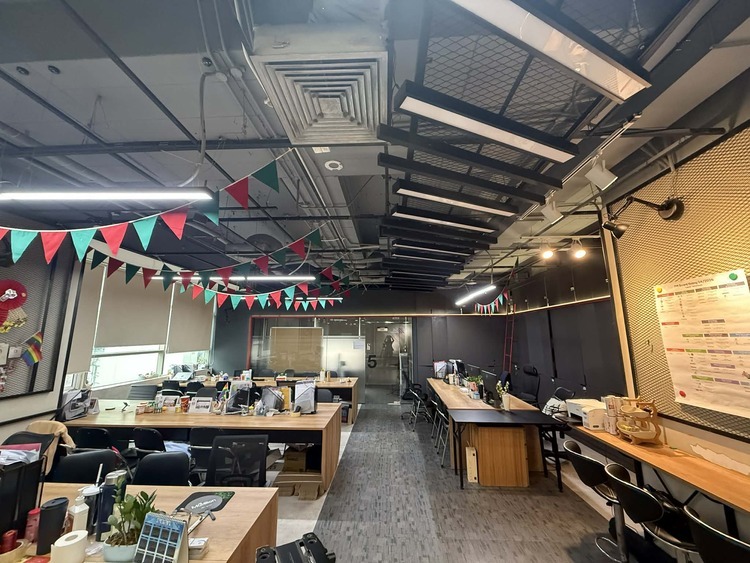 |
5S Media's office on the first online work day, 1/4 (left), and a regular work day, 2/4 (right). *Photo: Hang Pham*
Project Pluto, with years of remote work experience, noted that in the creative field, work performance is not dependent on "staff being in the same location." Beyond saving employees' commuting fuel costs, remote work also helps reduce office electricity consumption and optimizes operating expenses, including utilities and facilities. The work-from-home model is also being applied in manufacturing businesses for certain positions. Viet Uc Seafood Group allows its back-office staff, who constitute about one-third of the company's workforce, to work flexibly. "We cannot implement a comprehensive work-from-home policy, but we are compelled to re-evaluate our work organization to reduce operational pressure as energy costs rise," a Viet Uc representative stated.
As fuel prices soared, many businesses also provided fuel cost support to employees. VNG's headquarters are located in Tan Thuan Export Processing Zone, far from central Ho Chi Minh City. Tran Xuan Ngoc Thao, Director of Human Resources and Communications, noted that fluctuating fuel prices directly impact employees' daily commuting costs. Therefore, VNG supports 300,000 VND in fuel costs per employee per month.
Outdoor advertising company Unique supports 500,000 VND per person per month, including probationary employees. May tinh Thanh Giong also covers 10% of employees' fuel bills. For delivery and technical staff specifically, they receive 100,000 VND for every 100 km traveled. "Transportation and travel costs have increased significantly. Without responsive measures, operating costs will escalate, affecting product and service prices," Duong added. This support will be maintained by the company until the fuel market stabilizes.
Beyond direct subsidies, some businesses are exploring long-term strategies to optimize costs and reduce reliance on fossil fuels. These include optimizing delivery routes, increasing the use of fuel-efficient vehicles, installing solar panels to save energy costs, and considering green mobility solutions.
Many organizations are also preparing Business Continuity Plans (BCP) to avoid operational disruptions. VNG has pre-planned flexible and remote work options, ready to activate when needed. Viet Uc estimates that if energy prices push operating costs beyond projections, they will activate their BCP, along with measures to reduce travel and increase the proportion of employees working remotely.
In a late March report, the Asian Development Bank (ADB) projected that developing nations in Southeast Asia, including Vietnam, could see a 0,6-2,3% reduction in gross domestic product (GDP) and an inflation increase of up to 3% under conflict scenarios. The ADB recommended that countries control energy demand through solutions like encouraging remote or flexible work and organizing car-free days in urban areas to help reduce fuel consumption. Faced with surging energy prices, the International Energy Agency (IEA) also advised people to carpool, use public transportation, and limit air travel.
Thuy Truong - Quynh Trang