Global crude oil prices surged at the opening of the 30/3 trading session after Iran warned of a potential US troop deployment. WTI crude is currently up 3,1% to 102 USD per barrel, and Brent crude increased 3% to 116 USD.
On 29/3, Iranian Parliament Speaker Mohammad Bagher Ghalibaf accused Washington of secretly preparing a ground attack plan, stating that Tehran awaits the arrival of US troops.
This warning followed US President Donald Trump's assertion that "negotiations are ongoing," as he extended an ultimatum for Iran to reopen the Hormuz Strait.
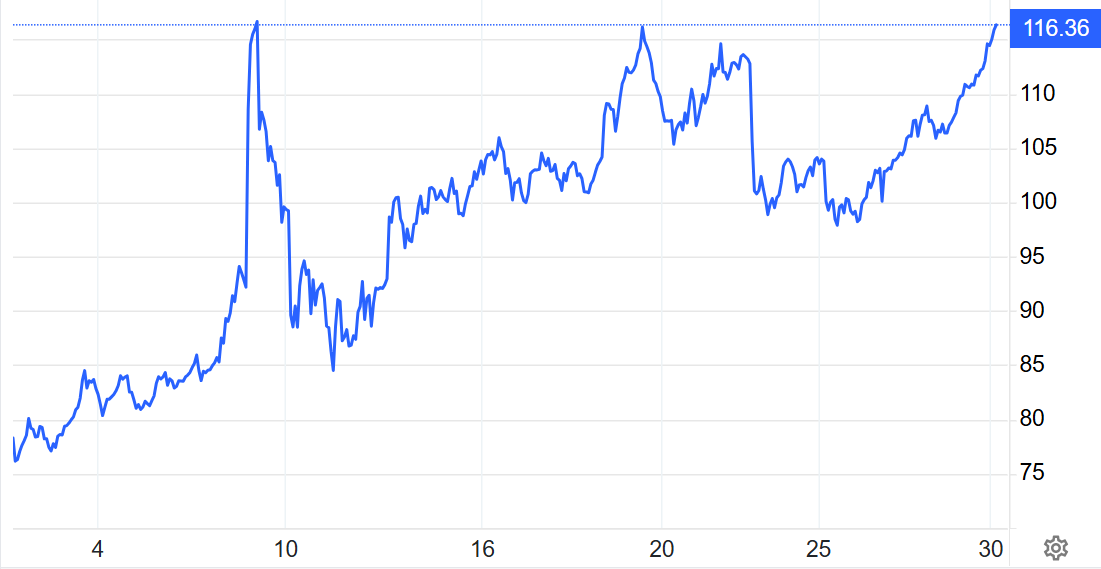 |
Brent price movements over the past month. Chart: Trading Economics |
In Yemen, Iran-backed Houthi forces attacked Israel on 28/3, increasing risks to regional oil shipping. The group could blockade the Bab al-Mandab Strait, a vital route connecting the Red Sea to global shipping lanes.
The conflict in the Middle East has lasted over one month, spreading across the region, sending energy prices soaring and fueling inflation fears. Since the conflict began, Brent and WTI prices have risen by approximately 50%. The conflict has reduced global oil supply by 11 million barrels per day, with the Hormuz Strait under Iranian control.
On Asian stock markets, Japan's Nikkei 225 index is currently down 4%. South Korea's Kospi also lost over 5%. Australia's S&P/ASX 200 fell 1,5%. Compared to other regions, Asia is more heavily reliant on energy supplies from the Middle East.
Futures for US and Hong Kong (China) stock markets are also trending downward. Last weekend, all three key Wall Street indices declined for the second consecutive session, reaching their lowest point since 8/2025. The DJIA and S&P 500 each lost 1,7%, while the Nasdaq Composite fell 2,1%.
"Stock markets remain closely tied to oil prices. High oil prices will push stock prices lower," stated Glen Smith, Chief Investment Officer at GDS Wealth Management.
Global gold prices also turned lower after rising in the previous weekend's session. Each ounce is currently down 60 USD to 4.433 USD.
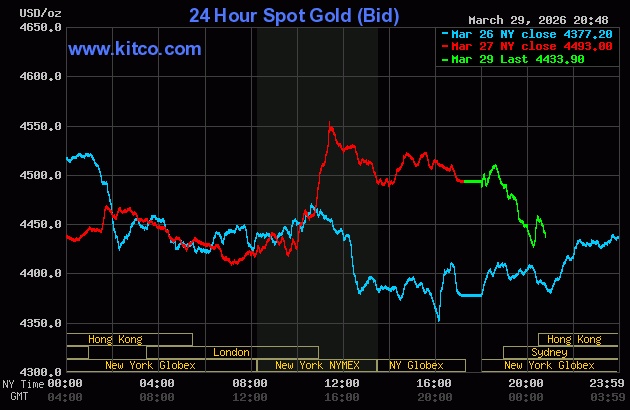 |
Global gold prices fell during the morning session on 30/3 (Hanoi time). Chart: Kitco |
The Middle East conflict has raised inflation concerns. This has led investors to lower expectations for the US Federal Reserve (Fed) to cut interest rates. High interest rates make gold less attractive, as the precious metal does not offer fixed returns.
Nevertheless, Commerzbank still raised its year-end gold price forecast from 4.900 USD to 5.000 USD. They believe the current decline will not be prolonged.
Ha Thu (according to CNBC, CNN)