According to the environmental impact assessment (EIA) report currently open for public comment, the Olympic Sports Urban Area project by Vingroup is a national key initiative. It aligns with the vision of establishing an Olympic urban center and a regional and international sports hub.
The project encompasses a research area of 16,000 ha, with the urban zone covering approximately 9,171 ha. Its implementation spans 12 communes and wards in Hanoi, surrounded by key transportation arteries such as national highways 1, 21B, 21C, the Phap Van - Cau Gie expressway, belt road 3,5, and belt road 4.
The investor states that the current land use in the project area is primarily agricultural production land, accounting for 54%. Rural residential land makes up nearly 17%, and aquaculture land is 11%. The project requires converting over 8,700 ha of land currently used for two or more rice crops.
The project is divided into four main zones. Zone A, spanning 3,280 ha and designed for a population of 310,000, will develop an urban area featuring high-rise mixed-use complexes integrated with the transit-oriented development (TOD) model. This zone will include shopping and entertainment complexes, as well as a system of hotels and resorts.
Zone B, covering 4,560 ha with a planned population of 285,000, will focus on developing a sports urban area and service urban area centered around an international-standard stadium. To attract international events, the investor will construct major facilities in this zone, including the Lac Viet stadium (135,000 seats), the Global Aquatic Arena (40,000 seats), and a sports tower.
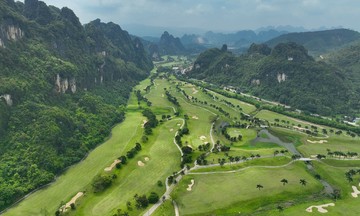
This zone will also feature an eSports mega-arena with tens of thousands of seats and a golf complex comprising two 18-hole courses designed for professional tournaments.
Zone C, measuring 4,498 ha and accommodating 280,000 people, will concentrate on developing a service and resort urban area integrated with the ecological space of the Red River. This includes an international athletes' village with thousands of apartments and villas, a system of hotels and resorts, and ecological residential areas within the urban core.
Zone D, spanning 3,743 ha with a population of 275,000, is slated for a multi-functional landscape axis. This will include a golf service and commercial center and low-rise housing.
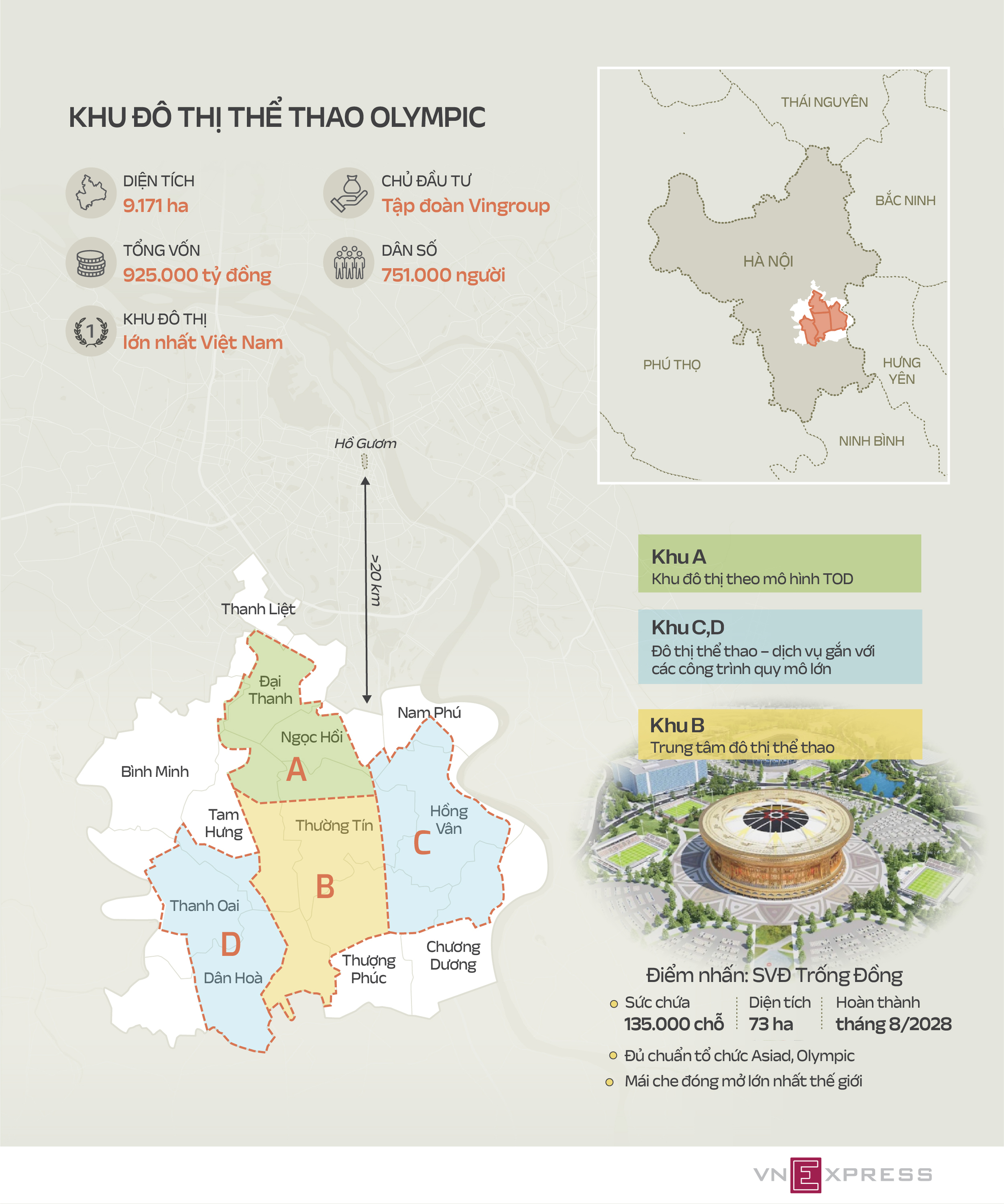 |
Scale of the Olympic sports urban area. Graphics: Ta Lu |
The investor announced plans to allocate independent social housing land with synchronized infrastructure. The specific social housing land within commercial housing projects will be determined during their implementation.
The total investment for the project is approximately 350,000 billion VND, which includes compensation, site clearance, and resettlement support costs. By 2030, the investor expects to complete the Ngoc Hoi station complex and the key sports facilities. From 2030 to 2040, the enterprise will continue to complete residential groups within the urban area and construct hospitals and a sports medical center. The entire urban area is projected for completion after 2040.
Globally, a sports urban area is defined as a complex of international-standard sports facilities, such as stadiums, swimming pools, and training academies, combined with residential and urban areas. These complexes also feature commercial, entertainment, and tourism facilities. Notable examples include Dubai Sports City (UAE) with a scale of 5,000 ha, Qatar Sports City - Aspire Zone, and Melbourne & Olympic Park (Australia).
Currently, land prices in the southern region of Hanoi are lower than in the western and eastern parts, due to fewer large-scale projects and urban areas. The available land fund in the south is also more extensive compared to other areas in the capital.
Ngoc Diem