Recently, a US Army soldier faced charges for betting on the capture of Venezuelan President Nicolas Maduro. Weeks before Maduro's apprehension, the soldier used classified information to place bets on the Polymarket platform, wagering that US forces would enter Venezuela and Maduro would be ousted. This resulted in a 400,000 USD win, highlighting a unique scandal within prediction markets.
Polymarket, the world's largest decentralized prediction market built on blockchain, allows users to wager cryptocurrency on the outcomes of political, sports, or economic events. This platform and the broader prediction market sector are profoundly influencing investor sentiment, gradually becoming a key "compass" that global financial circles consult before making decisions.
However, a recent study suggests a more concerning trend: a small group of "informed" traders are becoming the primary price setters in the market, while the majority of investors incur losses.
This study, part of an academic manuscript by researchers from London Business School and Yale, aimed to test the industry's core assumption that prediction markets function efficiently due to "the wisdom of the crowd." By analyzing all transactions on Polymarket from 2023 to 2025, the authors concluded that it is not the crowd, but rather a small group of well-informed traders, who drive prices.
Their analysis covered 1.72 million accounts with a total trading volume of 13.76 billion USD. They found that only about 3% of traders were truly knowledgeable, placing correct orders and thus determining accurate prices. This group consistently made precise predictions and acted swiftly.
Conversely, the vast majority, the remaining 97%, did not achieve such accuracy. While they contributed liquidity and trading volume to the market, they were, on the whole, in a losing position.
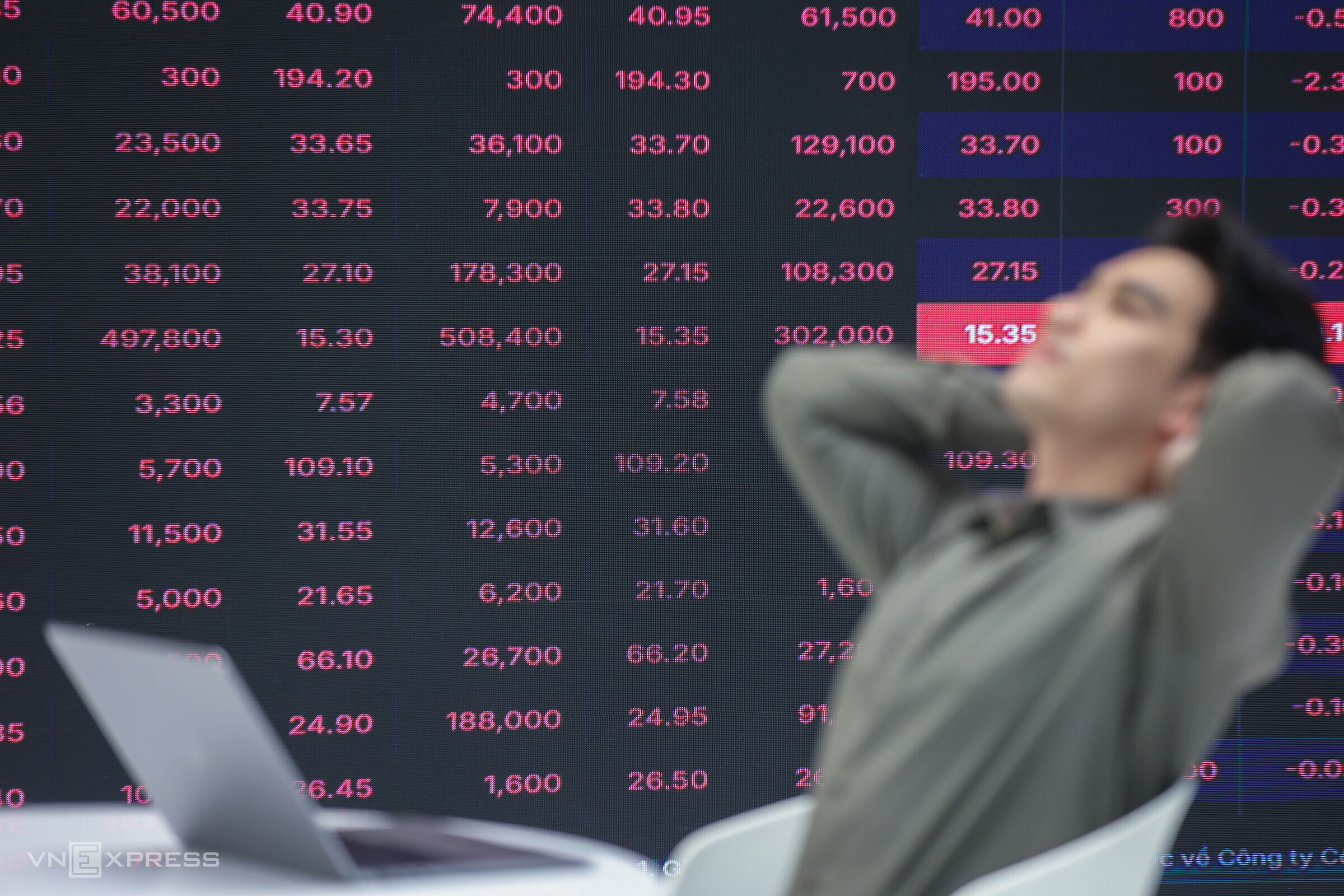 |
Investors monitor the market at a securities company office in Ho Chi Minh City. Photo: Quynh Tran |
A crucial challenge lies in distinguishing between skill and luck. With over one million participants, it is plausible that many significant wins occur purely by chance.
To isolate the element of luck, the researchers re-ran each transaction 10,000 times, keeping all factors constant except the trading direction. In this simulation, the decision to buy or sell was determined by a coin flip. This created a benchmark: if actual results consistently surpassed the "coin flip" model, it indicated skill; otherwise, it pointed to luck.
The results showed that among the biggest winners by absolute profit, only about 12% consistently outperformed this benchmark. Many winners were simply fortunate, as approximately 60% of them would have ended up losing under different circumstances.
Nevertheless, the group of skilled traders plays a vital role in enhancing market accuracy. When their trading proportion increases, prices often move closer to the correct outcome, particularly as an event's time approaches. These traders also react fastest to new information, such as announcements from the US Federal Reserve or corporate earnings reports, while most other traders show no consistent reaction.
However, this informational advantage also poses a significant problem: what happens when such information is not public or is not permitted for use? Both Polymarket and Kalshi prohibit trading based on insider information, yet the study indicates that this risk is real.
An example highlighted is the US operation to capture the Venezuelan president in January. Before the event, three new accounts placed substantial bets on Maduro's overthrow when the market probability was only 10%. These accounts executed very large orders before prices could react. When the event occurred, they collectively earned over 630,000 USD. Subsequently, two of these accounts ceased trading entirely, and the remaining one became almost inactive. While there is no evidence of wrongdoing, this case is notable.
Insider trading, if it occurs, has a far stronger impact on prices than regular trading, potentially 7 to 12 times greater in influence. However, such instances are rare and confined to specific events. Most of the time, market accuracy continues to rely on skilled traders who consistently make better predictions than the majority.
The study's conclusion challenges the widespread belief that prediction markets operate efficiently due to collective intelligence. In reality, what truly matters is not what the majority thinks, but who among them possesses genuine information and understanding.
Tieu Gu (according to CoinDesk)