Vingroup, the second-largest shareholder of VinSpace Joint Stock Company, outlined this plan in its 2025 annual report.
In addition to manufacturing and launching satellites, Pham Nhat Vuong's company is also building clean room facilities, testing equipment, and ground station systems to ensure the project stays on schedule.
VinSpace expects to collaborate with domestic and international partners to research and develop an aerospace ecosystem. They also aim to commercialize telecommunications and remote sensing services.
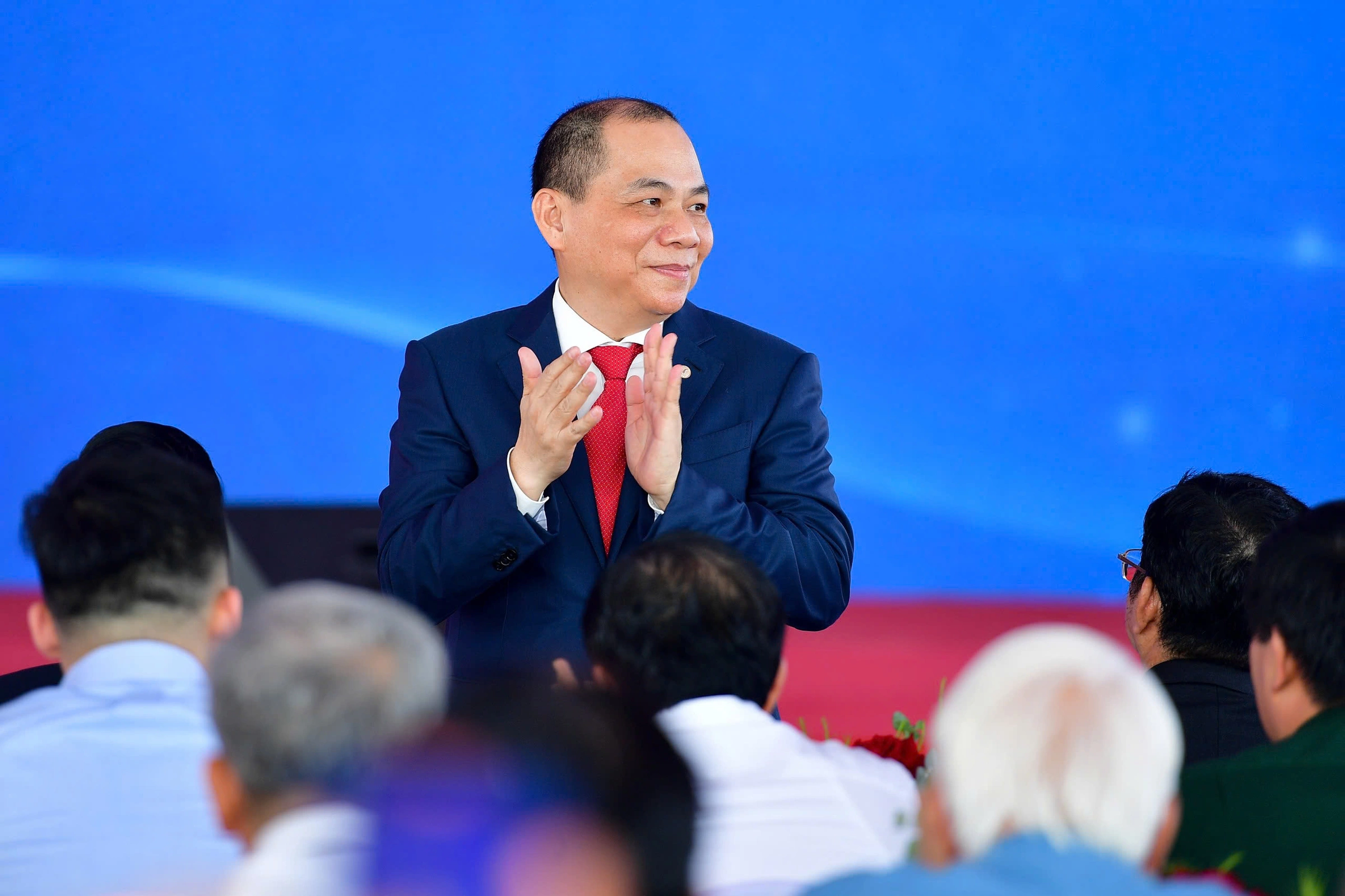 |
Pham Nhat Vuong, Chairman of Vingroup, at the groundbreaking ceremony for the Can Gio coastal urban area project, 4/2025. Photo: Thanh Tung |
Pham Nhat Vuong, Chairman of Vingroup, at the groundbreaking ceremony for the Can Gio coastal urban area project, 4/2025. Photo: Thanh Tung
Prior to VinSpace, the Vietnam Space Center was the only domestic entity to successfully build microsatellites, launched into orbit in 2013 and 2021. These satellites can be used for imaging, observing Earth's surface, supporting telecommunications data transmission, and scientific research.
Pham Nhat Vuong established VinSpace on 3/11, with a charter capital of 300 billion dong. The company operates in six sectors, notably aircraft manufacturing, spacecraft, telecommunication satellites, and air cargo transport. Billionaire Pham Nhat Vuong currently holds 71% of VinSpace's capital.
Vingroup is the company's second-largest shareholder, owning 19% of the shares. The remaining capital belongs to Pham Nhat Quan Anh and Pham Nhat Minh Hoang, Pham Nhat Vuong's two children.
Beyond VinSpace, Vingroup's ecosystem includes several technology companies: VinRobotics (industrial robot manufacturing), VinSmart Future (software), VinSOC, VCSS (cybersecurity), VinDynamics (humanoid robot manufacturing), and VinMotion.
Before investing in the aerospace industry, Vingroup ventured into air transport with the Vinpearl Air project in 2019. However, they withdrew from this sector in 2020.
Trong Hieu