On 6/1, General Secretary To Lam, on behalf of the Politburo, signed Resolution 79 on the development of the state economy.
According to the Politburo's guiding view, the state economy maintains a dominant role in the national economy. It serves as an important resource for the State to ensure macroeconomic stability, guide development, and intervene when necessary. However, this sector is also equal before the law with other economic sectors, engaging in healthy cooperation and competition.
Furthermore, state economic resources must be managed and utilized according to market principles, with full accounting, preventing losses and waste. This sector needs to lead in innovation, digital transformation, green transition, and guide key industries and sectors.
The state economy comprises resources held, managed, and controlled by the State, such as: land, natural resources, infrastructure, the budget, national reserves, extra-budgetary financial funds, state-owned enterprises and credit institutions, state capital in enterprises, and public service units.
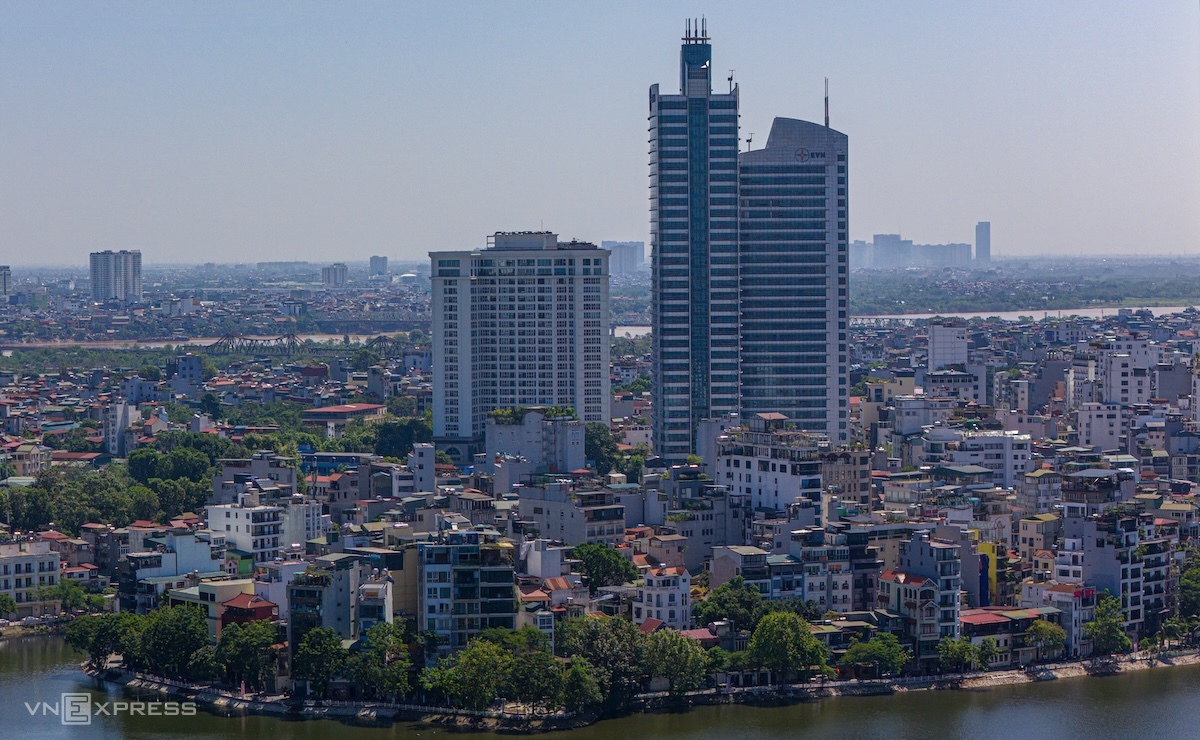 |
Building of Vietnam Electricity (EVN). *Photo: Giang Huy* |
After nearly 40 years of Doi Moi (Renovation), this sector continues to play a guiding, leading, and regulatory role in the economy. However, according to the Politburo, policies on the state economy have been slow to innovate. The management, exploitation, and utilization of many State resources and assets have not been truly effective. State-owned enterprises operate below their potential, given their position and resources, and their international competitiveness is limited. Some persistent issues and obstacles have not been addressed promptly, leading to waste and losses.
The main reasons stem from an incomplete understanding of the state economy's role in a market mechanism, inconsistent legal frameworks, and weak enforcement discipline. Additionally, governance capacity is limited, and the accountability of leaders is not high.
Vietnam aims to become a developing country with modern industry and upper-middle income by 2030, and a developed, high-income country by 2045. Accordingly, the state economy needs to enhance its efficiency, promoting its dominant, leading, and guiding role in the economy.
By 2030, the Politburo aims for 50 state-owned enterprises to be among the 500 largest businesses in Southeast Asia, and one to three enterprises in the top 500 globally. Vietnam will have at least three state-owned commercial banks among the 100 largest banks in Asia. Furthermore, public service units will continue to streamline operations, promoting autonomy and the socialization of public services.
By 2045, the state economy will become a solid foundation ensuring the economy's self-reliance and resilience, working with other sectors to achieve the goal of making Vietnam a developed, high-income country. During this phase, national reserves will reach 2% of GDP, with approximately 60 state-owned enterprises among the 500 largest businesses in Southeast Asia.
To achieve these goals, the Politburo calls for renewing leadership thinking, improving synchronous and transparent legislation, and removing institutional bottlenecks. The administration must strictly enforce laws, enhance discipline and order, in line with international commitments. At the same time, the state economy needs a clear distinction between its political, non-profit functions and its business activities.
The Resolution emphasizes that the State will create a fair competitive environment for all economic sectors in exploiting and utilizing national resources, encouraging public-private partnerships. Concurrently, the administration will continue to promote administrative procedure reform, reduce administrative intervention, shift strongly from pre-inspection to post-inspection, and improve human resource quality, ensuring commensurate incomes in line with the labor market.
The Politburo requests the completion of national databases, increased supervision, and evaluation of the efficiency of state capital and asset utilization. Management agencies need to end overlapping inspections and audits, strictly punish violations, recover maximum lost assets, and accelerate the resolution of stagnant projects to unlock resources.
By the end of 2024, the total assets of 671 state-owned enterprises (473 enterprises 100% State-owned and 198 units over 50% State-owned) reached over 5.6 quadrillion VND, a 45% increase from the previous year. These enterprises achieved total revenues of nearly 3.3 quadrillion VND, up 24%. Pre-tax profits were nearly 227.5 trillion VND, an 8% increase. They contributed nearly 400 trillion VND to the State budget, up 9%.
By Phuong Dung