On 20/2, the US Supreme Court ruled that tariffs former President Donald Trump imposed under the International Emergency Economic Powers Act (IEEPA) were illegal. Last year, Trump used IEEPA to impose retaliatory tariffs on most trading partners and specific tariffs on many countries, including Canada, Mexico, China, and Brazil.
Sarang Shidore, Director of the South Asia Program at the Quincy Institute, noted this ruling will limit Trump's ability to adjust tariffs for reasons such as Russian oil purchases or other non-trade, non-economic factors.
"I believe India will maintain a healthy relationship with Russia, including in the energy sector," Sarang Shidore stated. He predicted India might reduce, but is unlikely to completely stop, buying Russian oil.
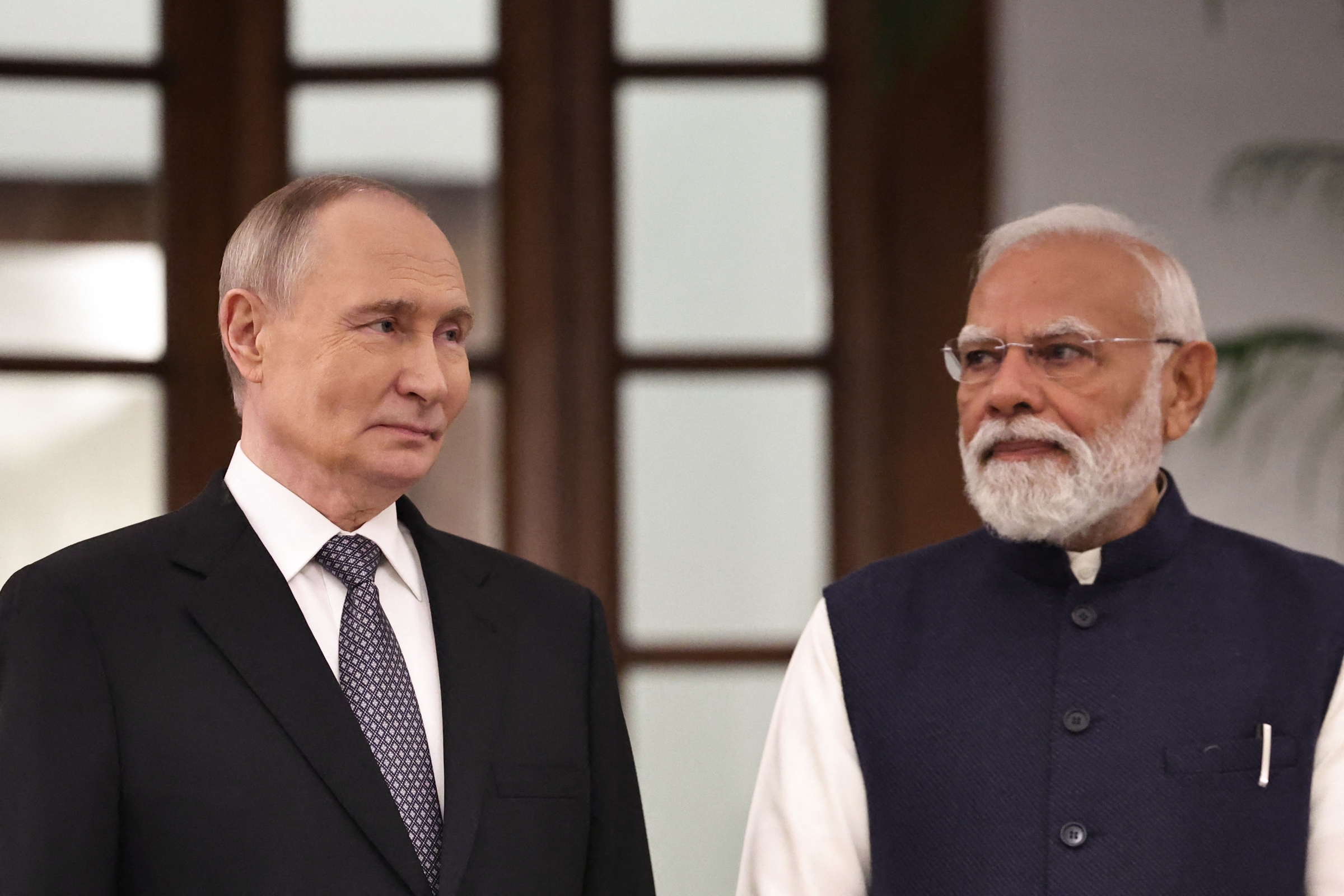 |
Russian President Vladimir Putin (left) and Indian Prime Minister Narendra Modi in New Delhi in December 2025. *AFP* |
According to data firm Kpler, India imported 1,16 million barrels of Russian oil per day in February, lower than last year's average of 1,71 million barrels. While port arrival data for March and April is not yet available, Muyu Xu, a senior crude oil analyst at Kpler, revealed that Indian refineries have not placed orders for Russian oil for April delivery. Earlier this month, the US and India reached a temporary trade agreement.
Following last weekend's ruling, Xu stated that India now has room to maintain Russian oil imports at 800.000-1 million barrels per day.
India's Russian oil purchases were a sensitive issue, straining relations with the US last year. In August 2025, Trump imposed an additional 25% import tariff on Indian goods, raising the total tariff faced by India to 50%, the highest among US trading partners.
However, after the temporary trade agreement, the US reduced this tariff to 18%. In a decree on 6/2, Trump lifted the 25% punitive tariff, stating that New Delhi committed to stop importing Russian oil and switch to buying energy from the US.
Yet, the joint statement from both countries did not mention India's commitment to limit Russian oil purchases. The document only referred to New Delhi's intent to buy US goods worth 500 billion USD, including energy, over the next five years under the agreement.
Alexandra Hermann, chief economist at Oxford Economics, said India's commitments to reduce Russian oil purchases "were never formalized and are probably difficult to enforce in practice." Price and diversification primarily drive India's energy strategy. "US crude oil is unlikely to significantly replace supply from Russia," she remarked.
Indian trade negotiators postponed a visit to Washington to finalize the temporary trade agreement. According to CNBC sources, both sides delayed the trip to assess the impact of the new ruling. Analysts suggest that the US Supreme Court's decision and Trump's retaliatory 10% tariff will diminish the advantages Indian exporters gained from the trade agreement.
Pankaj Srivastava, Vice President for commodity markets at energy consulting firm Rystad Energy, affirmed: "India will still import Russian oil despite various tariff policies." Following recent developments, Srivastava believes the US will not strongly pressure India on reducing Russian oil purchases, to avoid risks to its goal of significant energy exports to the country.
Kpler reported that India regularly buys 200.000-300.000 barrels of US crude oil per day. According to data from Kpler and Rystad Energy, by the end of January, Russia remained India's largest crude oil supplier, while the US ranked 6th.
Ha Thu (via CNBC, Reuters)