Russia's Ministry of Economic Development reported in late October that the nation's economy continued to lose momentum for the third consecutive quarter. Gross domestic product (GDP) grew by only 0.6% in Q3 compared to the previous year, a slowdown from 1.1% in Q2 and 1.4% in Q1.
Several sectors, including food production, textiles, footwear, and furniture, saw declines year-over-year. Oil refining output dropped by 4.5% due to Ukrainian drone attacks. Russia's metallurgy industry experienced its first recession since 2022, with production falling by 3.3%.
Overall, the economy grew by just 1% in the first nine months of the year, a quarter of the rate recorded during the same period last year. On 19/12, Russia's Central Bank cut its key interest rate by 50 basis points to 16%, citing easing inflation and signs of economic difficulty.
Despite the economic slowdown, it is unlikely to compel Russian President Vladimir Putin to negotiate an early end to the conflict with Ukraine. Analysts suggest the Kremlin can withstand current conflict conditions and Western sanctions for several more years.
"Economically, this year is not a breaking point; things remain under control", stated Maria Snegovaya, a Russia and Eurasia researcher at the Center for Strategic and International Studies (CSIS).
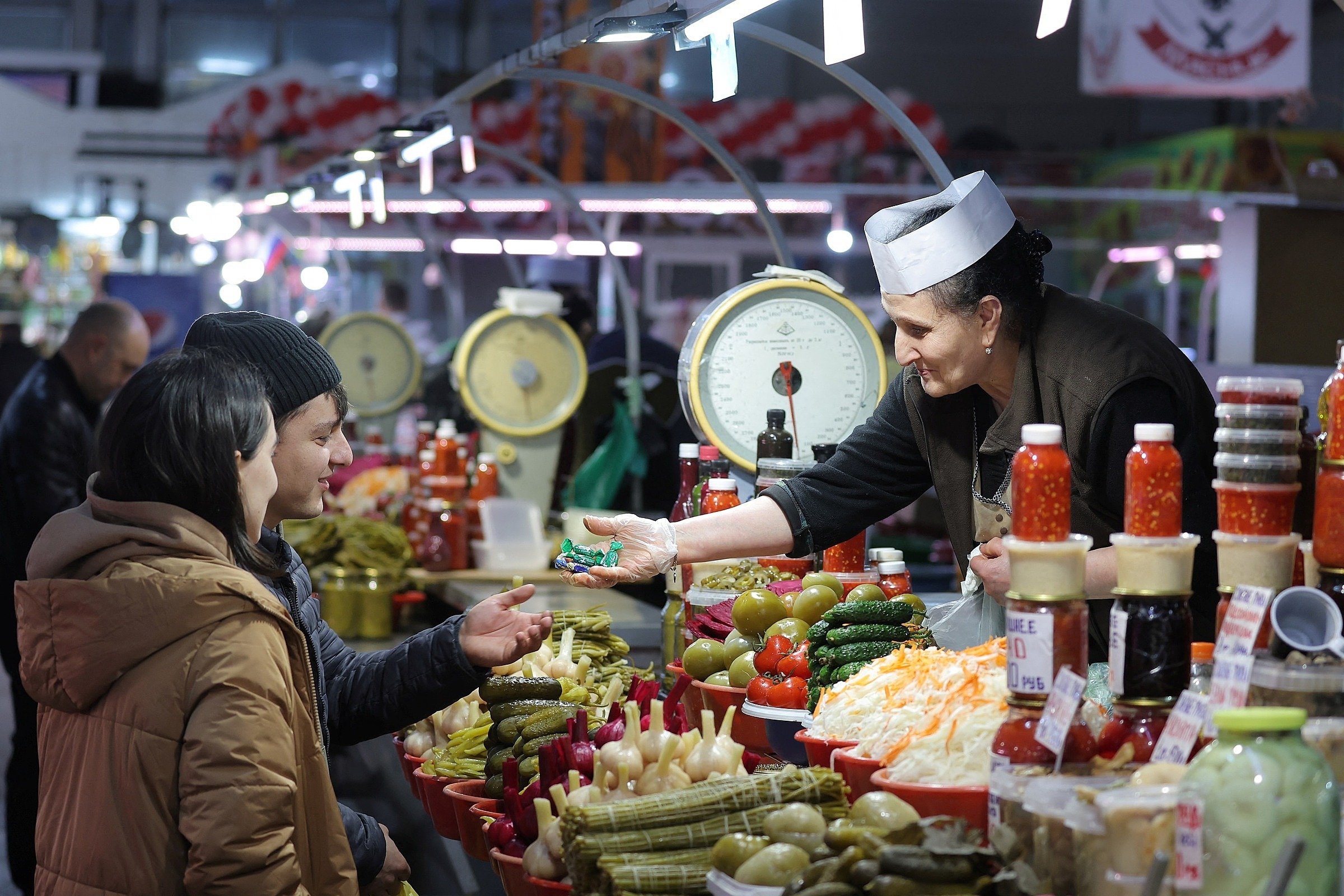 |
Inside a food market in Saint Petersburg, Russia. Photo: Reuters |
Western sanctions have not sufficiently harmed Russia's economy to force a change in its military strategy, Richard Connolly of the Royal United Services Institute (UK) told CNN.
"As long as Russia produces and sells oil at reasonable prices, it will have enough funds to endure. I am not saying the current picture is bright, but Moscow has sufficient grounds not to factor economics into its military planning", he observed.
Historically, Russia has been more likely to accept unfavorable peace deals during economic downturns, such as at the end of World War I, Snegovaya noted. However, the current economic situation "is far from that point, requiring much greater and prolonged pressure to reach it", she added.
Snegovaya also observed a shift, noting that the initial economic boost from surging military spending appears to have concluded. In the past few years, Russia has even increased corporate and personal income taxes, along with value-added tax (VAT), to offset a budget burdened by record military expenditures. Russian consumers also face significant price increases, particularly for imported goods.
High inflation, however, "does not cause much discontent" in Russia, unlike in the West, Snegovaya stated. Connolly and other experts suggest that post-Soviet Russia has frequently experienced high inflation, leading consumers to become accustomed to it. The International Monetary Fund (IMF) projects Russia's inflation to average 7.6% this year, down from 9.5% last year.
Russia currently allocates nearly 40% of its budget to the conflict, NATO Secretary General Mark Rutte revealed earlier this month. According to an April report by the Stockholm International Peace Research Institute (SIPRI), Russia's defense spending last year increased by 38% compared to 2023.
This increased spending benefits certain groups, such as weapons manufacturers and general laborers. Consequently, poverty rates in some Russian regions have decreased, reducing public pressure on President Putin.
Additionally, as Russia seeks to replace some imports, it has expanded domestic production in textiles, footwear, food, and basic electronics. Research by Ekaterina Kurbangaleeva, a lecturer at George Washington University, indicates this has boosted the incomes of some labor groups by three to five times between 2021 and 2024.
Some rural areas in Russia have even experienced economic improvements since the conflict began, partly due to high salaries paid to soldiers and their families. The government also provides substantial compensation to families of soldiers killed or wounded in the conflict, Kurbangaleeva stated.
While economic challenges may be manageable in the short term, the long-term outlook could differ significantly. The Kyiv School of Economics Institute for Economic Research reports that the value of highly liquid assets in Russia's National Welfare Fund has decreased by 57% since the conflict began. As this fund diminishes, "it will be very difficult for the government to maintain current defense spending without sharply reducing social expenditures", an Atlantic Council report noted.
Furthermore, recent US and UK sanctions on Russia's largest oil companies, Lukoil and Rosneft, have increased business costs. "Russian oil companies are redirecting exports through smaller firms, which is very expensive", said Kimberly Donovan, an analyst at the Atlantic Council.
If Western nations combine stronger sanctions with increased pressure on India and China to stop buying Russian oil, the Kremlin's calculations could change, she argued.
Nevertheless, President Putin expressed no concern over the economic slowdown. On 19/12, he stated that the growth rate of around 1%, down from 4% last year, was a deliberate move by Russia's Central Bank to cool inflation. Consequently, the nation's inflation could fall from 9.5% in 2024 to 5.5-5.7% this year. He also asserted that the budget would continue to meet military needs in the coming period.
Ha Thu (according to Reuters)