The Vietnam Association of Seafood Exporters and Producers (VASEP) recently indicated that export growth showed signs of slowing from the third quarter, influenced by US countervailing duties. Despite this, key product groups maintained strong momentum, establishing a foundation for full-year exports to reach the 11 billion USD target. This goal, set for this year, represents a 10-15% growth compared to 2024.
According to VASEP, the US market entered a volatile period. Exports for the 10-month period still increased, reaching 1,66 billion USD, but a downward trend became evident from the third quarter due to US countervailing duties. Both key products, shrimp and pangasius, saw declines in September and October.
Prospects are emerging from other markets. China remains an important pillar, generating over 2 billion USD in 10 months, a 32% increase. The country favors lobster, marine fish, and live crab, with demand expected to rise towards the year-end, opening significant growth opportunities for businesses.
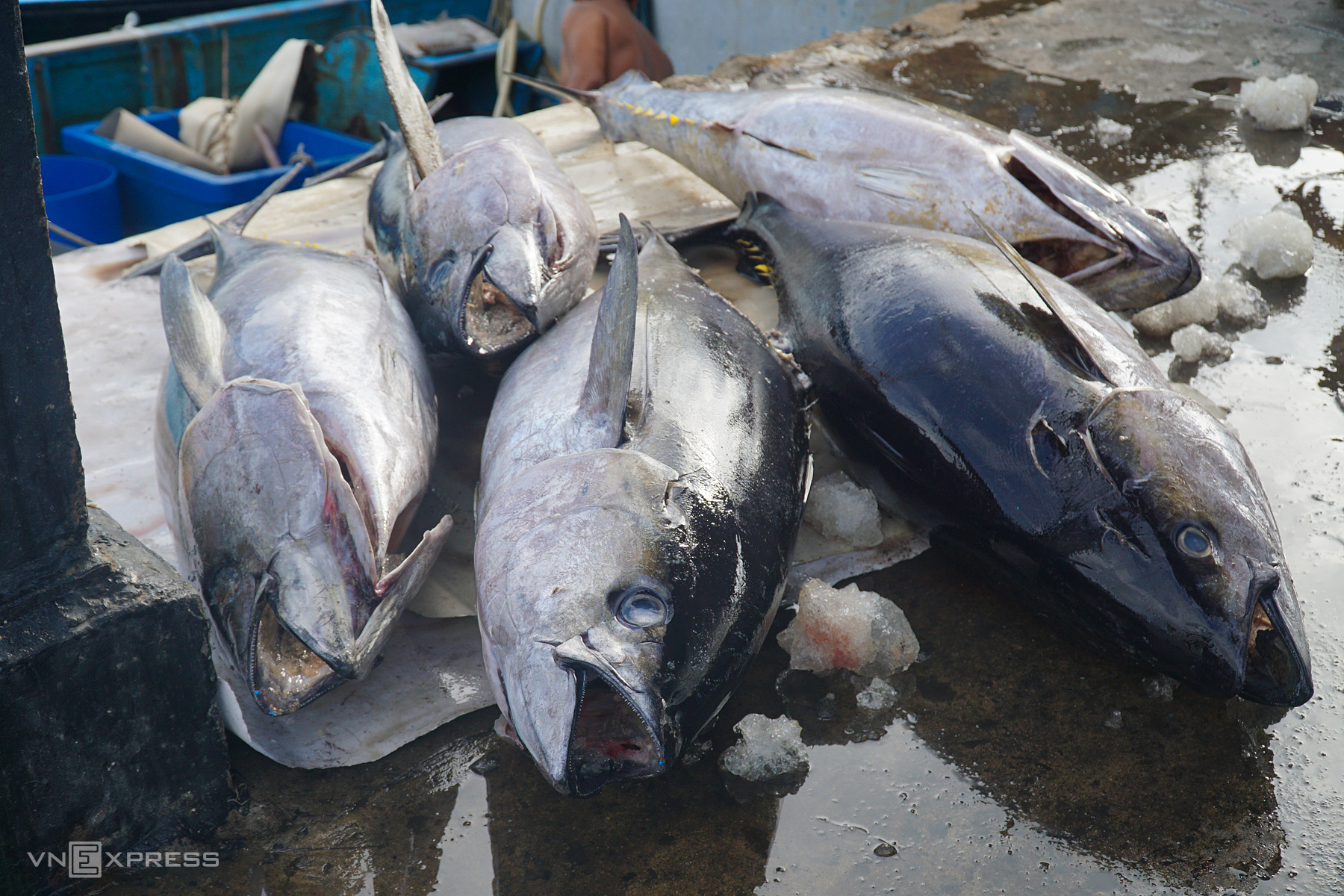 |
An ocean tuna fishing boat docks at Hon Ro Port, Nha Trang in early 2023. Photo: Bui Toan |
An ocean tuna fishing boat docks at Hon Ro Port, Nha Trang in early 2023. Photo: Bui Toan
Markets within the Comprehensive and Progressive Agreement for Trans-Pacific Partnership (CPTPP), particularly Canada, Australia, and Japan, continue to be the fastest-growing regions, demonstrating a strong advantage in leveraging tariff preferences. Over the past 10 months, Europe spent nearly one billion USD on Vietnamese seafood. Exports to South Korea also saw double-digit growth during the same period, reaching 725 million USD.
Among product categories, shrimp continues to play a pivotal role, with revenue exceeding 3,9 billion USD in 10 months. Pangasius ranks second, generating approximately 1,8 billion USD. Tuna, however, remains under pressure, with its revenue decreasing by 4% compared to the same period last year.
Looking ahead to 2026, VASEP forecasts numerous challenges for exports. These include persistent countervailing duties, the impact of the US Marine Mammal Protection Act (MMPA), and the possibility of the European Union (EU) maintaining its Illegal, Unreported, and Unregulated (IUU) fishing yellow card. Furthermore, competitive pressure from India, Ecuador, and Indonesia is steadily increasing.
A report by Agribank Securities (Agriseco) on the seafood industry highlights that Vietnam's shrimp prices consistently exceed those of Ecuador, India, or Indonesia. This reduces competitiveness and limits market options. Markets that accept higher prices, such as the US, Japan, South Korea, and the EU, demand high quality and stability. Regarding exports to the US, the reduction of countervailing duties to 20% is a positive sign, as it is not significantly higher than Ecuador (15%) or Indonesia (19%), and more favorable than India, according to Agriseco. However, the greatest risk remains an anti-dumping investigation.
The profits of seafood businesses exporting to the US have been significantly affected by countervailing duties. VASEP warns that if exporters continue to face a 35% anti-dumping duty after the final decision in December 2025, they will encounter even greater pressure.
Duy Tung