The Ministry of Industry and Trade is soliciting feedback on a draft amendment to Circular 09/2025, which outlines methods for determining and approving electricity generation and import price frameworks. The draft presents two options for solar energy: the first proposes prices based on socio-economic zoning within the National Master Plan for each period, while the second suggests applying prices according to individual provinces and cities.
For onshore and nearshore wind power, the Ministry of Industry and Trade only proposes determination based on socio-economic zoning within the National Master Plan for each period.
According to the drafting agency, some opinions suggest that calculating the price framework for solar and wind power based on the three regions (North, Central, and South) has been unsuitable, especially following province mergers and administrative boundary adjustments.
Solar and wind power are highly dependent on natural conditions such as solar radiation and wind speed. These factors can differ significantly among localities, affecting output and project investment efficiency. Therefore, according to the Electricity Regulatory Authority, determining the price framework based on more specific geographical areas will accurately reflect investment costs and facilitate attracting investors.
Currently, the solar and wind power generation price frameworks are structured across the three regions – North, Central, and South – with varying maximum levels depending on the type. In 2025, ground-mounted solar power has a price ceiling of 1,383 VND per kWh in the North, 1,107 VND in the Central region, and 1,012 VND in the South. Floating solar power prices are 1,686 VND, 1,336 VND, and 1,228 VND per kWh, respectively. Projects with battery storage apply higher ceilings, ranging from 1,150 to 1,877 VND per kWh depending on the type and region.
For onshore wind power, the price ceiling is approximately 1,959 VND per kWh in the North, 1,807 VND in the Central region, and 1,840 VND in the South. Nearshore wind power has a maximum level of approximately 1,987 VND per kWh across all three regions.
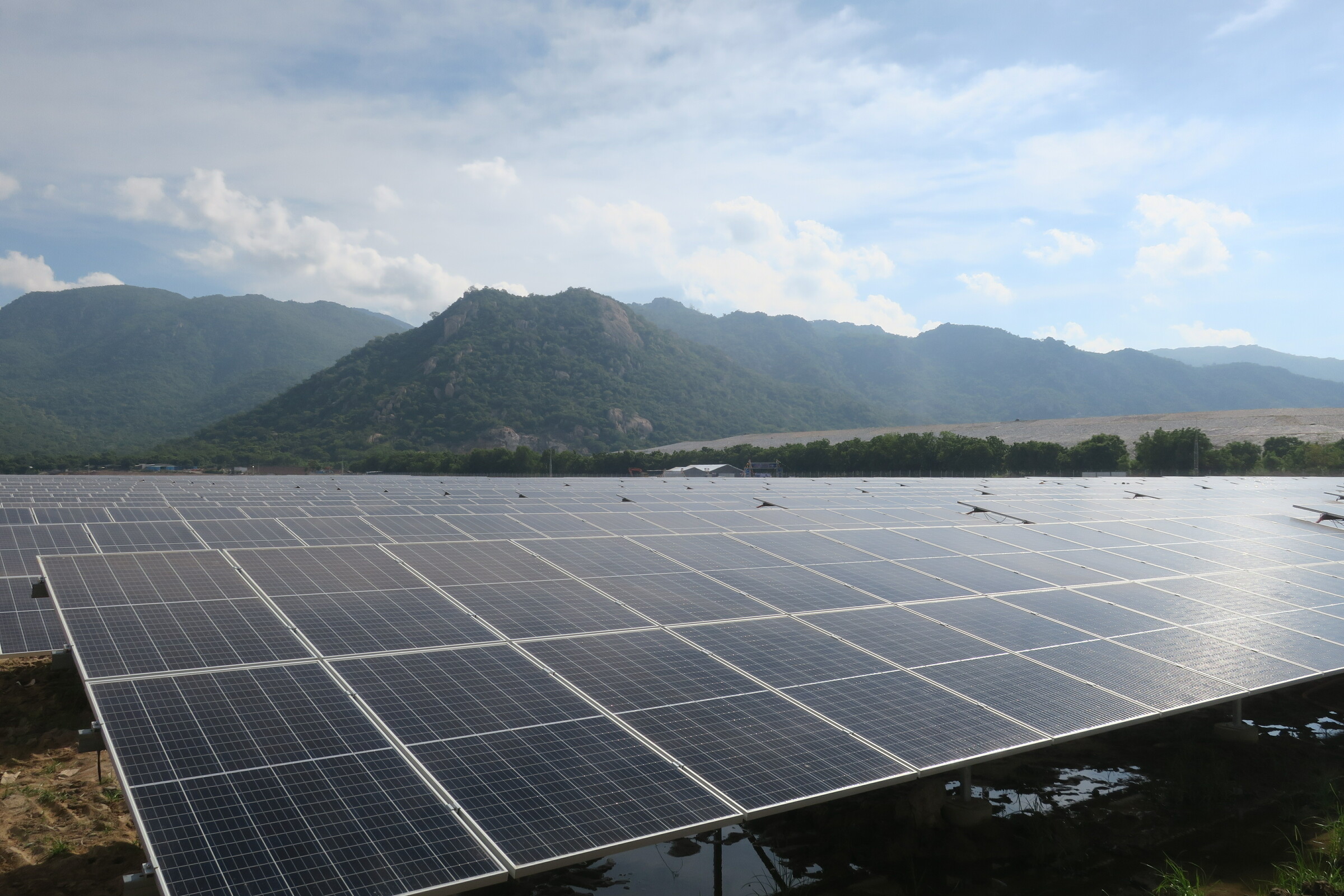 |
A solar power project in Binh Thuan. Photo: Viet Quoc
The draft also presents two pricing options for waste-to-energy plants. Under option one, waste delivered to the plant is valued as fuel at 0 VND, and local government payments for waste collection, transport, and processing are not factored into the electricity price. The plant would then negotiate its electricity sale price based on total investment and technical specifications.
With this approach, the plant has two separate revenue streams: electricity sales and waste processing paid for by the local government. The waste processing fee would be determined separately by the provincial People's Committee, adhering to the principle of avoiding double-counting costs already included in the electricity price.
Under option two, waste processing fees are considered when determining the electricity price. Specifically, the amount paid by local governments to the plant for waste treatment would be deducted when calculating the fuel price, thereby preventing a cost from being compensated twice through waste processing fees and electricity sales.
Additionally, the Ministry of Industry and Trade also proposes clarifying the classification of solar power on irrigation canals. According to the draft, photovoltaic panels installed on irrigation canals will not be categorized as floating solar power due to their simple structure, which is similar to ground-mounted installations.
Another proposed change is to transfer the responsibility for calculating and submitting the annual electricity generation price framework from Vietnam Electricity (EVN) to the electricity system and market operator. According to the Electricity Regulatory Authority, this shift to a neutral entity aims to enhance objectivity, align with system needs, and reduce conflicts of interest between electricity buyers and sellers.
Phuong Dung