The conflict in the Middle East is significantly affecting the region's oil export capacity and damaging energy infrastructure in some Organization of the Petroleum Exporting Countries (OPEC) member states. This conflict has eroded the group's market share, diminishing its ability to influence oil prices. As a result, policy statements and decisions from OPEC and its allies (OPEC+) now barely move the oil market.
Instead, China's reduced crude oil imports have become a dominant factor in 2026. This activity has helped balance the oil market during the most severe supply disruption in history.
According to Reuters' calculations, based on International Energy Agency (IEA) data, OPEC+ contributed 40% of global oil production in July. This figure is down from over 48% before the conflict erupted in late February. However, about 4-5 percentage points of this reduction are due to the United Arab Emirates (UAE) withdrawing from OPEC in May.
Seven key OPEC+ nations, including Saudi Arabia and Russia, accounted for only 25% of global oil production in July. The conflict has diminished OPEC+'s ability to quickly increase or decrease supply, as the Strait of Hormuz has been closed. This is a vital export route for Saudi Arabia, OPEC's largest producer, as well as other members like Iraq and Kuwait.
Supply disruptions due to conflict are not new to OPEC, from the war in Kuwait during the 1990-1991 Gulf War to the situation in Iraq in 2003. What is unusual this time is the scale of the disruption, with multiple producers facing supply restrictions simultaneously, diminishing OPEC+'s ability to offset production.
Since March, OPEC+ has announced six oil production increases. However, due to the blockade of the Strait of Hormuz, most of these increases exist only in theory. These decisions have had almost no impact on oil prices, except for the July decision, when the United States and Iran were in a ceasefire agreement.
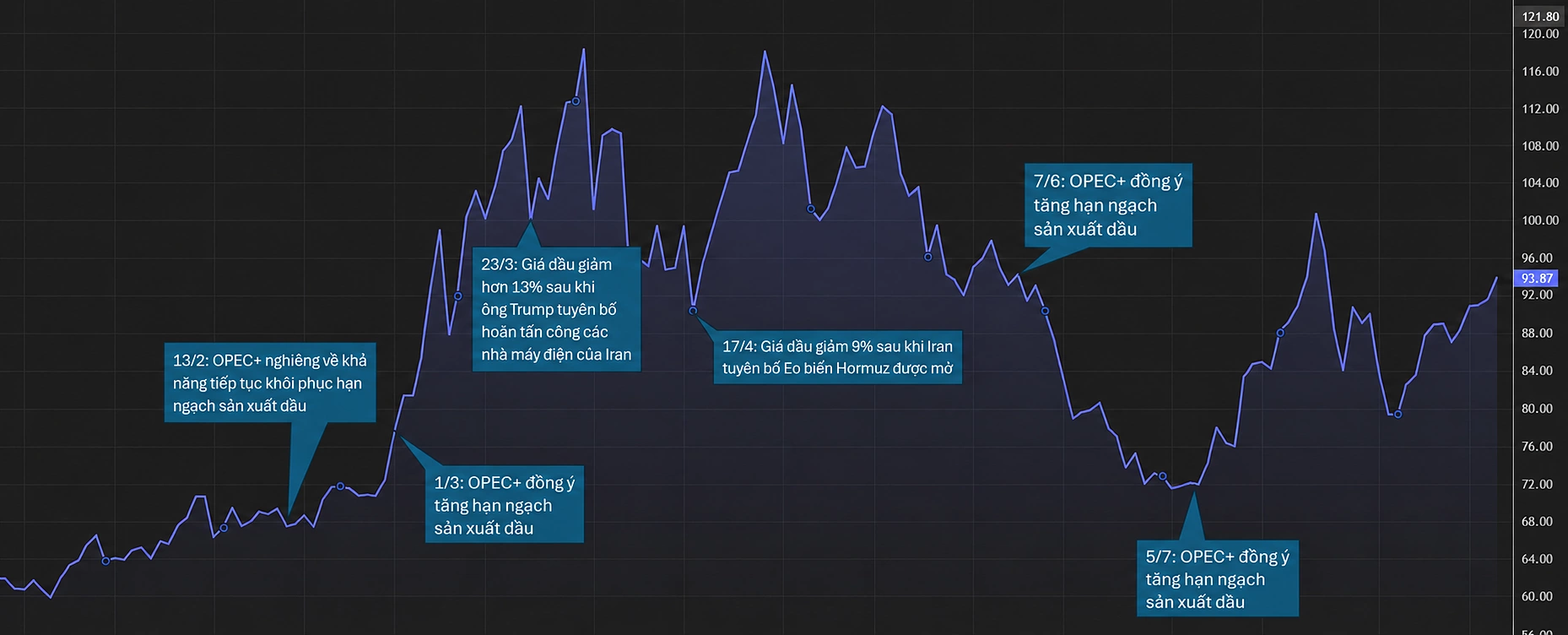 |
Brent crude oil price trends in 2026. *Chart: Reuters* |
The current contrast with 2019 is even more pronounced. Back then, OPEC+ and US President Donald Trump frequently disagreed on oil prices. Investors closely monitored every OPEC+ decision due to its potential market impact. At that time, the question was how much oil OPEC+ would choose to pump into the market. Currently, the focus is on how much oil can actually be produced and exported amidst the conflict.
One of the strongest factors influencing oil prices this year has been China's sharp reduction in oil imports. Since the conflict began, the country has purchased approximately 400 million barrels less oil compared to the same period last year. This decline reflects a fuel export ban, lower refining output, and China's increasing use of electric vehicles.
This trend also highlights China's growing role in balancing the oil market. This role was previously almost exclusively associated with OPEC+, thanks to its ability to adjust supply. China's weaker oil demand has also contributed to capping oil prices this year. Conversely, the country's strong oil purchases last year helped support the market. "They have become the center for adjusting market demand," concluded June Goh, an analyst at Sparta Commodities.
OPEC was founded in 1960. OPEC+ was established in 2016, with the participation of Russia and other producing countries. OPEC's global market share once peaked at around 50% during the oil crises of the 1970s, then fell to 30% in the mid-1980s as production from the North Sea, Alaska, and Siberia increased. On Reuters, OPEC+ stated that the group's decisions aim only to support market stability and do not target a specific oil price.
Ha Thu (according to Reuters)