On 28/4, the global market was surprised by the United Arab Emirates' (UAE) announcement that it would withdraw from the Organization of the Petroleum Exporting Countries (OPEC) starting 1/5.
Energy Minister Suhail Al Mazrouei stated the decision followed a comprehensive review of the country's production policies, current, and future capabilities. This move allows the UAE greater flexibility in responding to market fluctuations.
Sources and analysts indicate that the UAE's decision has been under consideration for a long time. It stems from numerous disagreements over OPEC's direction and economic, political relations with member states. William F. Wechsler, senior director for Middle East programs at the Atlantic Council in Washington DC, recalled that on 28/4, a senior UAE official commented on the move, stating: "That was long overdue."
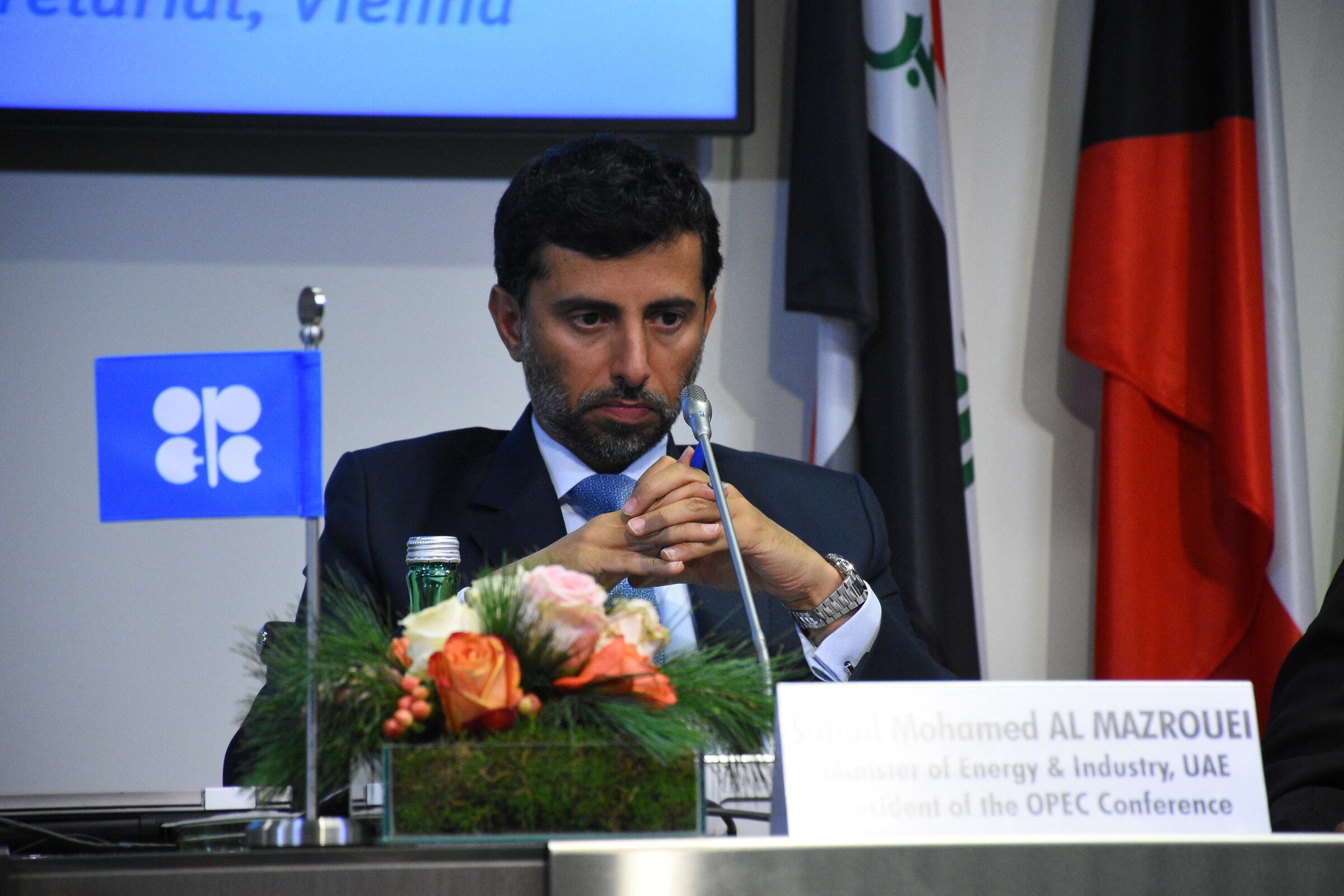 |
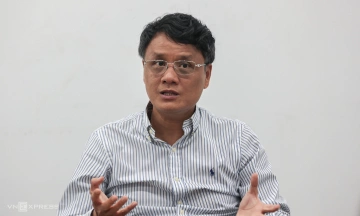
Energy Minister Suhail Al Mazrouei at a press conference following the OPEC ministerial meeting in Vienna, Austria on 7/12/2018. *AFP* |
Experts revealed that the intention to leave OPEC had been discussed privately for many years, both within the UAE and between UAE and US officials. Wechsler previously served as Deputy Assistant Secretary of Defense for Special Operations and Counterterrorism. "From Abu Dhabi's perspective, their national interests have diverged and are likely to increasingly conflict with other OPEC and OPEC+ members, notably Russia," he remarked.
A primary driver for the UAE's departure is its long-term strategy to maximize oil reserves before global demand peaks and declines due to the transition to renewable energy. Abu Dhabi has launched an investment package of up to 150 billion USD, aiming to expand oil production capacity from 3,4 million barrels to 5 million barrels per day by 2027 and potentially higher thereafter. Kristian Coates Ulrichsen, a Middle East fellow at Rice University's Baker Institute in Texas, stated: "This reflects a desire to maximize reserves and bring oil to market, avoiding the risk of 'stranded assets' if global demand falls during the shift away from fossil fuels."
Remaining in OPEC would prevent the UAE from increasing production at will, as it is currently subject to a quota of 3,2 million barrels per day. "For years, Abu Dhabi has sought to profit from its investments in expanding production capacity," said Helima Croft, an expert at RBC Capital Markets. Jorge Leon, head of geopolitical analysis at Rystad Energy, added that as oil demand approaches its peak, the challenge for producers is rapidly changing. "And waiting your turn in a quota system is like missing an opportunity to make money," he said.
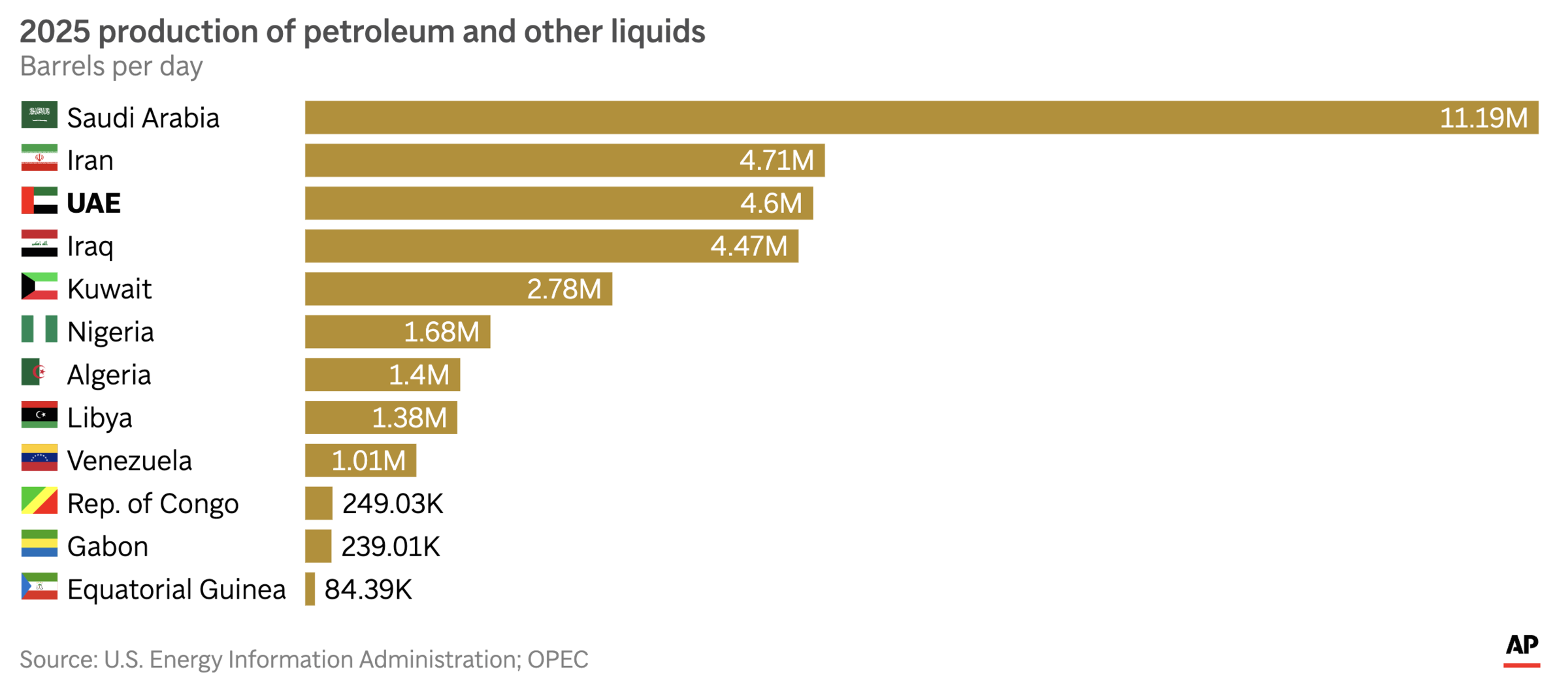 |
Oil and related product output of OPEC members (million barrels/day). *AP* |
The economic divergence between the UAE and Saudi Arabia further fueled the decision. The UAE's economy is more diversified and less directly dependent on oil revenue. "Economically, the growth of UAE's sovereign wealth funds in recent years has depended more on global economic developments than on oil prices," Wechsler illustrated. Conversely, Saudi Arabia relies on high oil prices for substantial budget revenue to fund massive infrastructure projects like its Vision 2030 program. Therefore, some OPEC members prioritize high oil prices, while the UAE is more concerned with global economic risks, which impact its investment returns.
Beyond economic motivations, geopolitical relations in the Gulf region have also diminished the UAE's enthusiasm for OPEC. Despite continued significant mutual investments, differences between the UAE and OPEC leader Saudi Arabia are growing. Kristian Coates Ulrichsen noted that the UAE had signaled its potential departure from OPEC at least five years ago, expressing differing views from Saudi Arabia on oil policy management ahead of the OPEC+ meeting in 11/2020.
The rift became evident at the OPEC+ meeting in 7/2021. On both occasions, the UAE sought to increase oil production, which OPEC had significantly cut during the pandemic, while Saudi Arabia preferred to keep output low to maintain high prices. The two nations once collaborated against Houthi rebels in Yemen in 2015. However, the alliance fractured and shifted to mutual blame in late 12/2025, when Saudi Arabia bombed a shipment it believed to be weapons en route to the UAE-backed Southern Transitional Council (STC) in Yemen. This incident led to public disputes, extending to differing policies on Sudan.
Before that rift was resolved, conflict erupted in the Middle East. This time, Iran targeted the UAE more than any other country, including Israel. Abu Dhabi criticized the "weak" response of its Gulf partners. Iran's — an OPEC member — blocking of oil tankers through the Strait of Hormuz and demanding fees extinguished any lingering desire for the UAE to remain in OPEC. Kristian Coates Ulrichsen assessed that statements from influential figures in the UAE indicate that the country's officials closely monitored which nations supported them during times of crisis and which did not. "The decision to leave OPEC reflects Abu Dhabi's calculation that continued membership in a Saudi-dominated organization no longer serves its interests," he stated.
Kristian Coates Ulrichsen even predicted that the UAE might reconsider its memberships in the Arab League, the Organization of Islamic Cooperation, or even the Gulf Cooperation Council, as Middle Eastern nations prepare for an uncertain post-conflict landscape. William F. Wechsler predicted that the UAE would likely further strengthen its relationship with the US after 1/5. Ironically, over time, this move could also bolster US-Saudi Arabian relations, as Riyadh would bear greater responsibility for stabilizing global oil prices within OPEC.
Phien An (according to Reuters, The Conversation, Atlantic Council, Al Jazeera)