Starting 24/2, goods imported into the US are subject to a temporary 10% tariff. This follows the US Supreme Court's rejection of import tariff policies based on President Donald Trump's International Emergency Economic Powers Act (IEEPA).
This mechanism, based on Article 122 of the Trade Act of 1974, has a maximum duration of 150 days, effective until 24/7. At a seminar titled "Solutions to Respond to the US 150-Day Temporary Tariff Policy" on the morning of 25/3, Professor Tran Ngoc Anh from Indiana University in the US, projected three potential scenarios after this period.
The most probable scenario (60%) suggests increased tariff pressure on goods from Vietnam if the Trump administration concludes its investigations under Article 301 concerning unfair trade practices. In such a case, sectors like steel, electric vehicles, and semiconductor components could face tariffs of 20-30% instead of the current 10%, according to Professor Ngoc Anh.
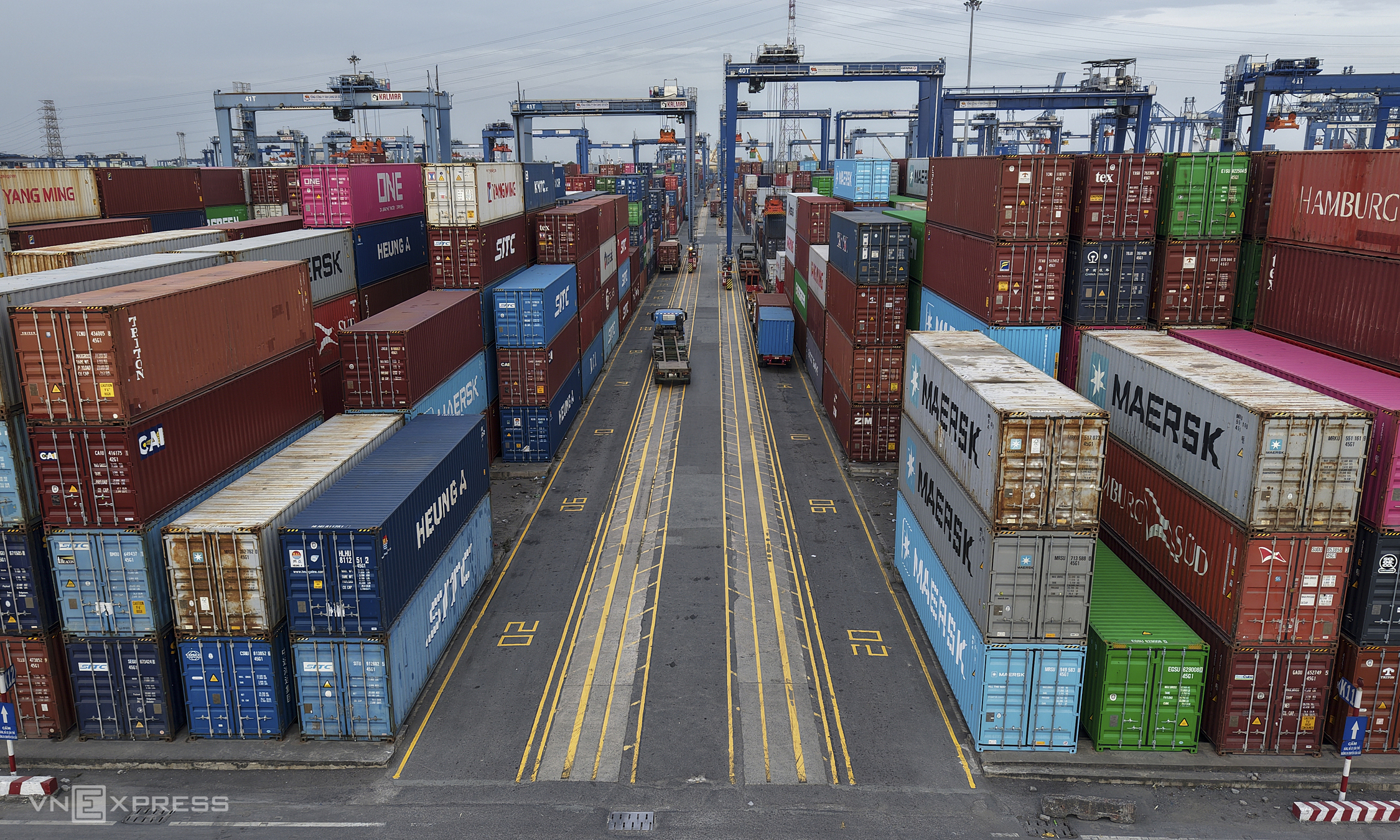 |
Containers at Cat Lai Port on 4/2. *Photo: Thanh Tung* |
The remaining two scenarios are more positive but depend on specific conditions. The Trump administration might proactively ease tariffs if inflation rises significantly, Brent crude oil prices exceed 140 USD per barrel, or if the US Court of International Trade (CIT) rules that the temporary tariffs, invoked under Article 122 by Trump, constitute an overreach of power and are thus invalid.
This scenario contains a variable: the developments in the Middle East conflict. The combined effect of higher gasoline prices and increased goods costs due to tariffs could fuel inflation, prompting the Federal Reserve (Fed) to maintain high interest rates. Professor Ngoc Anh noted, "This conflict inadvertently acts as a 'restraining factor', potentially forcing the US to expand its tariff exemption list to cool down living costs."
The third scenario involves Vietnam and the US reaching a trade agreement. Under this arrangement, Vietnam would open its market to US agricultural products, recognize US automotive standards, and commit to increasing purchases of Boeing aircraft. In return, many Vietnamese export items would be included in an annex enjoying 0% tariffs and exempted from broad tariff increases.
With a turnover of nearly 152 billion USD, the US was Vietnam's largest export market last year, growing more than 28% compared to 2024. In the first two months of 2026, export value increased by nearly 22% over the same period in 2025, reaching 23.8 billion USD, according to the General Department of Vietnam Customs.
Ms. Cao Thi Phi Van, Deputy Director of the Ho Chi Minh City Trade and Investment Promotion Center (ITPC), stated that the temporary 10% tariff provides short-term leeway for some businesses to maintain profit margins, reducing immediate pressure to adjust selling prices and allowing them to stabilize delivery schedules.
However, after 150 days, businesses risk partners demanding price reductions to share tariff costs, which could lead to a decrease in orders or contract disruptions if suitable agreements are not reached.
Doctor Huynh The Du from the University of Wisconsin Oshkosh in the US, advised businesses to utilize the 150-day period to accelerate deliveries, finalize commercial contracts, and meet front-loading trends.
Concurrently, businesses should promptly renegotiate contract terms with US partners, paying particular attention to Incoterms (international trade rules on party responsibilities), tariff cost-sharing mechanisms, and price adjustments.
"It is crucial to immediately develop contingency plans for a scenario where tariffs increase to 15% or when the US applies stricter tariff tools after 24/7. Furthermore, market diversification needs to be intensified to mitigate dependency risks," Doctor Du recommended.
Facing the risk of some goods encountering higher tariffs after Article 301 investigations, Professor Tran Ngoc Anh advised businesses and associations to prepare legally. This includes reviewing 10-digit HTS codes and collaborating with trade lawyers in Washington to participate in Article 301 hearings to demonstrate production capacity based on actual supply and demand.
Experts recommended that businesses implement Global Trade Management (GTM) systems and Blockchain technology to automate documentation, screen prohibited entities, and ensure origin transparency (especially for cotton, yarn, leather, and wood).
For policymakers, Doctor Huynh The Du suggested establishing a "150-day Tariff Response Steering Committee" to closely monitor developments, issue weekly updates, and address concerns regarding HS codes and rules of origin. Singapore has already updated its customs guidelines and market reports, while New Zealand offers legal consultation and contract review programs for businesses.
Additionally, strict management of Certificates of Origin (C/O) must continue, economic diplomacy should be promoted, and the risk of being targeted by Article 232 or 301 investigations should be minimized. "Combined with timely coordinated responses and strict adherence to trade rules, these will be decisive factors helping Vietnam firmly protect its market share and reputation in the US market," Doctor Du commented.
Vien Thong