On December 23, CNN reported that President Trump ordered the suspension of offshore wind projects and associated federal land lease contracts, delivering a significant blow to this energy sector.
The list of suspended projects includes Coastal Virginia, slated to be the largest offshore wind farm in the United States, with an expected completion by late next year. This farm features 176 turbines, a 2 GW capacity, and is projected to supply enough electricity for 600,000 households in Virginia.
Other wind farms affected by the decision include Vineyard Wind 1 in Massachusetts, Revolution Wind in Rhode Island, Sunrise Wind spanning Long Island and New England, and Empire Wind 1 off Long Island. Notably, the Revolution Wind mega-project, which has seen 5 billion USD in investment and is 80% complete, along with the governments of Rhode Island and Connecticut, filed a lawsuit against the Trump administration in September following an earlier halt order. Collectively, these projects represent a total capacity of 6 GW and are set to create thousands of jobs.
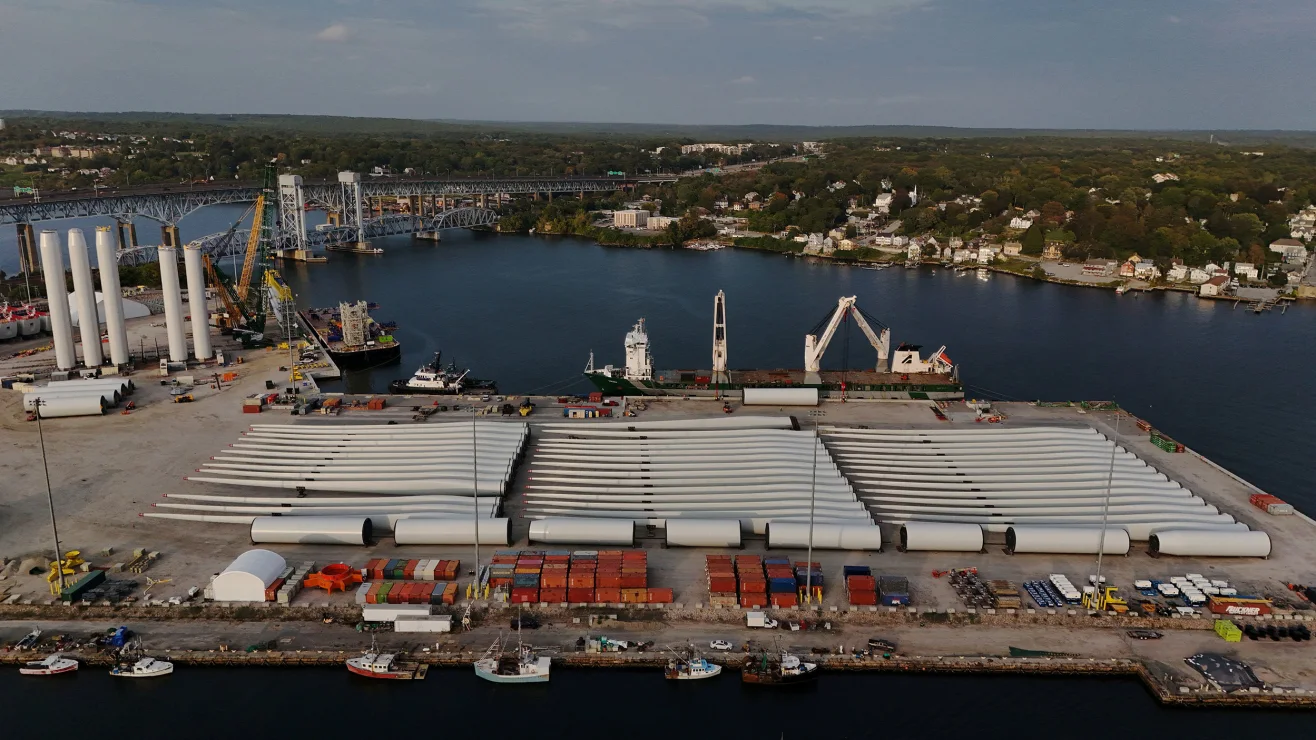 |
Revolution Wind turbine components assembled at a New London, Connecticut, dock in September. Photo: Reuters |
The US Department of the Interior cited unspecified national security risks as the reason for the suspension, without providing specific details. A statement from the department also noted that the movement and light reflection from wind turbines could interfere with radar systems.
Speaking on Fox Business, Secretary of the Interior Doug Burgum stated that the Department of Defense concluded that large-scale offshore wind farms "create radar interference, posing a real risk to the US," particularly for "east coast coastal centers." He added that this interference creates a significant problem in "identifying friend or foe in airspace."
Meanwhile, a Department of Defense official indicated they are collaborating with the Department of the Interior and other agencies to "assess options to mitigate national security risks posed by these projects."
Last year, the Swedish government also suspended a wind project due to concerns over military radar interference, amidst escalating tensions between the European Union and Russia. However, experts suggest that such issues can be resolved through adjustments to wind farm designs. They also highlighted that the US government has been aware of this potential problem for decades.
In fact, Oceantic Network, a consortium representing offshore wind companies, reported that its members have collaborated with the Department of Defense for over a decade to address national security concerns. Liz Burdock, the network's President and Chief Executive Officer, stated, "The Department of Defense approved all land lease contracts before farm construction."
Burdock characterized the suspension as an "attempt to mask the fact that the President dislikes offshore wind." He further warned that this action would increase electricity prices and lead to the loss of thousands of American jobs. "The US needs a comprehensive energy strategy, not a full-scale attack on renewable energy based on personal preference," Burdock emphasized.
The Trump administration's move faced criticism not only from clean energy advocates but also from fossil fuel industry groups. Erik Milito, President of the National Ocean Industries Association, stated, "Oil and gas companies are committed to investing significant capital to participate in offshore wind projects." He urged the administration to lift the suspension and refrain from any further actions detrimental to employment and investment.
By Bao Bao (according to CNN, CNBC, Fox)