From 1/7, taxpayers are eligible for new deductions for healthcare and education expenses. Under the amended Personal Income Tax Law and Decree 253 guiding this law, individuals can deduct up to 23 million dong for healthcare and 24 million dong for education each year, totaling a maximum of 47 million dong. These new provisions supplement existing deductions, which include family circumstances, mandatory insurance, and contributions to charity, humanitarian aid, and scholarships.
To qualify for these deductions, the Tax Department specifies that healthcare and education expenses must be supported by invoices and documents clearly showing the taxpayer's or dependent's information. Additionally, these costs must not have been covered by the state budget or any social insurance, health insurance, or other insurance schemes.
Decree 253 stipulates that tuition fees for all levels and types of education, from preschool through university, vocational schools, and specialized training courses, are eligible for personal income tax deductions.
This policy applies to both public and private educational institutions, provided the taxpayer possesses valid invoices and supporting documents. However, other school-related expenses, such as semi-boarding meal fees, shuttle services, uniforms, textbooks, and extracurricular activities, are not eligible for deduction.
For healthcare expenses, taxpayers are also required to provide a detailed breakdown of medical examination and treatment costs, using the form prescribed by the Ministry of Health.
Taxpayers must directly settle these education and healthcare deductions with the tax authorities; they cannot authorize their income-paying entities to do so on their behalf.
For example, if an individual has a taxable income of 20 million dong per month (240 million dong annually), their personal income tax under the new progressive schedule would be 18 million dong. If, during the year, this individual incurs 24 million dong in tuition fees for their child and 20 million dong in eligible medical examination and treatment costs, their taxable income would decrease to 196 million dong. Consequently, the personal income tax payable would be reduced to 13,6 million dong, representing a saving of 4,4 million dong compared to the previous calculation.
The Tax Department emphasizes that these deductible expenses are only applicable within the tax period in which they are incurred and cannot be carried over to subsequent years. Taxpayers must retain all necessary documents and invoices for settlement and clarification purposes.
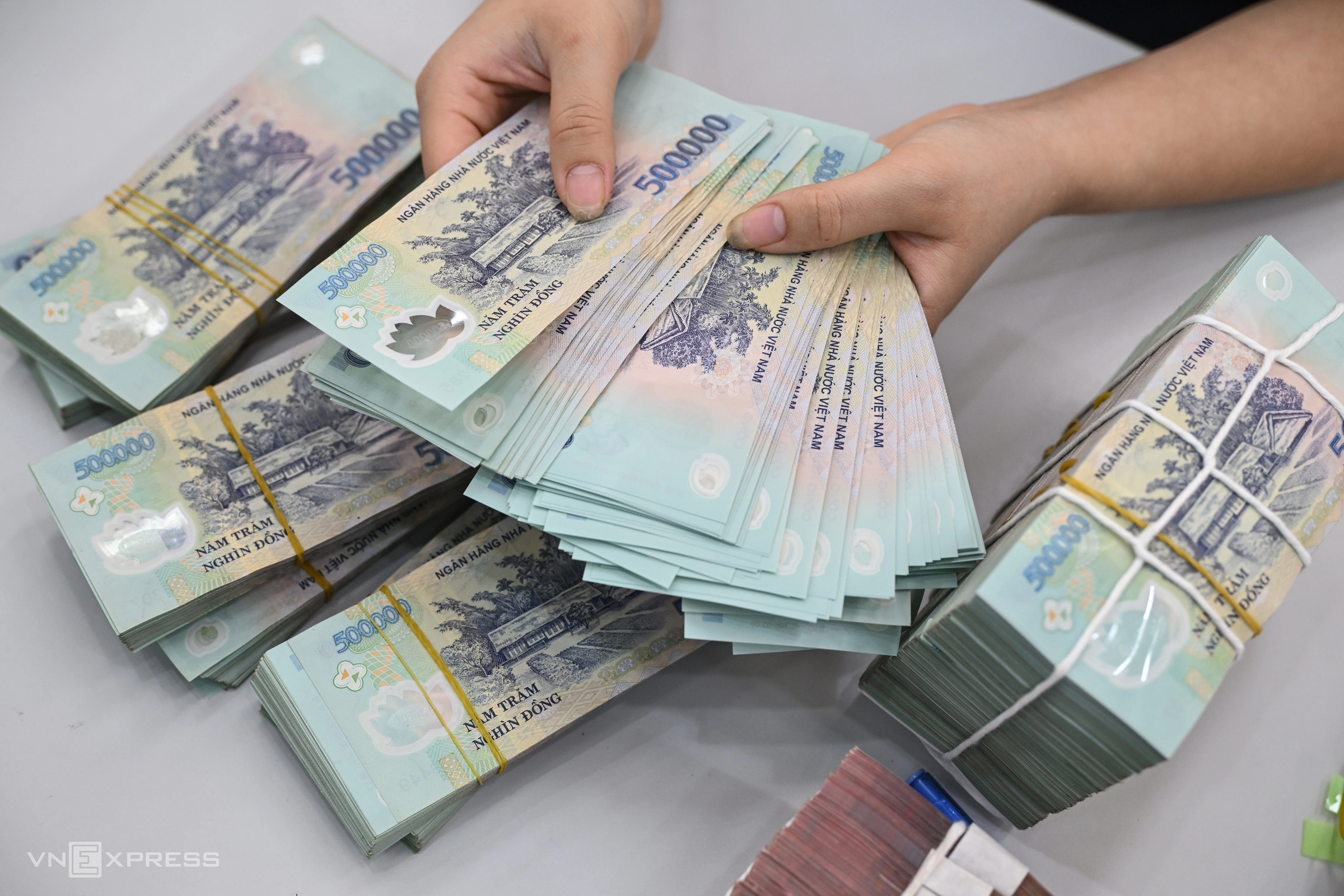 |
A transaction at a bank branch in Hanoi, 8/2026. Photo: Giang Huy |
Since the beginning of this year, the new personal income tax policy has also altered the calculation method for salaried employees. The personal deduction for the taxpayer is 15,5 million dong per month (equivalent to 186 million dong per year). The deduction for each dependent is 6,2 million dong per month.
The progressive tax schedule for income from salaries and wages has also been streamlined, reducing from 7 to 5 tiers:
| Tier | Income (million dong/month) | Tax rate (%) |
| 1 | Up to 10 | 5 |
| 2 | Over 10-30 | 10 |
| 3 | Over 30-60 | 20 |
| 4 | Over 60-100 | 30 |
| 5 | Over 100 | 35 |
This tax schedule is effective from the 2026 tax period, meaning that from 1/1/2026, businesses will provisionally calculate and deduct monthly and quarterly tax from employees' incomes according to these new rates. Subsequently, from 1/1/2027 to 31/3/2027, taxpayers will finalize their tax declarations to determine the total tax payable for the entire year 2026.
Compared to the previous tax schedule, the 15% and 25% tax rates have been eliminated, and the income brackets for each tier have been expanded. The threshold for applying the 5% tax rate has doubled to 10 million dong, while the 35% tax rate now applies to incomes starting from 100 million dong, an increase of 20 million dong from the previous threshold.
Tax continues to be calculated using the partial progressive method. This means that income falling within a specific tier will be taxed at that tier's corresponding rate, rather than applying the highest rate to the entire income.
Before tax calculation, employees benefit from deductions for family circumstances, insurance, and other expenses such as education and healthcare. Therefore, the income levels presented in the table may not represent an individual's total gross salary or actual monthly take-home pay.
Phuong Dung