At 8 PM on 27/5 (Vietnam time), US WTI crude oil prices fell 5,7% to 88,5 USD per barrel. Brent crude oil declined 4,7% to 95 USD.
Market sentiment shifted downward on expectations that Iran would restore traffic through the Strait of Hormuz. Reuters, citing information from Iran's national television, reported that Tehran possesses an initial, unofficial draft framework for a memorandum of understanding with the US.
Under this proposed agreement, Iran would restore commercial transport activities through the Strait of Hormuz within one month. In return, the US would withdraw military forces from Iran's vicinity and lift sanctions on its seaports. Iran anticipates coordinating with Oman to manage maritime activities through the Strait of Hormuz.
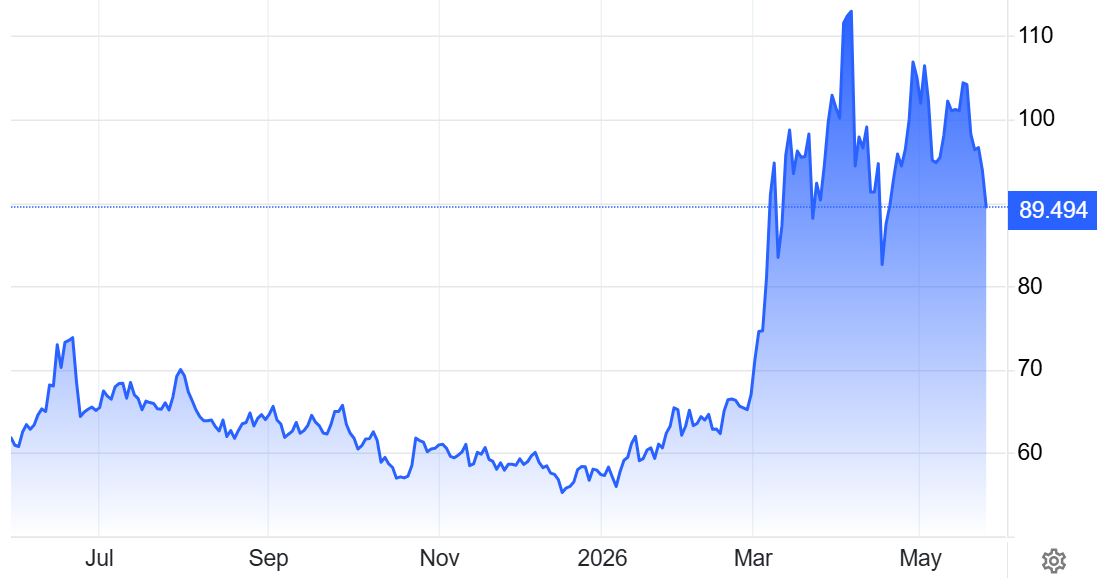 |
US WTI crude oil price movements over the past year. Chart: Trading Economics |
However, Iran's state television noted that this framework is not yet finalized. Tehran also stressed that it would not proceed without "concrete verification".
Globally, gold prices are also experiencing a sharp decline, attributed to the uncertain prospects for an end to the conflict. An ounce of gold has fallen by 93 USD to 4.413 USD. This marks its lowest point since late March.
The Strait of Hormuz has been under a blockade for the past three months due to the Middle East conflict, disrupting 20% of global crude oil and liquefied natural gas (LNG) supplies. This disruption pushed Brent oil prices temporarily above 120 USD, exacerbating inflationary pressures.
Consequently, global gold prices have faced sustained pressure throughout the conflict, as accelerating inflation has made central banks reluctant to cut interest rates. While gold serves as a hedge against inflation and economic-political instability, the precious metal is disadvantaged in a high-interest-rate environment because it does not yield fixed interest.
Ha Thu (via CNBC)