The United States recently opposed a United Nations (UN) resolution on climate change, which asserts that countries have a legal obligation to reduce fossil fuel consumption and address global warming. Passed on 20/5, the resolution also affirmed the necessity of an advisory opinion from the International Court of Justice (ICJ).
However, Tammy Bruce, deputy United States ambassador to the UN, stated that the resolution includes "inappropriate political requirements related to fossil fuels." She added that Washington sees no practical basis for the UN to raise such legal issues.
A key point of contention for the US is the resolution's implication of "binding obligations." The US maintains that ICJ opinions are merely advisory in international disputes, not "irrefutable" as the new resolution suggests. The UN, based on the court's potential opinion, calls on nations to take legal responsibility for preventing cross-border climate damage.
"Such expanded legal rules unacceptably interfere with each nation's sovereign right to regulate and manage energy policy," a representative of the Trump administration stated. The US delegation urged the United Nations to avoid interfering in the complex legal issues mentioned by the ICJ. The body should also not further complicate the work of the United Nations Framework Convention on Climate Change (UNFCCC) – a distinct UN body responsible for climate issues – which operates under entirely separate processes.
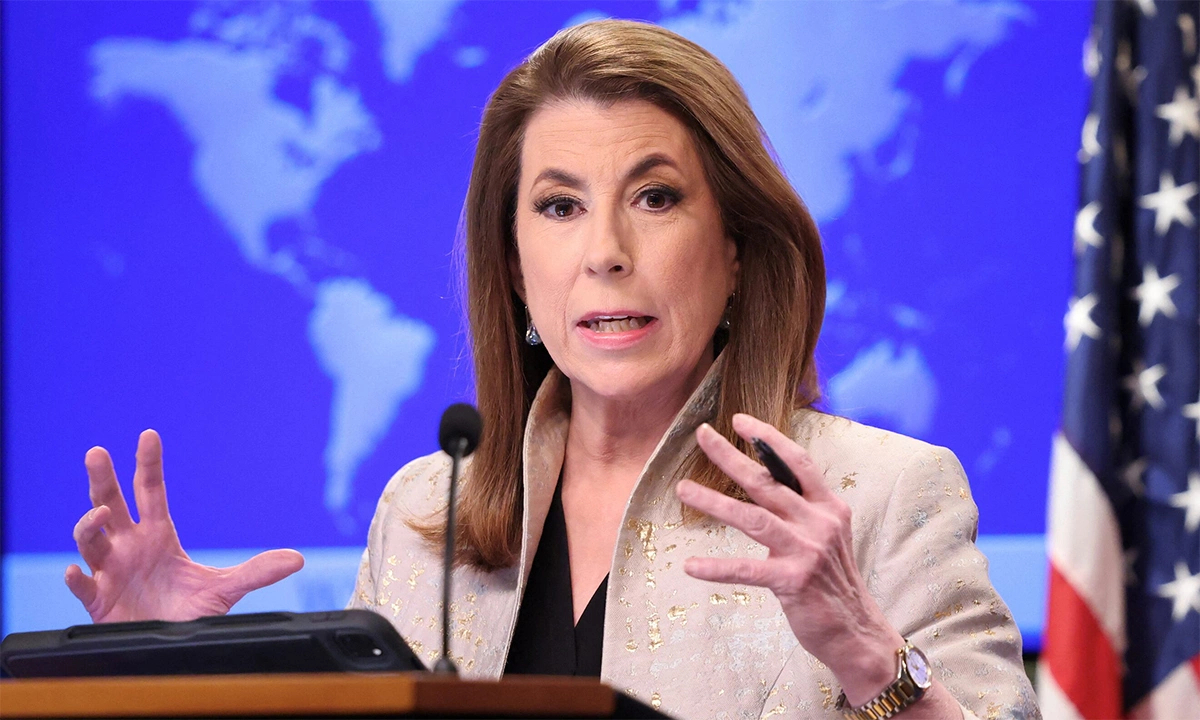 |
United States State Department spokesperson Tammy Bruce at a press conference on 6/3/2025. Photo: Reuters |
Earlier this year, former President Trump withdrew the US from the UNFCCC and 65 other international organizations, stating that these bodies "no longer served Washington's interests." Previously, he also withdrew the US from the Paris Climate Agreement and other environmental accords, consistently pursuing policies that promote fossil fuel production.
The US was not the only party to oppose this resolution. A group of oil-producing nations, including: Saudi Arabia, Russia, Israel, Iran, Yemen, Liberia, and Belarus, also opposed it. Turkey, host of the COP31 climate summit, India, and oil producers Qatar and Nigeria abstained from the vote. In contrast, United Nations Secretary-General Antonio Guterres emphasized governments' responsibility to protect citizens from the "worsening climate crisis."
Many nations have increased their resolve to shift away from fossil fuels, particularly since the Middle East conflict, which led to the closure of the Strait of Hormuz and tightened one-fifth of global oil trade. Last month, 56 countries reached a consensus on phasing out coal, oil, and gas. These nations included: the European Union (EU), Norway, the United Kingdom, Singapore, Bangladesh, Brazil, Canada, Colombia, and the Philippines.
Bao Bao (according to Reuters, USUN)