Artificial intelligence (AI) is becoming a common assistant for information retrieval, learning, shopping, and service comparison. With just a few actions, users can access a large amount of data quickly. However, for home internet, users clearly define roles: AI helps gather information, but real-world experience is the ultimate deciding factor.
According to Q&Me's Report on Internet Usage Behavior in Vietnam, published in 4/2026, only 8% of users consult AI when choosing an internet provider. In contrast, 51% still rely on recommendations from friends and family. Even for Gen Z, a "digital-first" generation, actual experience holds more weight than information from algorithms.
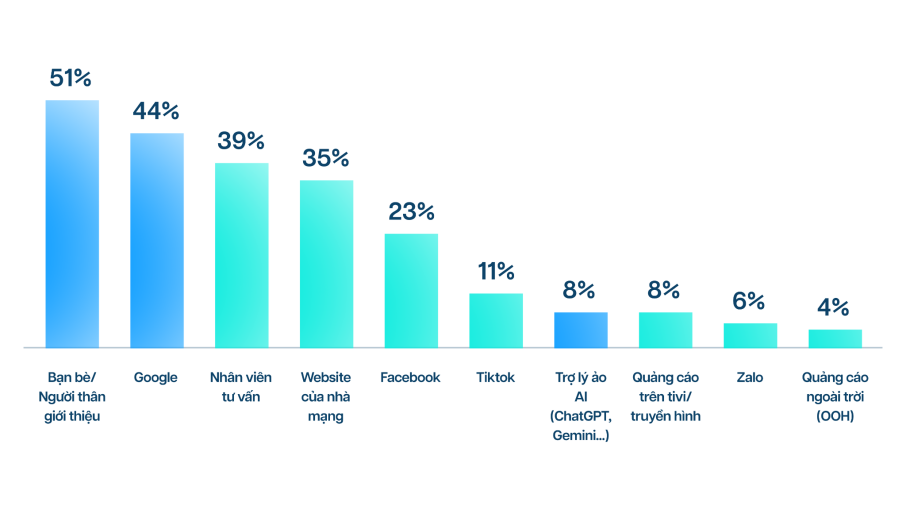 |
8% of users choose AI as a tool to decide on an internet provider. *Photo: Q&Me* |
Viet Trung, 32, from Ho Chi Minh City, shared his family's process for selecting an internet provider. Initially, he used AI to find information about various service packages. When it came time to decide on an installation, he prioritized asking friends about their experiences, potential issues, advantages, and disadvantages. "For me, online information helps understand, but the experiences of acquaintances truly help make the choice", he said.
This trend is also evident among Gen Z, a generation with high online frequency and significant reliance on the internet for learning, entertainment, and content creation.
Quynh Phuong, 25, from Hanoi, recounted her frustration with choppy internet while streaming movies or attending online meetings, especially in the evenings. These crucial factors are not discoverable through advertisements or AI consultation.
"Before subscribing to wifi, I asked my friends if it was stable during peak hours, if there was lag or disconnections", Quynh Phuong said.
 |
Gen Z has high online frequency and relies heavily on the Internet. *Illustration: Pexels* |
As user behavior shifts to prioritizing real experience, competition among internet providers enters a new phase. Q&Me data indicates that while speed remains a priority (4,1/5 points), other factors like price (3,93), customer care (3,92), and quick installation (3,89) are becoming important variables. This demonstrates that users require not just a fast connection, but a stable and reliable experience throughout their usage.
This trend also reflects changing user expectations for internet services. According to the Vietnam Customer Experience Report 2025, published late last year by a research unit, 60% of users call hotlines or visit transaction counters when encountering issues, rather than interacting via chatbots or automated channels. Concurrently, the Q&Me survey reveals that users increasingly expect quick responses to network problems, particularly for urgent technical support. They seek a resolution time of approximately one hour.
An FPT representative stated that in the AI era, technology shortens information gaps, but user trust is built on real-world experience. Therefore, to remain competitive, the company invests in infrastructure and speed, while ensuring stability and consistency throughout the customer journey.
"Our goal is for every real experience to become a reliable recommendation", the representative said.
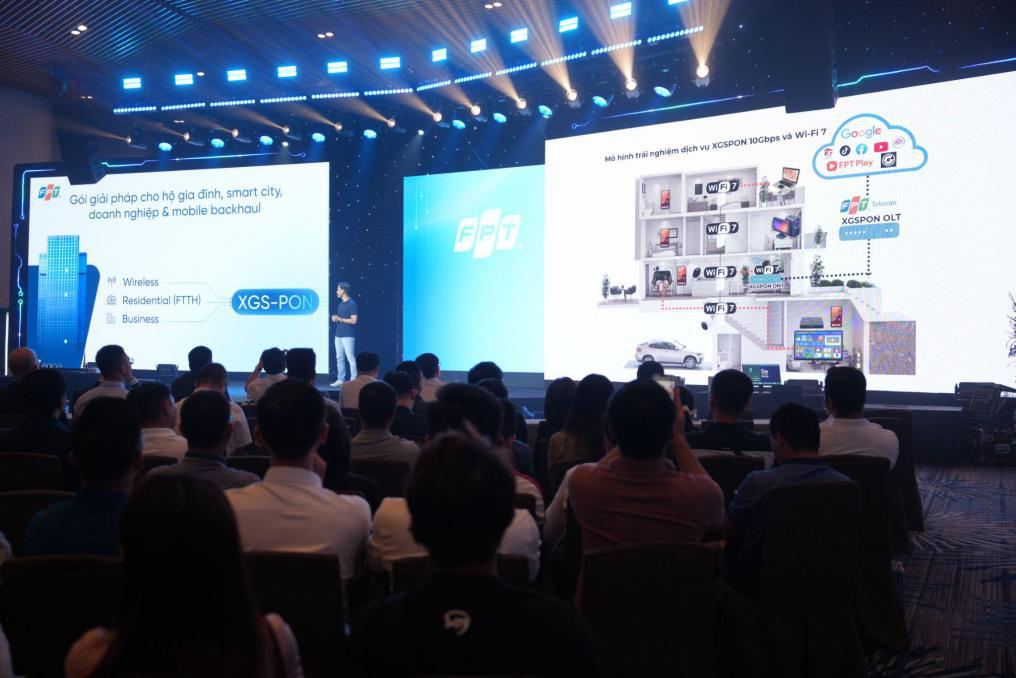 |
FPT continuously invests in infrastructure and upgrades services to serve customers. *Photo: FPT* |
In addition to infrastructure upgrades, FPT offers diverse service packages tailored to actual usage needs. They also frequently provide promotions and bandwidth upgrades for new or existing customers. Leveraging core technology, the company continues to invest in connection quality, especially for high-bandwidth packages of 1 Gbps or more, to ensure a seamless experience even with multiple devices or high-intensity usage demands.
Alongside internet services, the company is expanding its digital home ecosystem with solutions such as Internet-TV combos that integrate content across multiple devices, and surveillance camera installation services for security and remote management needs.
(Source: FPT)