With 94.6% of delegates in favor, the National Assembly approved amendments and additions to three laws: the State Bank of Vietnam Law, the Anti-Money Laundering Law, and the Law on Credit Institutions. The amended law takes effect on 1/12.
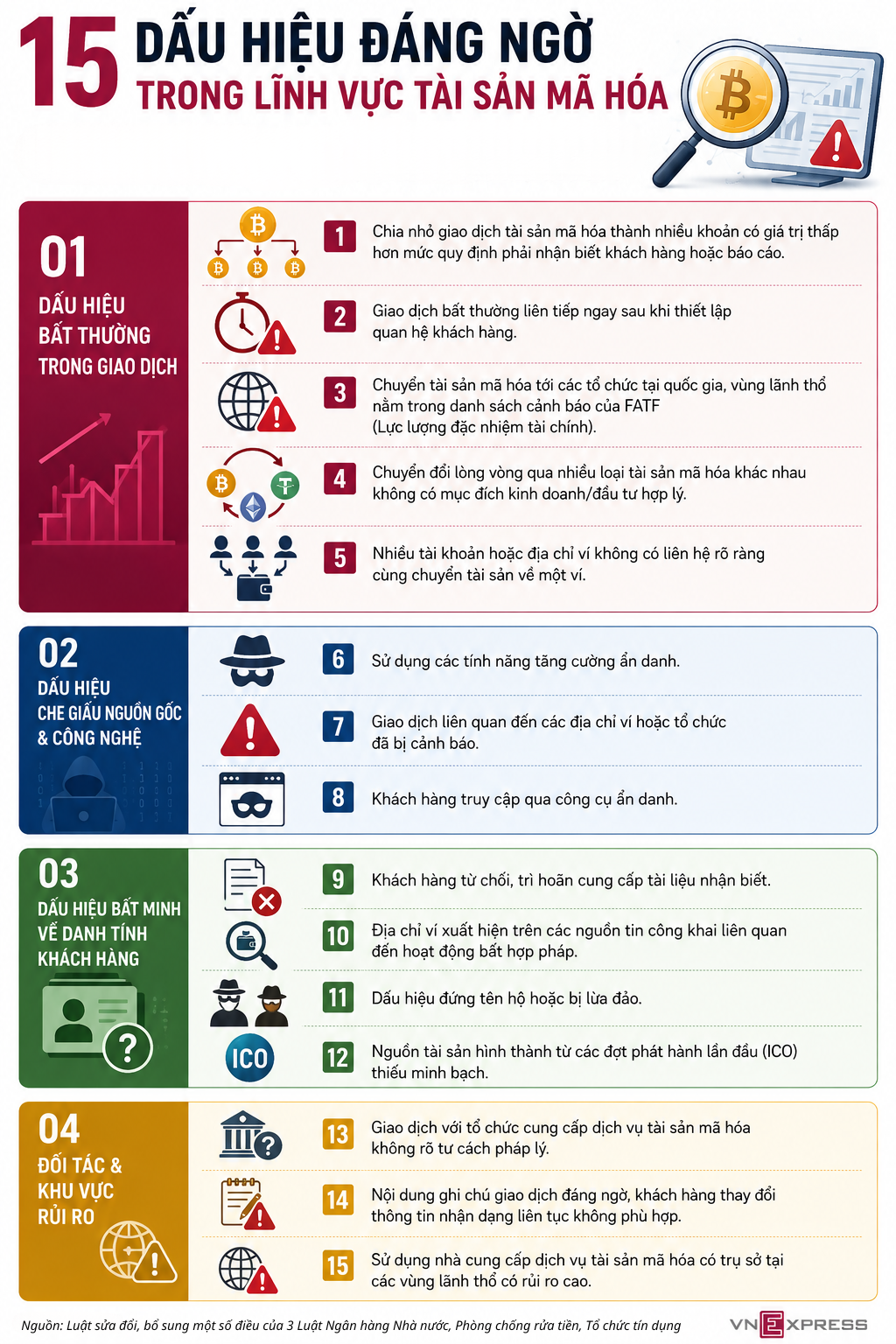
Under this law, crypto asset services are now subject to anti-money laundering regulations, with 15 suspicious signs requiring monitoring. This measure addresses international anti-money laundering requirements as Vietnam pilots a crypto asset market.
Specifically, the 15 signs are categorized into four groups: unusual transactions; concealment of origin or technology; unclear customer identity; and high-risk partners or regions within the crypto asset sector.
Regarding unusual transactions, the law identifies splitting crypto asset transactions into many low-value amounts, or large-value transactions with unclear purposes, as suspicious. Continuous deposits, transactions, and withdrawals of crypto assets within a short period are also suspicious signs that require monitoring for anti-money laundering purposes.
For customer identity, one suspicious sign is a customer refusing or delaying to provide documents or information about asset origins, or failing to give a reasonable explanation for transaction purposes.
The amended law also permits commercial banks to act as collateral management agents for corporate bonds. In a report explaining the amendments before the National Assembly's vote, Governor of the State Bank of Vietnam Pham Duc An stated that regulations on securities and enterprises will be updated to reflect the rights and responsibilities of collateral management agents.
This measure aims to prevent customer confusion, conflicts of interest, and control risks when banks serve as collateral management agents for corporate bonds.
 |
Governor of the State Bank of Vietnam Pham Duc An speaking at the afternoon session on 24/8. *Photo: National Assembly E-portal* |
Additionally, An mentioned that the Government has incorporated the National Assembly's feedback to separate the regulation on "applying other safety assurance ratios" into a distinct provision within the law. Specifically, the Government added a rule allowing the State Bank of Vietnam to consider and decide on applying one or more safety assurance ratios different from the prescribed levels to meet socioeconomic development requirements.
 |
Anh Tu