A closure of the Strait of Hormuz would pose difficulties for many nations. However, China, the world's largest oil importer through this strait—equaling the combined imports of India, Japan, and South Korea—would remain minimally affected. This robust position closely aligns with what Chinese planners have envisioned for decades, according to Lauri Myllyvirta, co-founder of the Centre for Research on Energy and Clean Air (CREA) in Finland.
The rapid adoption of electric vehicles (EVs) is a key factor in China's energy resilience. Beijing set a target in late 2020 for EVs to account for 20% of new car sales by 2025. Last year, their EV penetration reached approximately 50%. According to market research firm Benchmark Mineral Intelligence (BMI), China's electric vehicle sales in 2025 totaled 12,9 million units, representing 62% of the global fleet. Specifically for passenger vehicles, over half of new sales were new energy vehicles (NEVs), indicating a growing reliance on batteries over gasoline for transportation.
This unexpected surge in EV adoption is gradually reducing China's fuel consumption after decades of rapid growth. CREA estimates that these electric vehicles have helped cut gasoline and diesel consumption by an amount equivalent to imports from Saudi Arabia.
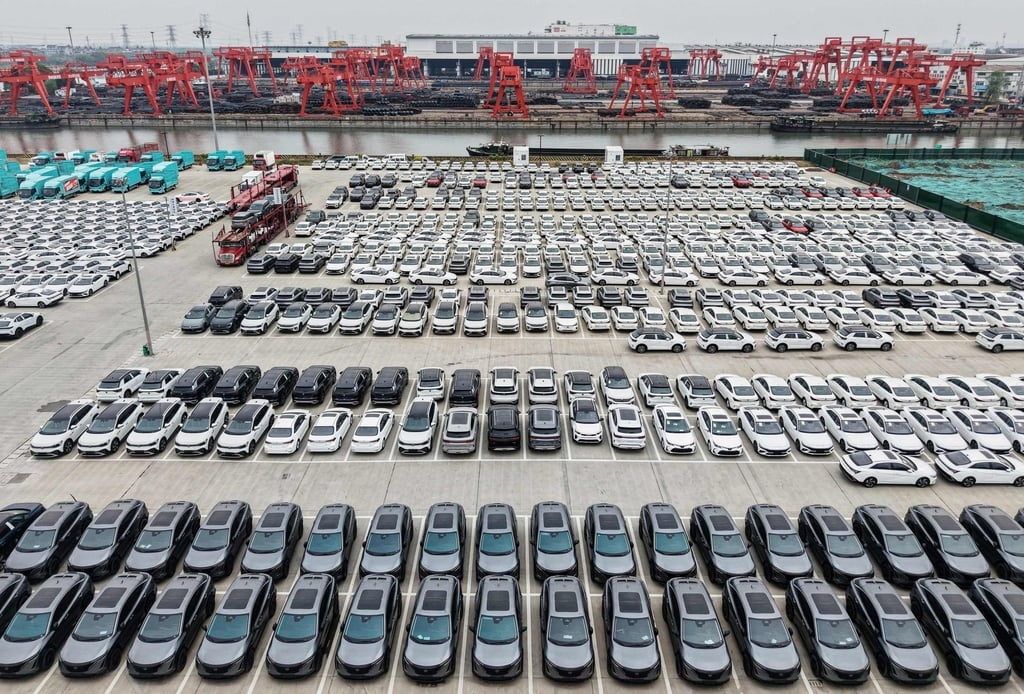 |
Electric vehicles for export at a port in Hangzhou, Zhejiang province, eastern China, 4/2025. Photo: AFP |
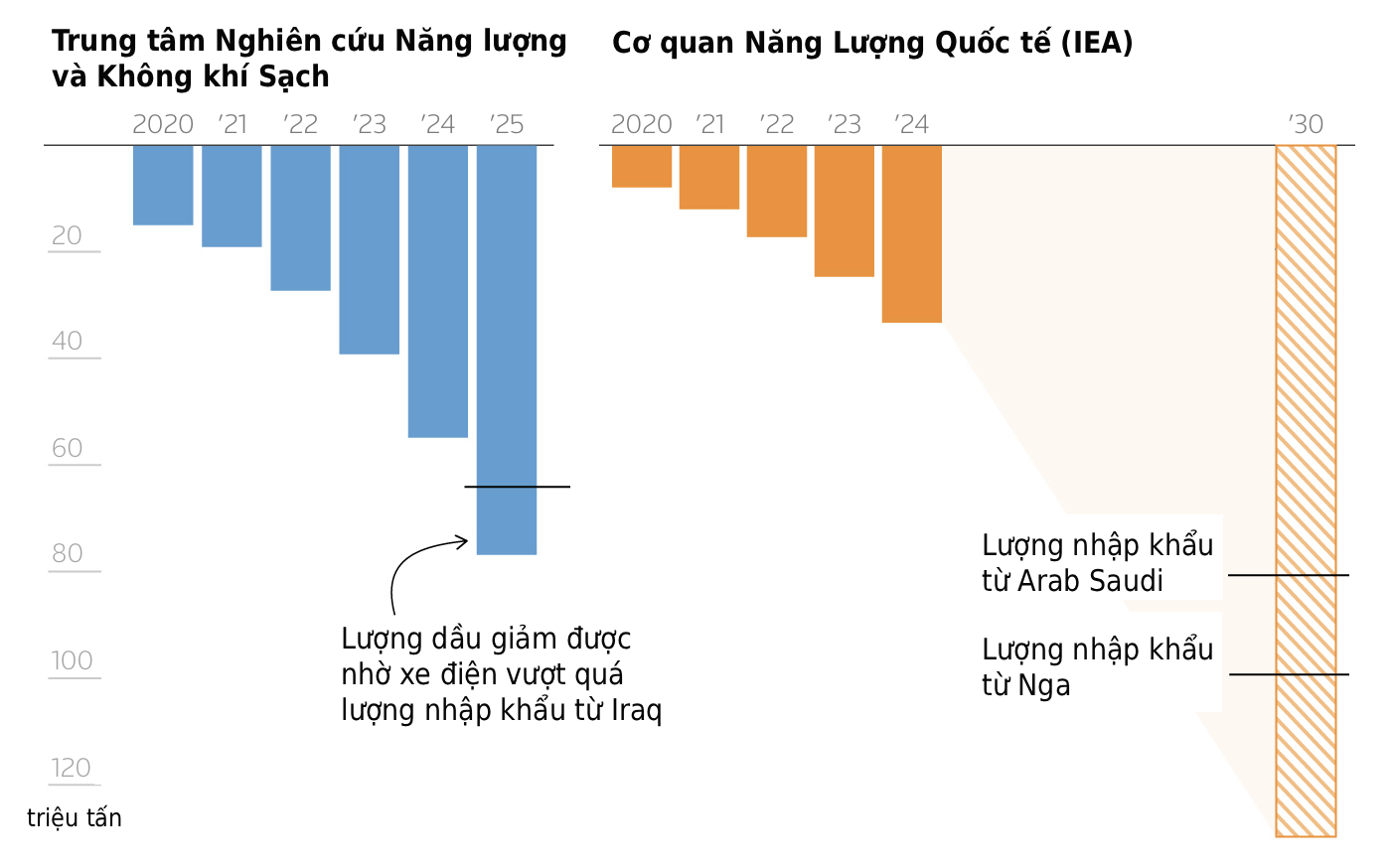 |
China's reduced gasoline and diesel consumption due to EV transition, according to estimates. Source: CREA, IEA |
A growing number of Chinese electric vehicle manufacturers are reporting profits, a contrast to competitors who have "burned cash" and delayed EV strategies. By the end of March, Leapmotor, Nio, and Xpeng announced profitability after multiple quarters of losses. Leapmotor, backed by Stellantis, achieved a profit of 78 million USD in 2025, compared to a 410 million USD loss last year. Nio reported an adjusted net profit of 104 million USD in Q4. In the same quarter, Xpeng also posted a net profit of approximately 55 million USD, compared to a 190 million USD loss in the year-ago period. They join established names like BYD, Xiaomi, and Li Auto in the growing list of profitable EV companies.
Furthermore, the supply of clean electricity for the economy is rapidly expanding, exceeding Beijing's targets. China's electricity generation primarily relies on coal and renewable energy, with the share of coal power decreasing significantly. Most of the annual electricity demand for economic growth can be met by new wind or solar capacity, reducing imports of coal and liquefied natural gas (LNG). According to energy research organization Ember, in 2024 alone, renewable energy supplied approximately 80% of the economy's increased electricity demand.
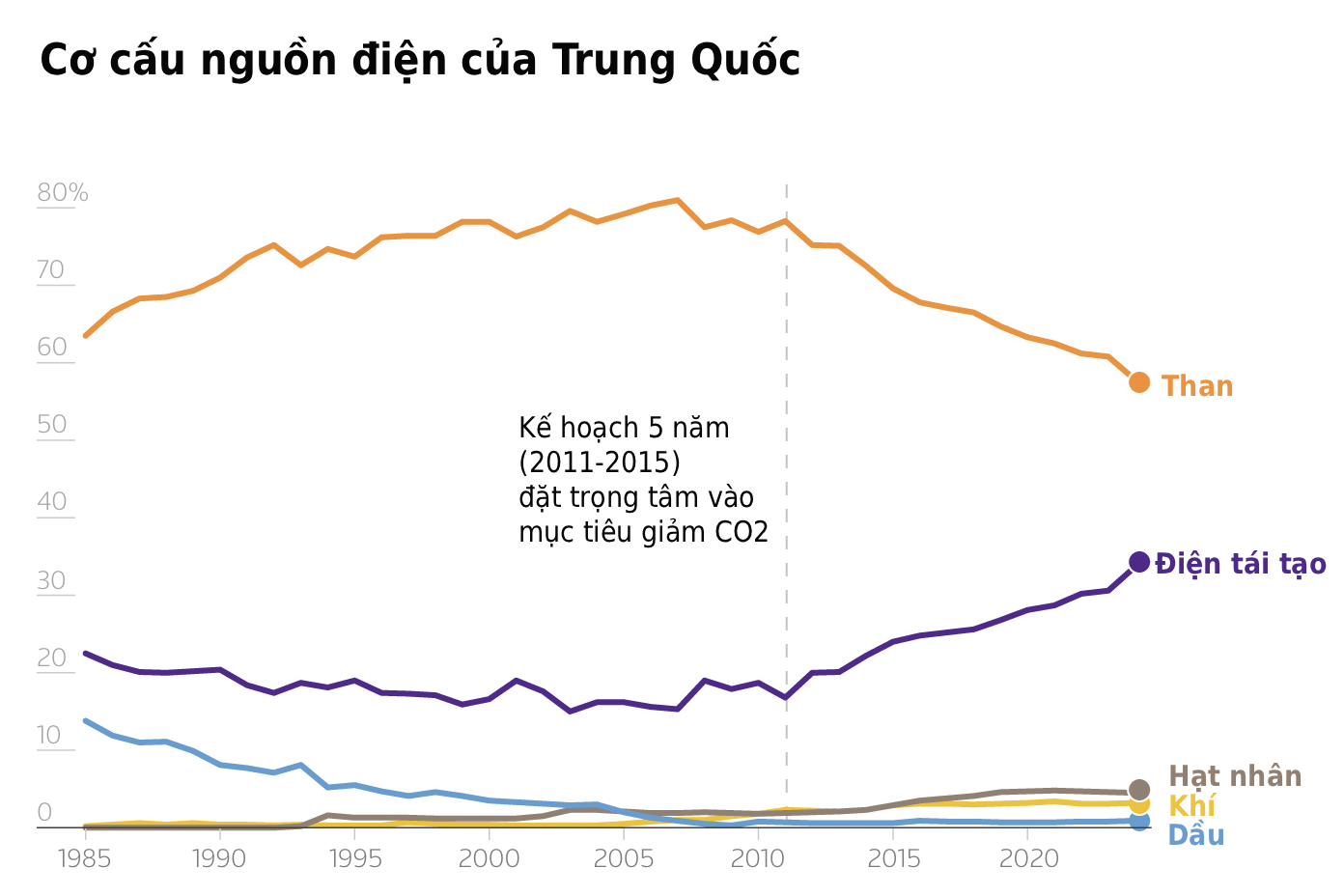 |
China's electricity source structure over the years. Source: Our World in Data, Energy Institute (UK), 2025 |
Muyi Yang, Ember's senior Asia energy analyst, noted that an energy shock from the Iran conflict could further reinforce China's current trajectory. "This situation exposes the risks of over-reliance on imported oil and gas. That is why the energy transition involves not only building more wind and solar power plants but also decarbonizing the entire economy," she stated. Analysts from OCBC Bank believe that in the long term, the electrification of transport and an increased share of renewable energy will continue to make the economy less susceptible to oil price shocks.
In fact, all three of China's largest oil and gas companies saw reduced profits in 2025 due to the energy transition. Sinopec, the world's largest refining company by capacity, reported a 36,8% decrease in profit compared to 2024. Last year, their gasoline and diesel output fell by 2,4% and 9,1% respectively, to 62,6 million tons and 52,6 million tons.
China's energy risks are also mitigated by its diversified supply strategy. It procures oil from numerous suppliers, ensuring no more than 20% of its imports come from a single country, unlike many other Asian nations. For example, Japan sources nearly 80% of its oil from Saudi Arabia and the UAE. With a comparable proportion, China imports from 8 countries, including significant volumes from Russia, Venezuela, and Iran—nations under US sanctions.
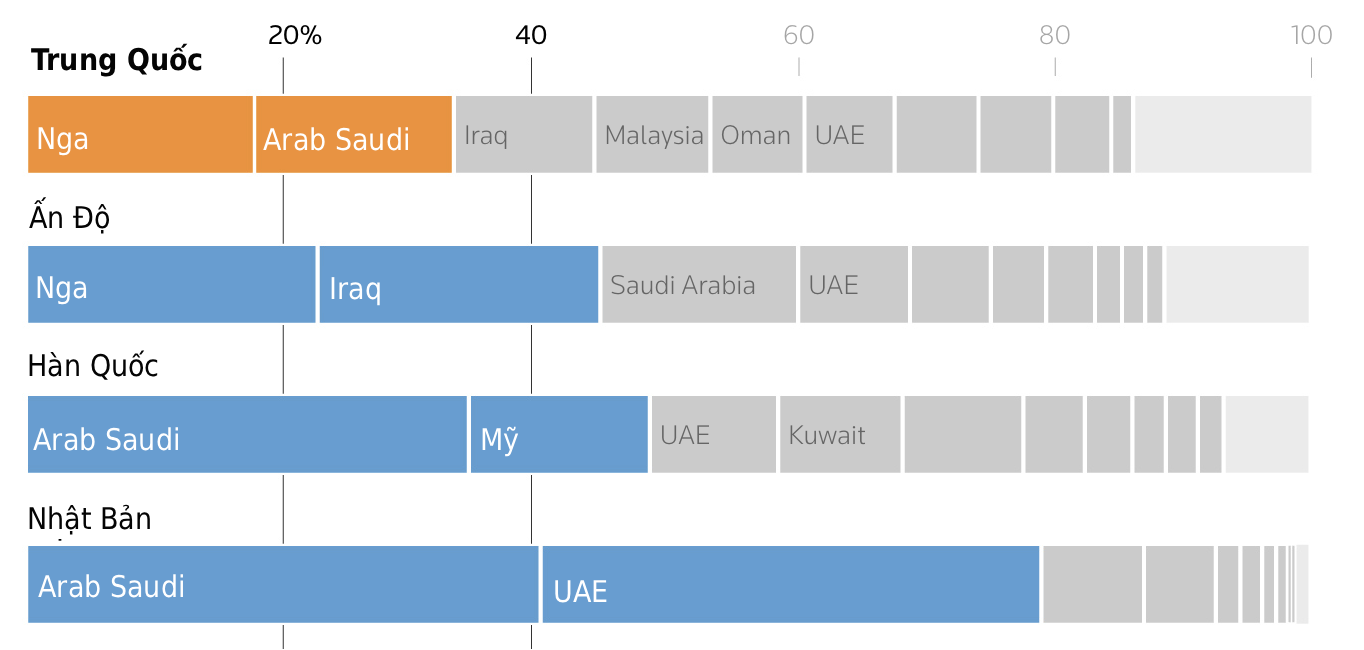 |
Crude oil import market structure of various countries. Source: International Trade Centre |
Additionally, China holds oil reserves totaling 1,4 billion barrels, exceeding the US Strategic Petroleum Reserve's 414 million barrels, according to global trade intelligence firm Kpler. Analysts estimate China could sustain itself for seven months if the Strait of Hormuz were to remain closed. In comparison, South Korea, which relies on the strait for 70% of its oil, has reserves insufficient for two months.
China has also intensified the construction of natural gas pipelines, reducing seaborne imports. Its geographical position allows for easier liquefied natural gas (LNG) imports via pipelines from Russia, Myanmar, and Central Asia—an advantage not readily available to Japan or South Korea.
Through decades of policy planning and the boom in electric vehicles and renewable energy, China is gradually decoupling its growth drivers from foreign fossil fuel supplies. Chen Lin, Vice President at energy market research firm Rystad Energy, forecasts that China's oil demand is likely to peak this year, then decline. "The country's situation is unlikely to worsen, despite its continued high crude oil import ratio," Chen stated.
Bao Bao (according to Reuters, CarbonBrief, CNBC)