


Petrolimex's net revenue reached nearly 98,700 billion dong in the first quarter, a 1.5-fold increase year-on-year and its highest quarterly figure in 13 years. Despite this revenue surge, the company posted a consolidated loss of 662 billion dong after accounting for all expenses. This marks Petrolimex's most significant loss since Q1 2020, when it reported over 1,800 billion dong in losses.
The substantial loss stems primarily from the fuel business, which incurred a 930 billion dong deficit in the first three months. Pham Van Quang, Petrolimex's Chief Accountant, explained this in a document submitted to the Ho Chi Minh City Stock Exchange (HoSE). Other business segments, in contrast, remained stable and saw a 15% increase compared to the previous year. This performance aligns with General Director Luu Van Tuyen's forecast at the annual meeting in late April, where he anticipated a potential 1,000 billion dong loss from fuel products due to unusual global market fluctuations following the Middle East conflict escalation in late February.
Petrolimex leadership highlighted that the global energy market experienced "exceptionally abnormal and unprecedented" volatility since the conflict began. In March, the average price of RON 95 finished gasoline reached 137 USD per barrel, 170% higher than the same period's average and 178% more than the previous month. At its peak, RON 95 surged to 170 USD per barrel, double the previous month's price. Similarly, finished oil averaged 192 USD per barrel and occasionally hit 292 USD, doubling the previous year's figure and tripling the prior month's price, respectively.
The dramatic price increases created significant challenges for smaller wholesale traders, who struggled with scarce supply and escalating costs, including high surcharges. This situation forced demand towards larger wholesalers like Petrolimex, leading to a 20% year-on-year increase in Petrolimex's total sales volume in March and a 13% rise from the previous month. To meet this heightened demand and compensate for reduced supply from other traders, Petrolimex had to adjust its import plans. The company sought immediate supply in late March from suppliers at high spot prices and exceptionally high surcharges. Diesel surcharges, for instance, soared to 35-40 USD per barrel, while gasoline surcharges reached 12-15 USD, many times higher than the usual 2.5-3 USD.
In addition to procurement challenges, Petrolimex maintained an inventory of nearly 1 million cubic meters-tons, 1.3 times the regulated level, to ensure a stable domestic fuel supply. However, the market trend sharply reversed by early April, with prices plummeting. RON 95 prices on 21/4 dropped by 46 USD from their peak a month earlier, and finished diesel oil (DO) decreased by up to 140 USD per barrel.
"When fuel prices continuously decreased significantly in April, the risk from the decline in value of imported goods was a key factor impacting business performance," Pham Van Quang stated in the document to HoSE. By the end of Q1, Petrolimex's inventory stood at over 36,266 billion dong, a substantial increase from 14,000 billion dong at the beginning of the year. The company consequently provisioned over 6,500 billion dong for inventory value decline.
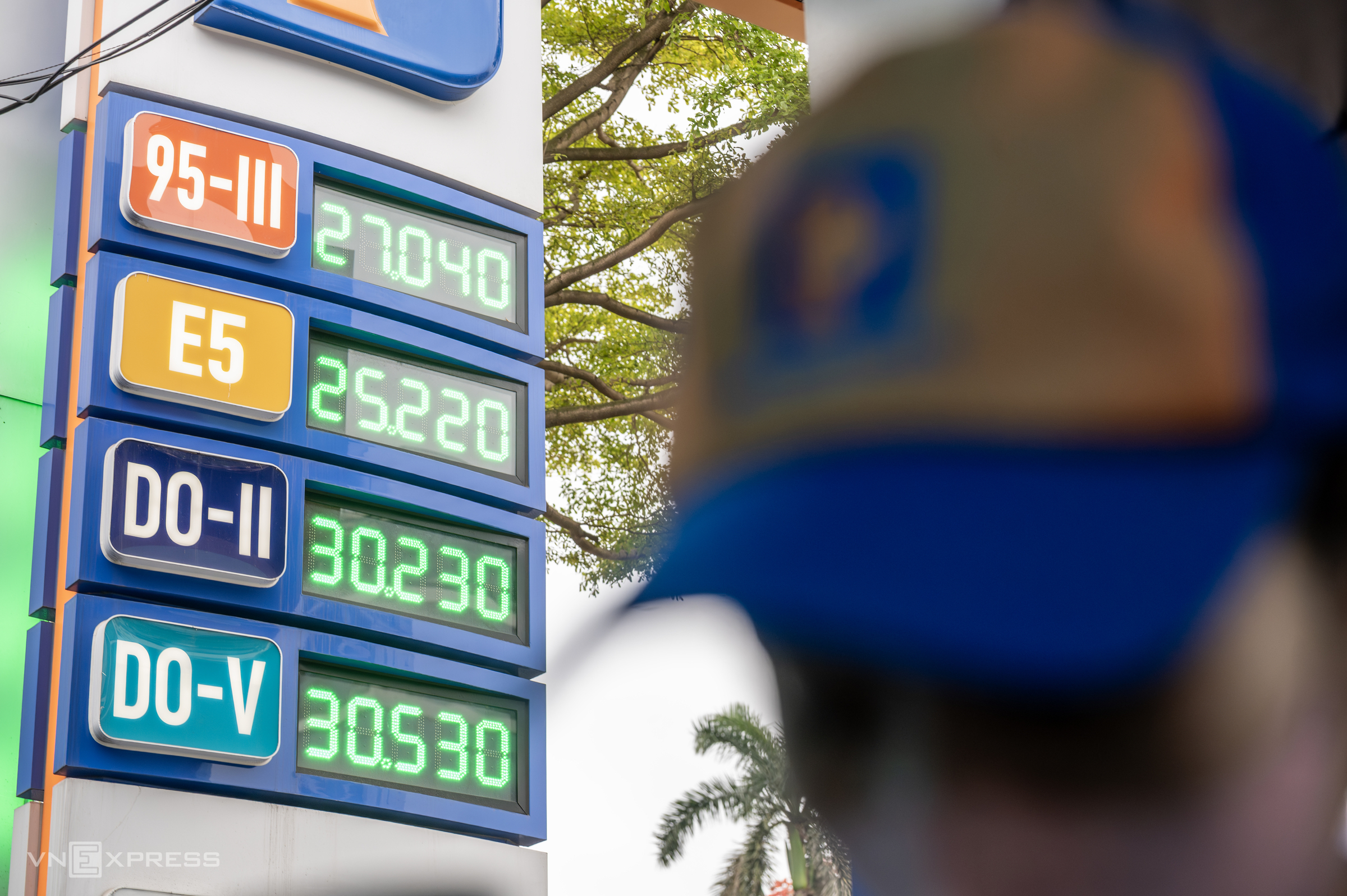 |
Fuel prices at Petrolimex in late March 2026. Photo: Giang Huy |
Analysts from Vietcap Securities Company noted that this provisioning figure is about 4 times higher than that in Q1 2020 and 5.7 times higher than Q2 2022. Historically, such provisions correlate with expectations of falling oil prices, as observed during the Covid-19 pandemic or at the peak of the Russia-Ukraine conflict. The Vietcap report elaborated: "Platts Singapore diesel prices, a reference index for input costs, have fallen by about 40% since late March, reaching approximately 150 USD per barrel on 23/4, leading to significant inventory losses. Furthermore, Petrolimex has become more sensitive to oil price fluctuations due to its role in ensuring national fuel supply stability."
Vietcap's analysis suggests that Petrolimex's cautious provisioning approach is reasonable in the current market. Without these provisions, the after-tax profit for minority shareholders could have reached approximately 4,300 billion dong. Petrolimex currently commands about 50% of the domestic fuel retail market. For this year, the company targets a total consolidated revenue of 330,300 billion dong, a 7% increase year-on-year. Consolidated pre-tax profit is projected to decrease slightly to 3,370 billion dong. General Director Luu Van Tuyen affirmed at the late April annual meeting that management would prioritize shareholder interests, even if the 2026 profit plan does not match 2025's performance.
Phuong Dong


