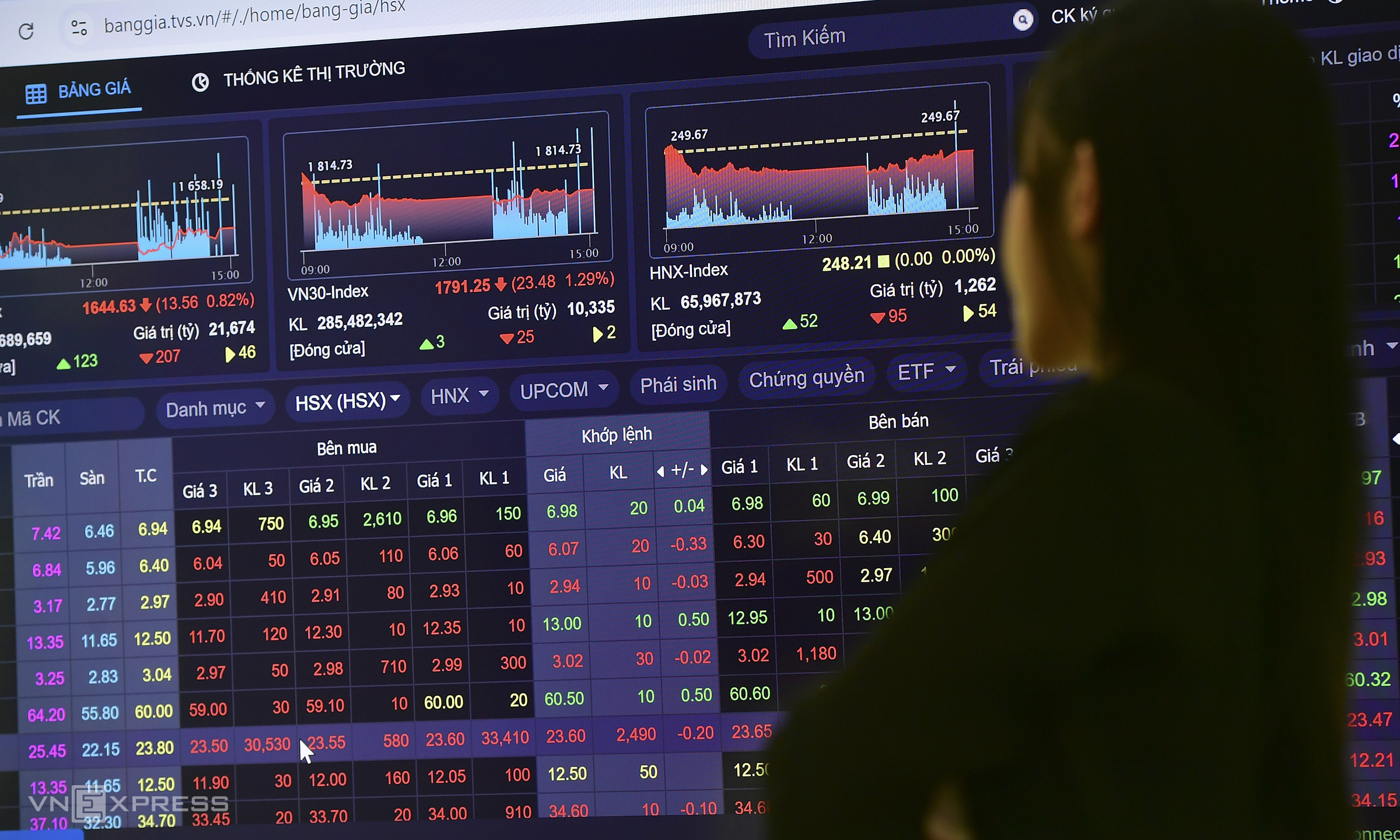
In early June, the average transaction value across all ba stock exchanges was around 20 trillion VND, a notable decrease from 35 trillion VND in the first quarter. On 5/6, liquidity dropped to just over 14.5 trillion VND, its lowest point in mot year.
This downturn in liquidity is not a recent phenomenon; it began in April. According to SHS Securities data, hai months prior, the average daily transaction value across all ba exchanges was around 26-27 trillion VND, also a reduction of approximately 25% compared to the first quarter.
Furthermore, these figures for April and May were lower than the 29.5 trillion VND average recorded in 2025, a period when the VN-Index typically traded below the 1,700-point mark. This trend contradicts the expectations of many experts who had anticipated a more vibrant market, with billions of USD in foreign capital expected to "pour in" once the market was officially upgraded by FTSE Russell.
Regarding the reasons for the decline in stock market liquidity compared to the first quarter, Nguyen The Minh, Director of Investment Banking at An Binh Securities (ABS), attributed it to investor sentiment affected by geopolitical conflict between the US and Iran. This event caused sharp fluctuations in global oil prices and domestic gasoline prices within a short period, leading traders to worry about rising inflation.
Additionally, the expert from ABS noted that high domestic interest rates also played a role. VnExpress reported that in early June, most banks offered popular interest rates of 6.5% or more for 12-month terms, an increase of about 1-2% from late last year. Customers depositing several hundred million VND could negotiate rates of 8-8.5% at some smaller banks.
"When interest rates increase, investors are less likely to disburse funds into high-risk assets like stocks, as their margin loan interest will increase, or they choose to deposit savings to optimize returns," Minh stated. Data from the State Bank of Vietnam also shows that residential deposits at credit institutions reached over 10.38 quadrillion VND by the end of January, a 0.45% increase from the end of 2025, marking an all-time high.
Nguyen Trong Dinh Tam, Director of Retail Investment Advisory at Thien Viet Securities (TVS), identified the market's indecisive state as the reason for reduced liquidity during this period. The VN-Index attempted to surpass 1,900 points ba times in the early months of the year but quickly retreated after reaching this milestone.
After a series of continuous fluctuations, the VN-Index returned to its early-year level following the trading session on 8/6. During the same period, according to Vietcap Securities data, companies within the Vingroup ecosystem contributed over 70 points to the market, with the "oil and gas group" adding over 20 points. Tam suggested that capital flow in the early part of the year was concentrated in a few sectors, narrowing profit opportunities for investors and leading to a general decline in liquidity.
Furthermore, the ABS expert pointed out that the market lacks strong information to create growth momentum. While many companies outlined ambitious business plans during the second quarter general shareholders' meetings, these details have not generated enough impact to attract new capital. Instead, investors remain focused on macroeconomic factors such as Middle East tensions, inflation, and interest rates.
Nguyen The Minh viewed the "loss of momentum" in liquidity during this period as an indicator of investor caution. Meanwhile, declining liquidity might deter new traders from disbursing funds.
MB Securities, however, suggested that a rapid drop in liquidity could cause the market to trend downward in search of buying demand. Strong fluctuations and indecisive movements are anticipated more frequently before the market establishes a clear trend.
Conversely, Nguyen Trong Dinh Tam asserted that high or low liquidity is not the cause of market increases or decreases. "This indicator is almost purely statistical, or valuable only for technical analysis," the TVS expert affirmed.
 |
Stock trading at Kafi exchange, 4/2026. Photo: Quynh Tran |
The An Binh Securities expert predicted that the current situation is poised for improvement, with the market likely to become active again from the second half of July. The primary reason is investor expectations that interest rates may cool down in the second half of 2026, following directives from regulatory bodies.
Additionally, according to Nguyen The Minh, the market's official upgrade in September could also help improve liquidity. "New capital flows might gradually begin to disburse from July-August, making the stock market more vibrant," Minh said.
This expert added that upcoming initial public offerings (IPOs) and divestments by State-owned enterprises could also act as catalysts to attract investors. Notable upcoming deals such as Dien May Xanh, LPBS, and DatVietVAC could attract capital, according to Minh.
Trong Hieu