Vietnam's government plans to award scholarships to 30,000-32,000 new STEM students this year, as part of a strategic initiative to cultivate a high-tech workforce. Professor Doctor Nguyen Tien Thao, Director of the Higher Education Department under the Ministry of Education and Training, announced this information at a conference on 27/6, detailing the implementation of STEM human resource training programs and policies.
The Ministry recently approved a list of 109 training majors, encompassing 15 groups of basic science, key engineering, and strategic technology fields. These fields are expected to enroll approximately 166,000 students across undergraduate, master's, and doctoral programs this year. Of these, 30,000-32,000 individuals will receive government scholarships.
For undergraduate programs, the monthly scholarship ranges from 3.7 to 5.5 million VND. Eligibility is open to two groups of students: those who achieved first, second, or third prizes at national or international competitions; and candidates who scored 22,5 points on their graduation exam, including mathematics and two of four subjects (physics, chemistry, biology, English), not counting priority or bonus points, and ranked within the top 30% of highest scores in their specific major group nationwide.
Meanwhile, master's and doctoral students will receive approximately 8.4 million VND per month. Additionally, about 22,000 undergraduate students admitted last year are eligible for scholarships, with selection based on their academic and research performance.
Currently, Vietnam has over 770,000 students enrolled in STEM fields, representing 29% of the total student population. Professor Thao observed that there remains significant potential for further growth in STEM enrollment. He believes this scholarship policy will motivate high school students, regardless of their economic background, to pursue STEM fields. Consequently, within the next 3-5 years, the national workforce in these sectors will become more abundant, aiming to reach 35% of all students by 2030.
Minister of Education and Training Hoang Minh Son emphasized that training human resources in STEM fields is an effective approach for rapid adaptation, mastery, and development of high and strategic technologies. He stressed the importance of communicating these programs and support policies for talented students to those preparing to register for university.
However, experts note that investment in STEM education must extend beyond scholarships. Associate Professor Doctor Tran Manh Cuong, Vice Rector of the University of Natural Sciences, Vietnam National University, Hanoi, highlighted the need for investment in faculty, facilities, equipment, and laboratories. He specifically pointed out current limitations in funding for repairing damaged equipment at the university.
Professor Doctor Mai Thanh Phong, Rector of the University of Technology, Vietnam National University, TP HCM, noted the importance of developing non-specialized skills in STEM workforce training. Responding to business feedback regarding students' weak soft skills, the university has collaborated with experts to develop programs focusing on communication, self-management, and leadership thinking. The university has also implemented several initiatives to train STEM talents, including offering international-standard training programs (on-site internationalization), requiring 100% participation in research activities for students in talent programs, and establishing a fund to support tuition loan interest from businesses.
 |
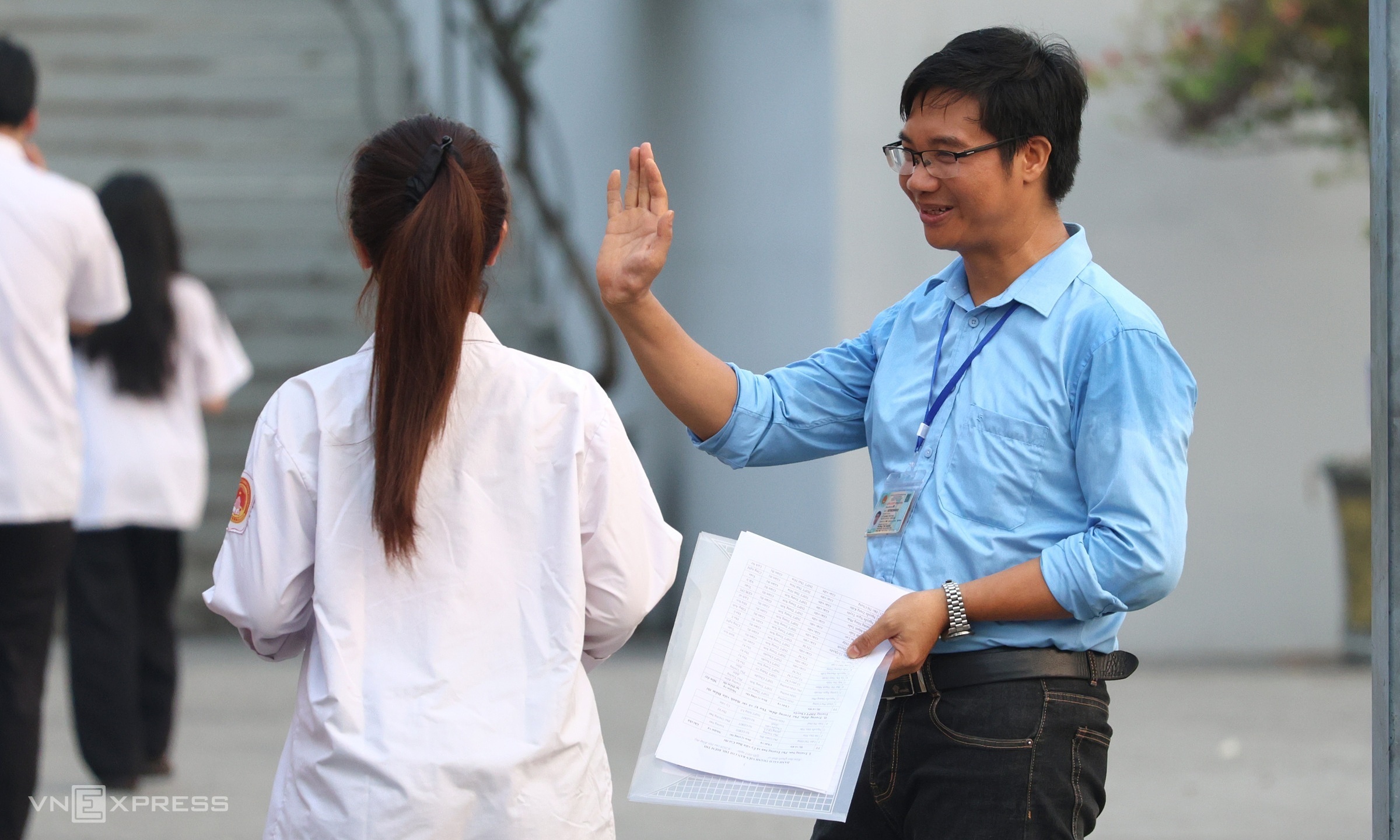
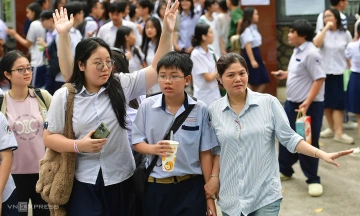
Students taking graduation exams in TP HCM, 6/2026. Photo: Quynh Tran |
Khanh Linh