The Breakthrough Prize Foundation, often called the "Oscars of science", announced the news on 19/4.
"I was very surprised. It took me a while to calm down. This is a great honor", the 64-year-old mathematician shared with Scientific American upon receiving the news.
According to the organizers, Frank Merle received the award for his significant contributions to humanity's understanding of nonlinear evolution equations. These mathematical tools describe how waves, fluids (such as water and air), and other dynamic systems change over time.
His research primarily focuses on singularities, which are moments or locations where the solution to an equation suddenly increases to infinity. He has solved many fundamental problems, including proving that some equations previously thought to be "stable" can actually "explode" (become infinite) within a finite period.
Despite receiving a substantial cash prize, Merle's greatest excitement came from finding new approaches to these problems, especially when most people doubted he could achieve anything significant.
"Then, one problem after another was solved. And now those efforts have received widespread recognition", Merle stated.
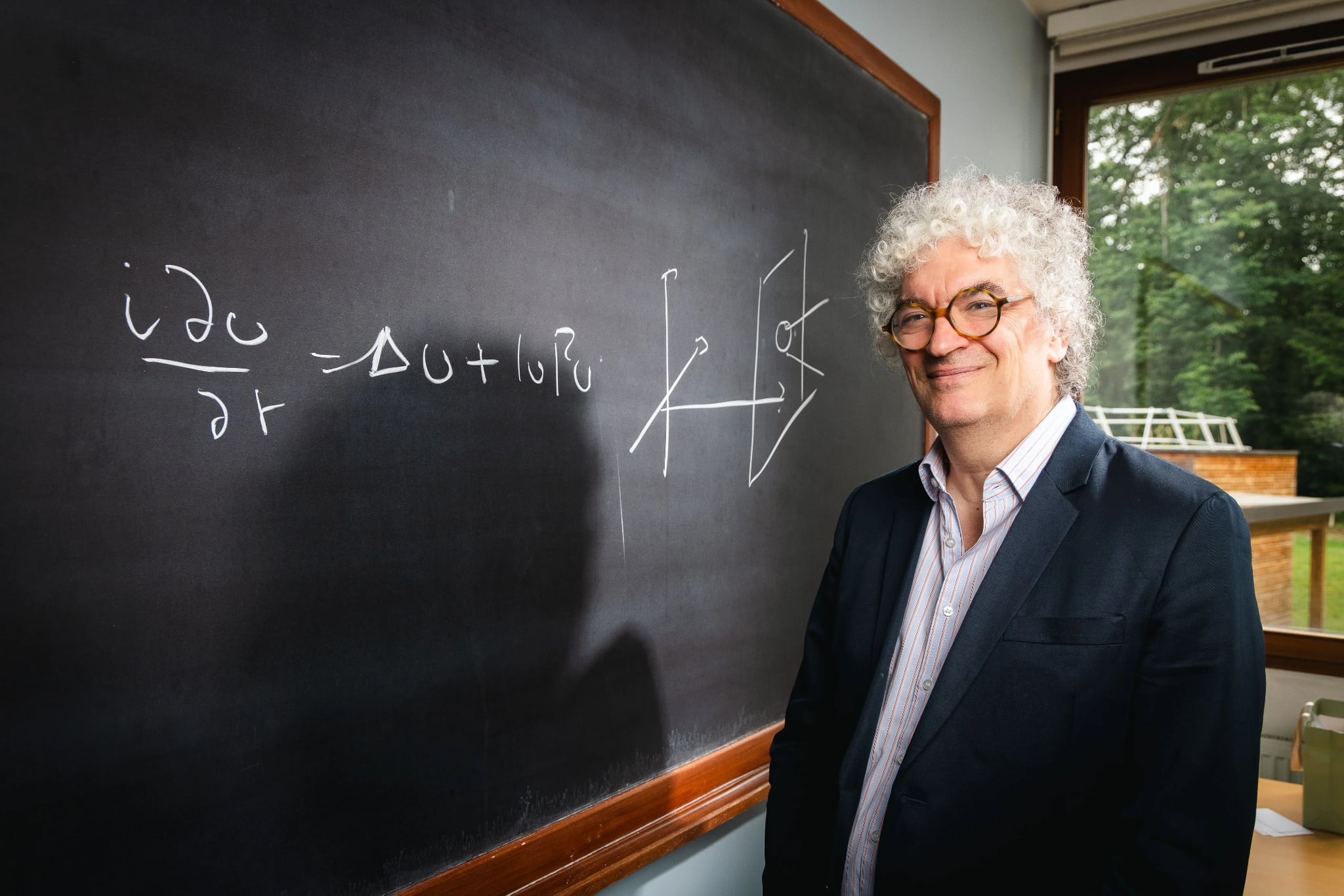 |
Mathematician Frank Merle. Photo: Scientific American |
According to Breakthrough, Merle's career contributions have reshaped many fundamental assumptions in the field, forged deep connections between mathematics and physics, and opened new avenues for notoriously difficult unsolved problems.
His most notable research includes work on the nonlinear Schrödinger equation in quantum physics. Initially, he classified all the ways this equation could "explode". Later, he and his collaborators demonstrated that even the "defocusing" version of this equation, long believed to be extremely stable, could actually break down and become infinite.
Furthermore, while studying the soliton decay conjecture (which predicts that all wave disturbances will eventually dissipate into stable, shape-preserving wave packets), Merle and his colleagues developed powerful mathematical techniques to analyze how energy moves and concentrates within these systems.
He also collaborated with mathematicians Yvan Martel and Pierre Raphael to clarify how singularities form in KdV-type equations – equations that describe phenomena ranging from shallow water waves to dangerous rogue waves in the ocean.
Currently, in addition to his work at CY Cergy Paris University, Merle holds a Professorship in Analysis at the French Institute of Advanced Scientific Studies (IHES). Earlier in his career, he earned his doctoral degree from Pierre and Marie Curie University - Paris VI and previously taught at the Courant Institute of New York University (US) before returning to France.
The Breakthrough Prize was established in 2012 to honor scientists, inspire young scientists, and promote science for global benefit. The prize was initiated by scientists and entrepreneurs, including physicist Yuri Milner and Meta CEO Mark Zuckerberg.
Awards are given in three fields: Mathematics, Fundamental Physics, and Life Sciences. Each prize is valued at 3 million USD. Other awards from the foundation, such as New Horizons and Maryam Mirzakhani New Frontiers, are for young scientists and are valued at 50,000-100,000 USD.
To date, Breakthrough is the world's most generously endowed science prize. This year's total prize money amounts to 18,75 million USD.
Khanh Linh